

Weimar and Nazi Germany
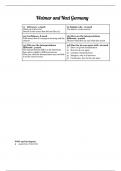
1) Inference- 4 mark 2) Explain why- 12 mark
What can I infer (x2) Use factors, events and etc
Details in the source that tell me this (x2)
3a) Usefulness- 8 mark 3b) How are the interpretations
Talk about what it’s saying or showing and the different- 4 mark
context Discuss what they say and what they mean
3c) Why are the interpretations 3d) How far do you agree with- 16 mark
different- 4 mark 1) Intro: on given interpretation
The interpretations differ as the historians 2) How far do you agree
have given weight to different sources 3) Compare interpretations
Then say what the interpretation says and link
4) Disagree, why is it incorrect
it to the correct source
5) Conclusion- how far do you agree
WWI and its impact:
● Lasted from 1914-1918
, ● 16 million people died
● Women filled men’s jobs
● Treaty of Versailles blamed Germany, signed on 11th November
● Severe economic problem
● Kaiser abdicated on 9th November so the Weimar Republic was set up
● Allies and other countries, Britain, France, the USA were against Germany
● Germany’s government were debted from 50 billion to 150 billion
● British Navy blocked German ports preventing food from being brought in
● Soldiers refused to control people rioting on the streets
Good things about the Weimar constitution Bad things about the Weimar constitution
● Men and women over the age of 20 could vote ● Everyone had freedom of speech
● Everyone had freedom of speech ● President was elected every 7 years
● Weimar republic was a democracy- people voted ● Coalition governments forming meant no
for people to represent them in the Reichstag agreements were made
● Voting system was democratic, % of votes is % of ● Voting system meant no one ever got any seats
seats ● President had the power to appoint and dismiss
the Chancellor
Terms of the Treaty of Versailles:
● French were allowed to work in Saar (Germany’s industrial area)
● Germany loses all overseas colonies
● Give up land and rights
● France takes Alsace- Lorraine back
● Weren’t allowed to have army troops- army was reduced to 100 men
● No tanks
● Rhineland became a demilitarised zone
● Germany had to pay reparations
● Germany had to pay 6.6 billion euros
● Blamed Germany
● Germany was banned to unite with Austria- Hungary
Why was there opposition to the Treaty:
● Unfair to Germany- they didn’t get a say in it
● Germans believed they could have won the war
● Germans were humiliated
● Austria wasn’t blamed for anything
● Were left in debt with no help- restrictions and no facilities
● Allies left them
Threats to the Weimar:
● Spartacist Revolt- communist group who emerged from the German social democratic party. Tried
overthrowing the Weimar government to create a communist state. Captured and killed by the army. Inspired
uprisings.
● Kapp Putsch- came from the announcement of reducing the army in 1920. Plan was to seize Berlin and form
their own right wing party. Successfully seized Berlin and forced Weimar to flee.
Causes of hyperinflation:
● Second year of paying reparations (1922) Germany failed to pay, French and Belgian troops invaded the Ruhr
to take the money themselves
● Germans went on strike- Weimar supported this and printed lots of money to pay making it lose it’s worth
Effects and impact of hyperinflation:
1) Inference- 4 mark 2) Explain why- 12 mark
What can I infer (x2) Use factors, events and etc
Details in the source that tell me this (x2)
3a) Usefulness- 8 mark 3b) How are the interpretations
Talk about what it’s saying or showing and the different- 4 mark
context Discuss what they say and what they mean
3c) Why are the interpretations 3d) How far do you agree with- 16 mark
different- 4 mark 1) Intro: on given interpretation
The interpretations differ as the historians 2) How far do you agree
have given weight to different sources 3) Compare interpretations
Then say what the interpretation says and link
4) Disagree, why is it incorrect
it to the correct source
5) Conclusion- how far do you agree
WWI and its impact:
● Lasted from 1914-1918
, ● 16 million people died
● Women filled men’s jobs
● Treaty of Versailles blamed Germany, signed on 11th November
● Severe economic problem
● Kaiser abdicated on 9th November so the Weimar Republic was set up
● Allies and other countries, Britain, France, the USA were against Germany
● Germany’s government were debted from 50 billion to 150 billion
● British Navy blocked German ports preventing food from being brought in
● Soldiers refused to control people rioting on the streets
Good things about the Weimar constitution Bad things about the Weimar constitution
● Men and women over the age of 20 could vote ● Everyone had freedom of speech
● Everyone had freedom of speech ● President was elected every 7 years
● Weimar republic was a democracy- people voted ● Coalition governments forming meant no
for people to represent them in the Reichstag agreements were made
● Voting system was democratic, % of votes is % of ● Voting system meant no one ever got any seats
seats ● President had the power to appoint and dismiss
the Chancellor
Terms of the Treaty of Versailles:
● French were allowed to work in Saar (Germany’s industrial area)
● Germany loses all overseas colonies
● Give up land and rights
● France takes Alsace- Lorraine back
● Weren’t allowed to have army troops- army was reduced to 100 men
● No tanks
● Rhineland became a demilitarised zone
● Germany had to pay reparations
● Germany had to pay 6.6 billion euros
● Blamed Germany
● Germany was banned to unite with Austria- Hungary
Why was there opposition to the Treaty:
● Unfair to Germany- they didn’t get a say in it
● Germans believed they could have won the war
● Germans were humiliated
● Austria wasn’t blamed for anything
● Were left in debt with no help- restrictions and no facilities
● Allies left them
Threats to the Weimar:
● Spartacist Revolt- communist group who emerged from the German social democratic party. Tried
overthrowing the Weimar government to create a communist state. Captured and killed by the army. Inspired
uprisings.
● Kapp Putsch- came from the announcement of reducing the army in 1920. Plan was to seize Berlin and form
their own right wing party. Successfully seized Berlin and forced Weimar to flee.
Causes of hyperinflation:
● Second year of paying reparations (1922) Germany failed to pay, French and Belgian troops invaded the Ruhr
to take the money themselves
● Germans went on strike- Weimar supported this and printed lots of money to pay making it lose it’s worth
Effects and impact of hyperinflation:


