Acromegaly
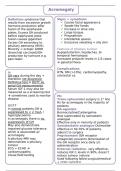
Definition syndrome that Signs + symptoms
results from excessive growth Coarse facial appearance
hormone production after Spade-like hands
fusion of the epiphyseal Increase in shoe size
plates. Excess GH produced Large tongue
before epiphyseal plate Prognathism
fusion causes gigantism Interdental spaces
Excess GH secondary to Excessive sweating + oily skin
pituitary adenoma (95%)
Minority = ectopic GHRH Features of pituitary tumour
(bronchial carcinoid)/GH Hypopituitarism, headaches, bi-
production by tumours e.g. temporal hemianopia
pancreatic Increased prolactin levels in 1/3 cases
galactorrhoea
Complications
Ix HTN, DM (>10%), cardiomyopathy,
GH vary during the day + colorectal ca.
therefore not diagnostic
Definitive test is OGTT w/
serial GH measurements
Serum IGF-1 may also be
measured as a screening test
sometimes used to monitor Mx
disease Trans-sphenoidal surgery is 1st line
Rx for acromegaly in the majority of
OGTT patients
In normal patients GH is DA-agonists
suppressed to < 2 mu/L / Bromocriptine/Carbergoline
hyperglycaemia Now superceded by somastatin
In acromegaly there is no analogue
suppression of GH Effective only in minority of patients
May also demonstrate Somatostatin analogue Octreotide-
impaired glucose tolerance effective in 50-70% of patients,
which is associated w/ adjunct to surgery
acromegaly Pegvisomant (GH receptor
A pituitary MRI may antagonist) prevents dimerisation of
demonstrate a pituitary the GH receptor once daily s/c
tumour administration
ECG + ECHO External radiation- very effective-
cardiomyopathy reduces IGF-1 levels in 90%, doesn’t
Visual field testing reduce tumour volume
Used following failed surgical/medical
+ older patients)
Definition syndrome that Signs + symptoms
results from excessive growth Coarse facial appearance
hormone production after Spade-like hands
fusion of the epiphyseal Increase in shoe size
plates. Excess GH produced Large tongue
before epiphyseal plate Prognathism
fusion causes gigantism Interdental spaces
Excess GH secondary to Excessive sweating + oily skin
pituitary adenoma (95%)
Minority = ectopic GHRH Features of pituitary tumour
(bronchial carcinoid)/GH Hypopituitarism, headaches, bi-
production by tumours e.g. temporal hemianopia
pancreatic Increased prolactin levels in 1/3 cases
galactorrhoea
Complications
Ix HTN, DM (>10%), cardiomyopathy,
GH vary during the day + colorectal ca.
therefore not diagnostic
Definitive test is OGTT w/
serial GH measurements
Serum IGF-1 may also be
measured as a screening test
sometimes used to monitor Mx
disease Trans-sphenoidal surgery is 1st line
Rx for acromegaly in the majority of
OGTT patients
In normal patients GH is DA-agonists
suppressed to < 2 mu/L / Bromocriptine/Carbergoline
hyperglycaemia Now superceded by somastatin
In acromegaly there is no analogue
suppression of GH Effective only in minority of patients
May also demonstrate Somatostatin analogue Octreotide-
impaired glucose tolerance effective in 50-70% of patients,
which is associated w/ adjunct to surgery
acromegaly Pegvisomant (GH receptor
A pituitary MRI may antagonist) prevents dimerisation of
demonstrate a pituitary the GH receptor once daily s/c
tumour administration
ECG + ECHO External radiation- very effective-
cardiomyopathy reduces IGF-1 levels in 90%, doesn’t
Visual field testing reduce tumour volume
Used following failed surgical/medical
+ older patients)