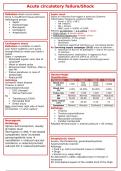
Acute circulatory failure/Shock
Definition shock occurs when Septic shock
there is insufficient tissue perfusion Sepsis an infection that triggers a particular Systemic
Aetiological groups Inflammatory Response syndrome (SIRS)
Septic Fever < 36oC/ >38 oC
HR >90/min
Haemorrhagic
RR > 20/min
Neurogenic WBC count < 4,000/ >12,000
Cardiogenic Patients w/ infections + ≥ 2 criteria = sepsis
Anaphylactic + Organ failure severe sepsis
+ Refractory hypotension septic shock
In surgical patients- at risk groups
Anastomotic leaks
Abscesses
Cardiogenic shock
Extensive superficial infections e.g. necrotising fascitis
Definition a condition in which Rx Surviving sepsis campaign (2012) areas of attention:
your heart suddenly can’t pump 1. Admission of Abx for all pathogens + search for source
enough blood to meet your body’s of infection
needs 2. Haemodynamic stabilisation aggressive fluid
Signs + symptoms stabilisation (Aim for CVP 8-12 cm H2O
Distended jugular veins due to 3. Modulation of septic response including glycaemic
raised JVP control
Weak or absent pulse
Abnormal heart rhythms, often a
fast HR
Pulsus paradoxus in case of
tamponade Haemorrhagic
Reduced BP Classification
Aetiology Parameter Class I Class II Class III Class IV
Ischaemic heart disease Blood loss 750- 1500-
<750 >2000
Trauma direct (ml) 1500 2000
myocardial/contusion Blood loss
<15% 15-30% 30-40% >40%
o ECG changes? (%)
o Sternal fractures? Pulse rate <100 >100 >120 >140
Rx BP Normal Normal Reduced Reduced
Transthoracic ECHO RR 14-20 20-30 30-40 >35
Pericardial fluid Urine output
(ml)
>30 20-30 5-15 <5
Direct injury
Note most likely right side of heart Symptoms Normal Anxious Confused Lethargic
w/ chamber +/ valve rupture Aetiology
Trauma
Tension pneumothorax
Spinal cord injury
Myocardial contusion
Neurogenic Cardiac tamponade
Aetiology Palpable femoral pulse = arterial pressure > 65 mmHg
Spinal cord transection, usually
@ higher level
Interruption in ANS decreased
sympathetic tone/ increased
parasympathetic tone Anaphylactic shock
vasodilation + reduced vascular Severe, life-threatening, generalised/systemic
resistance reduced pre-load, hypersensitivity reaction
reduced CO reduced perfusion Aetiology
Food e.g. nuts (commonest cause in children)
Drugs
Venom (e.g. wasp sting)
Rx Adrenaline 1:1000, repeated every 5 minutes if
necessary
IM: anterolateral aspect of the middle third of the thigh
Definition shock occurs when Septic shock
there is insufficient tissue perfusion Sepsis an infection that triggers a particular Systemic
Aetiological groups Inflammatory Response syndrome (SIRS)
Septic Fever < 36oC/ >38 oC
HR >90/min
Haemorrhagic
RR > 20/min
Neurogenic WBC count < 4,000/ >12,000
Cardiogenic Patients w/ infections + ≥ 2 criteria = sepsis
Anaphylactic + Organ failure severe sepsis
+ Refractory hypotension septic shock
In surgical patients- at risk groups
Anastomotic leaks
Abscesses
Cardiogenic shock
Extensive superficial infections e.g. necrotising fascitis
Definition a condition in which Rx Surviving sepsis campaign (2012) areas of attention:
your heart suddenly can’t pump 1. Admission of Abx for all pathogens + search for source
enough blood to meet your body’s of infection
needs 2. Haemodynamic stabilisation aggressive fluid
Signs + symptoms stabilisation (Aim for CVP 8-12 cm H2O
Distended jugular veins due to 3. Modulation of septic response including glycaemic
raised JVP control
Weak or absent pulse
Abnormal heart rhythms, often a
fast HR
Pulsus paradoxus in case of
tamponade Haemorrhagic
Reduced BP Classification
Aetiology Parameter Class I Class II Class III Class IV
Ischaemic heart disease Blood loss 750- 1500-
<750 >2000
Trauma direct (ml) 1500 2000
myocardial/contusion Blood loss
<15% 15-30% 30-40% >40%
o ECG changes? (%)
o Sternal fractures? Pulse rate <100 >100 >120 >140
Rx BP Normal Normal Reduced Reduced
Transthoracic ECHO RR 14-20 20-30 30-40 >35
Pericardial fluid Urine output
(ml)
>30 20-30 5-15 <5
Direct injury
Note most likely right side of heart Symptoms Normal Anxious Confused Lethargic
w/ chamber +/ valve rupture Aetiology
Trauma
Tension pneumothorax
Spinal cord injury
Myocardial contusion
Neurogenic Cardiac tamponade
Aetiology Palpable femoral pulse = arterial pressure > 65 mmHg
Spinal cord transection, usually
@ higher level
Interruption in ANS decreased
sympathetic tone/ increased
parasympathetic tone Anaphylactic shock
vasodilation + reduced vascular Severe, life-threatening, generalised/systemic
resistance reduced pre-load, hypersensitivity reaction
reduced CO reduced perfusion Aetiology
Food e.g. nuts (commonest cause in children)
Drugs
Venom (e.g. wasp sting)
Rx Adrenaline 1:1000, repeated every 5 minutes if
necessary
IM: anterolateral aspect of the middle third of the thigh