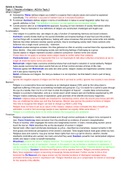
Limits of knowledge – concepts, problems, possible responses, overall judgements
Key words:
Local scepticism Concerned with some particular and restricted domain of
knowledge – but does not raise doubts about knowledge as a
whole.
Global Raises doubts about all of our knowledge – arguments conclude
scepticism that knowledge in any area is impossible.
e.g. brain in a vat
threatens to undermine the whole of our belief system.
Normal Normal incredulity is doubt about commonplace everyday
incredulity questions about human life and the kinds of practical
considerations that happen to matter in that context.
Philosophical
scepticism
Normal incredulity vs philosophical scepticism:
Normal incredulity Philosophical
scepticism
When Happens when ordinary evidence makes Occurs even when
us challenge a particular belief. ordinary evidence makes a
belief very likely to be
true. Often involves high
unlikely (but still possible)
scenarios.
Impact on Grounded in ordinary evidence, often Has a theoretical, not
behaviour alters behaviours practical, purpose. tends
not to impact behaviour.
How it Limited. Occurs against a background of Is infectious, so tend to
spreads other beliefs which are taken for extend to a whole set of
granted. beliefs.
Sensitivity Sensitive to ordinary evidence. Is Requires such a high
to evidence overcome if grounds for doubt are burden of proof that the
removed. grounds for doubt are hard
to remove.
Scope Usually directed at a particular belief – Can be local – restricted to
but can include a whole area e.g. being sets of beliefs, e.g.
sceptical about astrology. religious claims. Can also
be global – about
knowledge in general.
Purpose Ensures a particular belief is true. Helps Tests knowledge claims.
us guide our actions. Reveals hidden/ basic
assumptions.
Descartes’ three waves of doubt:
, Context: in meditations – Descartes uses his so-called method of doubt in an
attempt to rebuild his system of belief – involves suspending judgement about
all things he previously took for granted and only accepting beliefs that are
indubitable (cannot be doubted). In this way he can achieve certainty.
He does not go through each belief individually but attempts to destroy the
‘principles’ or most beliefs, so that the rest collapse of their own accord.
Descartes employs 3 distinct ‘waves of doubt’, each more radical than the last:
Doubting the senses:
- Because his senses have sometimes deceived him, Descartes argues it would
be best not to trust them.
- The possibility of perpetual error is sufficient to lead him to doubt the whole
of sense experience.
Problems of this:
1.
We are only able to tell that our senses are sometimes deceptive
precisely because on other occasions we take them to be accurate. I
can only tell that a stick looks bent in water if I trust my eyes when
it is not in water.
In the same way, just because some paintings are forgeries, it does
not follow that all paintings are forgeries – in fact, this is not
possible – as forgeries can only exist if there are originals.
Possible Descartes is not saying that all his sense-based beliefs could be
responses false, but rather that not one of them is guaranteed to be true. The
key distinction here is between ‘possibly all false’ – all his beliefs
may be false – and ‘all possibly false’ – some may be true, even
through we may not be able to tell which.
Overall
judgement
The dreaming argument
- If Descartes can have dreams which are just like being awake, then can he be
sure he is not dreaming now? This possibility means that any belief drawn
from what he is perceiving around him may be false.
Problems of this:
Dreams are Dreams are very different in character from real life – we can easily
very different tell the difference.
Possible Descartes:
response Argues that whatever criterion I use to tell that I am awake, it
remains that I merely dream that the criterion is satisfied. So, there
can never be ‘any reliable way of distinguishing being awake from
Key words:
Local scepticism Concerned with some particular and restricted domain of
knowledge – but does not raise doubts about knowledge as a
whole.
Global Raises doubts about all of our knowledge – arguments conclude
scepticism that knowledge in any area is impossible.
e.g. brain in a vat
threatens to undermine the whole of our belief system.
Normal Normal incredulity is doubt about commonplace everyday
incredulity questions about human life and the kinds of practical
considerations that happen to matter in that context.
Philosophical
scepticism
Normal incredulity vs philosophical scepticism:
Normal incredulity Philosophical
scepticism
When Happens when ordinary evidence makes Occurs even when
us challenge a particular belief. ordinary evidence makes a
belief very likely to be
true. Often involves high
unlikely (but still possible)
scenarios.
Impact on Grounded in ordinary evidence, often Has a theoretical, not
behaviour alters behaviours practical, purpose. tends
not to impact behaviour.
How it Limited. Occurs against a background of Is infectious, so tend to
spreads other beliefs which are taken for extend to a whole set of
granted. beliefs.
Sensitivity Sensitive to ordinary evidence. Is Requires such a high
to evidence overcome if grounds for doubt are burden of proof that the
removed. grounds for doubt are hard
to remove.
Scope Usually directed at a particular belief – Can be local – restricted to
but can include a whole area e.g. being sets of beliefs, e.g.
sceptical about astrology. religious claims. Can also
be global – about
knowledge in general.
Purpose Ensures a particular belief is true. Helps Tests knowledge claims.
us guide our actions. Reveals hidden/ basic
assumptions.
Descartes’ three waves of doubt:
, Context: in meditations – Descartes uses his so-called method of doubt in an
attempt to rebuild his system of belief – involves suspending judgement about
all things he previously took for granted and only accepting beliefs that are
indubitable (cannot be doubted). In this way he can achieve certainty.
He does not go through each belief individually but attempts to destroy the
‘principles’ or most beliefs, so that the rest collapse of their own accord.
Descartes employs 3 distinct ‘waves of doubt’, each more radical than the last:
Doubting the senses:
- Because his senses have sometimes deceived him, Descartes argues it would
be best not to trust them.
- The possibility of perpetual error is sufficient to lead him to doubt the whole
of sense experience.
Problems of this:
1.
We are only able to tell that our senses are sometimes deceptive
precisely because on other occasions we take them to be accurate. I
can only tell that a stick looks bent in water if I trust my eyes when
it is not in water.
In the same way, just because some paintings are forgeries, it does
not follow that all paintings are forgeries – in fact, this is not
possible – as forgeries can only exist if there are originals.
Possible Descartes is not saying that all his sense-based beliefs could be
responses false, but rather that not one of them is guaranteed to be true. The
key distinction here is between ‘possibly all false’ – all his beliefs
may be false – and ‘all possibly false’ – some may be true, even
through we may not be able to tell which.
Overall
judgement
The dreaming argument
- If Descartes can have dreams which are just like being awake, then can he be
sure he is not dreaming now? This possibility means that any belief drawn
from what he is perceiving around him may be false.
Problems of this:
Dreams are Dreams are very different in character from real life – we can easily
very different tell the difference.
Possible Descartes:
response Argues that whatever criterion I use to tell that I am awake, it
remains that I merely dream that the criterion is satisfied. So, there
can never be ‘any reliable way of distinguishing being awake from