Reason as a source of knowledge – concepts, problems, possible responses, overall
conclusion
Key terms:
Empiricism Empiricist philosophers claim that experience and evidence from
the senses provide us with the most, if not all of our knowledge.
- A posteriori
Rationalism Rationalists claim that reason, by itself, can be a source of
knowledge.
- Independent of experience
- A priori – justified independently of experience
Innatism says that we are born with some knowledge already (and innate
knowledge obviously doesn’t come from perceptual experience
because you haven’t had any perceptual experience when you are
newly born).
- A priori
A priori Justification independent of experience.
A posteriori Justification is based on experience.
Analytic truth True in virtue of the meaning of the words
- E.g. triangles have three sides.
- Cannot be denies without resulting in a logical contradiction.
Synthetic True in virtue of how the world is.
truth - E.g. ‘grass is green’
- Denial does not lead to a logical contradiction.
Ockham’s If completing explanations explain some phenomenon equally well,
razor go for the simpler one.
Innatism:
- Claim that we are born with knowledge.
- Usually believe that knowledge can be revealed through reason.
- Philosophers: Plato, Leibniz
Plato: ‘slave boy’ argument:
Context: in Meno, Plato shows how a slave boy can access his innate ideas.
P1: the slave boy has no prior knowledge of geometry/ squares.
P2: Socrates only asks questions; he does not teach the boy about squares.
P3: after the questioning, the slave boy can grasp an eternal truth about
geometry/squares.
P4: this eternal truth was not derived from the boy’s prior experience, nor from
Socrates.
C: this eternal truth must have existed innately in the boy to begin with.
, - The reason for this, according to Plato, is that knowing is really a process of
remembering – not searching through experience.
o Our souls have contact with the world of the forms before we are born,
and when we live we just need people like Socrates who can help us
recollect what we already know.
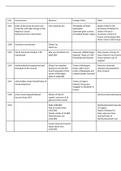
Problems of Plato’s ‘slave boy’ argument:
1.
Memory or Perhaps the slave is simply using reason to work out what must be
the faculty of the case given certain features of lines and shapes. It is not
reason? necessary to posit innate knowledge to explain how the boy can
reason his way to the discovery of a geometric truth.
Possible
response
Overall
judgement
2.
Empiricism we gain the concepts of number and shape from experience and
then gain mathematical knowledge when analysing those concepts.
The slave boy may not have had any formal mathematical education,
but he must have experienced the shapes of objects in his life. That
experience could be how gained geometric concepts which he then
used to demonstrate mathematical knowledge. Socrates’ questions
could also have helped to sharpen and develop those concepts.
- Or even had questions where he is actually teaching the slave
boy through experience as questions and answers are
themselves a form of experience, and so the slave boy is just
using innate logic and reason, which is not the same as innate
knowledge.
The knowledge demonstrated could therefore have been gained by
analytic a priori reasoning about concepts gained from experience.
That being the case, the knowledge demonstrated by the slave boy
cannot be used to prove that there is innate knowledge. We have a
better explanation, that it was caused by experience and therefore
have no reason to accept the conclusion that there is innate
knowledge.
This criticism can be backed up by Locke (empiricist) -> believed we
were born Tabula Rasa (blank slate) which was quickly filled with
experience.
- So the slave boy might have been able to be taught
mathematics truths very quickly by Socrates - & if geometry
really was innate then it would be universal.
- This would mean that babies and ‘idiots’ (people with learning
, difficulties) would be born with this knowledge.
- BUT, we have no evidence of this - & so if we follow Plato’s
argument, then we certainly have not proved there is innate
knowledge.
Possible
response
Overall
judgement
3.
Too Assumes a whole world of metaphysical forms which is difficult to
complicated prove & it assumes the immortality of the soul and transmigration,
both of which require proof which we don’t have & modern science
(unavailable to Plato) can be used against these ideas.
Possible
response
Overall
judgement
OVERALL CONCLUSION OF PLATO’S INNATISM –
Innate ideas: Leibniz:
- Believed that the human mind could gain knowledge of the world through
reason alone (though prompted by the senses) – his belief also rests on claim
that we have innate ideas – which he called ‘principles’ – which are revealed by
reason.
Argument from the necessity of truth:
o Leibniz argued that there are different kinds of truths -> some of which
termed necessary.
o The ‘necessity’ of a truth cannot be revealed by the senses, but only
reason – which is the application of principles that are innately inside
us.
P1: the senses only reveal instances of general truths.
P2: the senses cannot reveal the necessity of a general truth.
P3: our minds can see the necessity of some general truths.
C: our ability to see the necessity of general truth is not derived from the senses, but
is based on innate principles.
conclusion
Key terms:
Empiricism Empiricist philosophers claim that experience and evidence from
the senses provide us with the most, if not all of our knowledge.
- A posteriori
Rationalism Rationalists claim that reason, by itself, can be a source of
knowledge.
- Independent of experience
- A priori – justified independently of experience
Innatism says that we are born with some knowledge already (and innate
knowledge obviously doesn’t come from perceptual experience
because you haven’t had any perceptual experience when you are
newly born).
- A priori
A priori Justification independent of experience.
A posteriori Justification is based on experience.
Analytic truth True in virtue of the meaning of the words
- E.g. triangles have three sides.
- Cannot be denies without resulting in a logical contradiction.
Synthetic True in virtue of how the world is.
truth - E.g. ‘grass is green’
- Denial does not lead to a logical contradiction.
Ockham’s If completing explanations explain some phenomenon equally well,
razor go for the simpler one.
Innatism:
- Claim that we are born with knowledge.
- Usually believe that knowledge can be revealed through reason.
- Philosophers: Plato, Leibniz
Plato: ‘slave boy’ argument:
Context: in Meno, Plato shows how a slave boy can access his innate ideas.
P1: the slave boy has no prior knowledge of geometry/ squares.
P2: Socrates only asks questions; he does not teach the boy about squares.
P3: after the questioning, the slave boy can grasp an eternal truth about
geometry/squares.
P4: this eternal truth was not derived from the boy’s prior experience, nor from
Socrates.
C: this eternal truth must have existed innately in the boy to begin with.
, - The reason for this, according to Plato, is that knowing is really a process of
remembering – not searching through experience.
o Our souls have contact with the world of the forms before we are born,
and when we live we just need people like Socrates who can help us
recollect what we already know.
Problems of Plato’s ‘slave boy’ argument:
1.
Memory or Perhaps the slave is simply using reason to work out what must be
the faculty of the case given certain features of lines and shapes. It is not
reason? necessary to posit innate knowledge to explain how the boy can
reason his way to the discovery of a geometric truth.
Possible
response
Overall
judgement
2.
Empiricism we gain the concepts of number and shape from experience and
then gain mathematical knowledge when analysing those concepts.
The slave boy may not have had any formal mathematical education,
but he must have experienced the shapes of objects in his life. That
experience could be how gained geometric concepts which he then
used to demonstrate mathematical knowledge. Socrates’ questions
could also have helped to sharpen and develop those concepts.
- Or even had questions where he is actually teaching the slave
boy through experience as questions and answers are
themselves a form of experience, and so the slave boy is just
using innate logic and reason, which is not the same as innate
knowledge.
The knowledge demonstrated could therefore have been gained by
analytic a priori reasoning about concepts gained from experience.
That being the case, the knowledge demonstrated by the slave boy
cannot be used to prove that there is innate knowledge. We have a
better explanation, that it was caused by experience and therefore
have no reason to accept the conclusion that there is innate
knowledge.
This criticism can be backed up by Locke (empiricist) -> believed we
were born Tabula Rasa (blank slate) which was quickly filled with
experience.
- So the slave boy might have been able to be taught
mathematics truths very quickly by Socrates - & if geometry
really was innate then it would be universal.
- This would mean that babies and ‘idiots’ (people with learning
, difficulties) would be born with this knowledge.
- BUT, we have no evidence of this - & so if we follow Plato’s
argument, then we certainly have not proved there is innate
knowledge.
Possible
response
Overall
judgement
3.
Too Assumes a whole world of metaphysical forms which is difficult to
complicated prove & it assumes the immortality of the soul and transmigration,
both of which require proof which we don’t have & modern science
(unavailable to Plato) can be used against these ideas.
Possible
response
Overall
judgement
OVERALL CONCLUSION OF PLATO’S INNATISM –
Innate ideas: Leibniz:
- Believed that the human mind could gain knowledge of the world through
reason alone (though prompted by the senses) – his belief also rests on claim
that we have innate ideas – which he called ‘principles’ – which are revealed by
reason.
Argument from the necessity of truth:
o Leibniz argued that there are different kinds of truths -> some of which
termed necessary.
o The ‘necessity’ of a truth cannot be revealed by the senses, but only
reason – which is the application of principles that are innately inside
us.
P1: the senses only reveal instances of general truths.
P2: the senses cannot reveal the necessity of a general truth.
P3: our minds can see the necessity of some general truths.
C: our ability to see the necessity of general truth is not derived from the senses, but
is based on innate principles.