

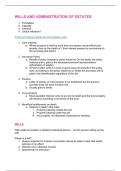
WILLS AND ADMINISTRATION OF ESTATES
1. Formalities
2. Capacity
3. Intention
4. Undue influence?
Property Passing outside will and intestacy rules
1. Joint property
a. Where property is held by more than one person as beneficial joint
tenants, then on the death of 1 their interest passes by survivorship to
the surviving joint tenant.
2. Insurance Policy
a. Benefit of policy belongs to policy holder so On the death, the policy
matures and is paid to the deceased personal representatives
(administers of estate)
b. If Policy holder write it in trust or given away the benefit of the policy
does not belong to the policy holder so on death the proceeds will be
paid to the beneficiaries regardless of the will.
3. Pension
a. Letter of wishes on how pension to be distributed but the pension
provider does not have to follow this
b. Usually paid to family
4. Trust property
a. Most equitable interest come to an end on death and the trust property
will devolve according to the terms of the trust.
5. Beneficial entitlements on death
a. Solicitor to deal in this order:
i. Property passing outside the will
ii. Property passing under the will
iii. Any property not disposed of passing on intestacy
WILLS
Wills made by testator or testatrix (individual person – not the person writing up the
will)
Whats in a will?
1. Always important to include a revocation clause to make it clear that earlier
wills are of no effect
2. Direction as to disposal of body
3. Appointment of executors
, a. After death the executors will apply to the probate register for grant of
probate which confirms the the will is valid and that executor has
authority to act.
4. Gifts
a. Legacies – gifts of personalty
b. Devise – gift of realty
c. Term legacy used to cover both
d. Pecuniary gift – money
Valid Will
1. Wills Act 1837
2. Three requirements:
a. Capacity
i. Requirements for the Testator -
1. Aged 18 or over
2. Requisite mental capacity
a. Banks v Goodfellow (1870)
i. A soundness of mind, memory and
understanding
3. Must understand the nature of their act and its broad
effect, the extent of their property and the moral claims
4. The testator must not be suffering from any insane
delusion which affects the disposition of property
ii. Exception to the rule – Parker v Felgate
1. A will can be valid if the testator has capacity when they
give instructions for the will even if they lose capacity by
the time the will is executed. And at the time the testator
executes the will they appreciate that they are signing a
will prepared in accordance with their previous
instructions
iii. Mental capacity Act 2005 –
1. Introduced a statutory test but it has been found that this
does not apply to wills.
iv. ‘GOLDEN RULE’
1. if the testator lacks capacity then the will is void.
a. Suggested in Kenward v Adams (1975)
2. Medical practitioner to provide a written report confirming
that the testator has testamentary capacity and ask the
doctor to witness the will.
3. Solicitor should record their own view of the testators
capacity in a file note – kept on file
v. Burden of Proof
1. It is for the person who is asserting that a will is valid to
prove it – generally rely on a presumption
vi. Presumption of Capacity
1. The presumption applies if the will is rational on its face
and the testator showed no evidence of mental confusion
before making the will
, 2. If someone tries to challenge then the burden shifts to the
challenger to prove lack of capacity.
b. Intention
i. General and specific intention
1. Intend to make a will and must intend to make the
particular will now being executed
ii. Burden of proof
1. On the person asserting the will is valid
2. Presumption of knowledge and approval arises
a. Does not apply when:
i. Testator blind/illiterate/not signing
personally
1. Probate will require evidence to
prove knowledge and approval
2. Usual that a statement included in
the will to say that the will was read
over to the testator
ii. Suspicious circumstances
1. i.e. if the will has been prepared by
someone who is to be a mjor
beneficiary or is a close relative
2. in such cases the person must
remove the suspicion by proving that
the testator knew and approved wills
contents
iii. Wintle v Nye
1. HL held that the suspicious
circumstances of the beneficiary
preparing the will meant there was
no presumption of knowledge and
approval
iv. Gill v Woodall
1. She suffered from a severe anxiety
disorder and agoraphobia. There
was No evidence that she had read
the will or had it explained to her. So
COA held that the presumption did
not apply
iii. Force, Fear, Fraud, Undue influence and mistake
1. A solicitor should interview the testator in absence of the
third party to ensure that the will drafted reflects the
testators wishes.
c. Formalities
i. S9 Wills Act 1837
1. (a) in writing and signed by the testator or by someone in
his presence and by his direction and
, a. an electronic will held only on computer not
considered in writing
2. (b) testator intended by his signature to give effect to the
will (will must be signed) and
a. In the Estate of Cook (1960) – a will signed ‘your
loving mother’ was held to be valid
3. (c) the signature is made or acknowledged by the testator
in the presence of 2 or more witnesses present at the
time and
a. if either witness is a beneficiary under the will or is
the spouse or civil partner of the beneficiary the
will remains valid but the gift to the witness or
spouse fails
4. (d) each witness either
a. (i) attests and signs the will or
b. (ii) acknowledges his signature in the presence of
the testator but no form of attestation shall be
necessary
i. remote witnessing between 31 Jan 2020 to
31 January 2024 so that presence includes
presence by means of videoconference
c. s15 Wills Act 1837 provides that if a
beneficiary or a spouse/civil partner of a
beneficiary acts as a witness the gift to the
beneficiary fails. s15 does not extend to
other family members. The pecuniary gift
is therefore valid and Jane will receive
£5,000.
ii. Exception to S9
1. Privileged Wills
a. A will made on actual military service or by a
mariner or seaman at sea may be in any form
including a mere oral statement (s 11)
b. Only requirement that testator intends to dispose
of his property after his death
iii. Burden of proof
1. Presumption of due execution
2. Will should include clause that recites that the s9
formalities were observed – ‘signed by the testatrix in our
joint presence and then by us in hers’
a. Attestation clause
3. If that clause is not included then the probate registry will
require an affidavit of due execution from a witness or
any person that was presence during the execution
iv. Solicitors Duties
1. Give clear instructions
1. Formalities
2. Capacity
3. Intention
4. Undue influence?
Property Passing outside will and intestacy rules
1. Joint property
a. Where property is held by more than one person as beneficial joint
tenants, then on the death of 1 their interest passes by survivorship to
the surviving joint tenant.
2. Insurance Policy
a. Benefit of policy belongs to policy holder so On the death, the policy
matures and is paid to the deceased personal representatives
(administers of estate)
b. If Policy holder write it in trust or given away the benefit of the policy
does not belong to the policy holder so on death the proceeds will be
paid to the beneficiaries regardless of the will.
3. Pension
a. Letter of wishes on how pension to be distributed but the pension
provider does not have to follow this
b. Usually paid to family
4. Trust property
a. Most equitable interest come to an end on death and the trust property
will devolve according to the terms of the trust.
5. Beneficial entitlements on death
a. Solicitor to deal in this order:
i. Property passing outside the will
ii. Property passing under the will
iii. Any property not disposed of passing on intestacy
WILLS
Wills made by testator or testatrix (individual person – not the person writing up the
will)
Whats in a will?
1. Always important to include a revocation clause to make it clear that earlier
wills are of no effect
2. Direction as to disposal of body
3. Appointment of executors
, a. After death the executors will apply to the probate register for grant of
probate which confirms the the will is valid and that executor has
authority to act.
4. Gifts
a. Legacies – gifts of personalty
b. Devise – gift of realty
c. Term legacy used to cover both
d. Pecuniary gift – money
Valid Will
1. Wills Act 1837
2. Three requirements:
a. Capacity
i. Requirements for the Testator -
1. Aged 18 or over
2. Requisite mental capacity
a. Banks v Goodfellow (1870)
i. A soundness of mind, memory and
understanding
3. Must understand the nature of their act and its broad
effect, the extent of their property and the moral claims
4. The testator must not be suffering from any insane
delusion which affects the disposition of property
ii. Exception to the rule – Parker v Felgate
1. A will can be valid if the testator has capacity when they
give instructions for the will even if they lose capacity by
the time the will is executed. And at the time the testator
executes the will they appreciate that they are signing a
will prepared in accordance with their previous
instructions
iii. Mental capacity Act 2005 –
1. Introduced a statutory test but it has been found that this
does not apply to wills.
iv. ‘GOLDEN RULE’
1. if the testator lacks capacity then the will is void.
a. Suggested in Kenward v Adams (1975)
2. Medical practitioner to provide a written report confirming
that the testator has testamentary capacity and ask the
doctor to witness the will.
3. Solicitor should record their own view of the testators
capacity in a file note – kept on file
v. Burden of Proof
1. It is for the person who is asserting that a will is valid to
prove it – generally rely on a presumption
vi. Presumption of Capacity
1. The presumption applies if the will is rational on its face
and the testator showed no evidence of mental confusion
before making the will
, 2. If someone tries to challenge then the burden shifts to the
challenger to prove lack of capacity.
b. Intention
i. General and specific intention
1. Intend to make a will and must intend to make the
particular will now being executed
ii. Burden of proof
1. On the person asserting the will is valid
2. Presumption of knowledge and approval arises
a. Does not apply when:
i. Testator blind/illiterate/not signing
personally
1. Probate will require evidence to
prove knowledge and approval
2. Usual that a statement included in
the will to say that the will was read
over to the testator
ii. Suspicious circumstances
1. i.e. if the will has been prepared by
someone who is to be a mjor
beneficiary or is a close relative
2. in such cases the person must
remove the suspicion by proving that
the testator knew and approved wills
contents
iii. Wintle v Nye
1. HL held that the suspicious
circumstances of the beneficiary
preparing the will meant there was
no presumption of knowledge and
approval
iv. Gill v Woodall
1. She suffered from a severe anxiety
disorder and agoraphobia. There
was No evidence that she had read
the will or had it explained to her. So
COA held that the presumption did
not apply
iii. Force, Fear, Fraud, Undue influence and mistake
1. A solicitor should interview the testator in absence of the
third party to ensure that the will drafted reflects the
testators wishes.
c. Formalities
i. S9 Wills Act 1837
1. (a) in writing and signed by the testator or by someone in
his presence and by his direction and
, a. an electronic will held only on computer not
considered in writing
2. (b) testator intended by his signature to give effect to the
will (will must be signed) and
a. In the Estate of Cook (1960) – a will signed ‘your
loving mother’ was held to be valid
3. (c) the signature is made or acknowledged by the testator
in the presence of 2 or more witnesses present at the
time and
a. if either witness is a beneficiary under the will or is
the spouse or civil partner of the beneficiary the
will remains valid but the gift to the witness or
spouse fails
4. (d) each witness either
a. (i) attests and signs the will or
b. (ii) acknowledges his signature in the presence of
the testator but no form of attestation shall be
necessary
i. remote witnessing between 31 Jan 2020 to
31 January 2024 so that presence includes
presence by means of videoconference
c. s15 Wills Act 1837 provides that if a
beneficiary or a spouse/civil partner of a
beneficiary acts as a witness the gift to the
beneficiary fails. s15 does not extend to
other family members. The pecuniary gift
is therefore valid and Jane will receive
£5,000.
ii. Exception to S9
1. Privileged Wills
a. A will made on actual military service or by a
mariner or seaman at sea may be in any form
including a mere oral statement (s 11)
b. Only requirement that testator intends to dispose
of his property after his death
iii. Burden of proof
1. Presumption of due execution
2. Will should include clause that recites that the s9
formalities were observed – ‘signed by the testatrix in our
joint presence and then by us in hers’
a. Attestation clause
3. If that clause is not included then the probate registry will
require an affidavit of due execution from a witness or
any person that was presence during the execution
iv. Solicitors Duties
1. Give clear instructions


