Responses Eve Holland
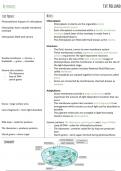
Key Points: Notes:
Photosynthesis happens in chloroplasts Chloroplasts:
- Chloroplasts in plants are the organelles where
Chloroplasts have a double membrane photosynthesis occurs
envelope - Each chloroplasts is contained within a double membrane
envelope (each layer of the envelope is made from a
Chloroplasts filled with stroma phospholipid bilayer)
- The chloroplasts are filled with fluid known as the stroma
Structure:
- The fluid, stroma, carries its own membrane system
- These membranes contain pigments, enzymes and electron
carriers required for the light-dependent reactions
Double membrane → stroma → - The stroma is the site of the light-independent stage of
thylakoids → grana → lamellae photosynthesis and the membranes it contains are the site of
the light-dependent stage.
- This membrane system includes flattened fluid filled sacs
Stroma also contains: called thylakoids
- 70s ribosomes
- The thylakoids are stacked together to form structures called
- loop of DNA
grana
- starch grains
- Grana are connected by membranous channels known as
lamellae
Adaptations:
- Grana membranes provide a large surface area which
maximises the amount of light dependent reactions that can
occur
Grana = large surface area - This membrane system also contains lots of pigments in an
arrangement which ensures as much light can be absorbed as
Lots of pigments = more light absorbed possible.
- The pigment molecules are arranged in light-harvesting
clusters known as photosystems
DNA loop = codes for proteins Stroma contains 70s ribosomes, starch grains and a loop of DNA:
- Loop of DNA - codes for chloroplasts proteins
70s ribosomes = produces proteins - 70s ribosomes - proteins coded for by loop are produced
here
Starch grains = stores sugar - Starch grains - store sugars formed during photosynthesis.
Summary:
, The Light-Dependent Stage Of Photosynthesis Eve Holland
Key Points: Notes:
The Process:
1. Chlorophyll absorbs light
energy 1. Pigments is chlorophyll absorb light energy
2. 2 electrons become excited and move up energy levels and then
are removed from the chlorophyll - photoionisation
2. Electrons are excited and 3. These electrons are passed down a chain of carriers - known as
removed from chlorophyll the electron transport chain, until they reach photosystem 1
3. Electrons move along 4. At each carrier, the electrons lose energy
electron transport chain until 5. This energy is used to pump protons (H+) from the stroma into
the thylakoid lumen
photosystem 1
6. An electrochemical gradient of protons form
7. Protons then diffuse back into the stroma through ATP synthase
4. Energy lost at each carrier 8. The kinetic energy of protons is used to combine ADP + Pi → ATP
used to pump H+ from
stroma → thylakoid 9. Light energy is also used to split water molecules into H+, OH- and
½ O2 (protons, electrons and oxygen) - Photolysis
10. These electrons replace those lost and the oxygen is waste
5. Electrochemical gradient
forms and protons diffuse 11. Light energy hits photosystem 1 and the electron is emitted from
back into stroma through the chlorophyll and binds H+ from photolysis of H2O to form H
ATP synthase 12. H then bond with with NADP to form reduced NADP
13. Reduced NADP is then used in the light-independent reaction
6. Kinetic energy ADP + Pi →
Key Notes & Words:
ATP
Light dependent stage occurs in the thylakoids
7. Light energy hits
photosystem 1 and electron Photolysis - the use of light energy to split a water molecule into H+, OH-
is lost and ½ O2
Photoionisation - when light energy excited electrons causing them to
8. Electron binds with NADP to
move up energy levels and then be emitted from the molecule.
form reduced NADP
Chemiosmosis - the facilitated diffusion, of protons, through
9. Photolysis (water splitting) transmembrane ATP synthase back into the stroma
replaces lost electrons
Photophosphorolation - the overall process of using light energy and the
electron transport chain to phosphorylate ADP → ATP
Summary:
Key Points: Notes:
Photosynthesis happens in chloroplasts Chloroplasts:
- Chloroplasts in plants are the organelles where
Chloroplasts have a double membrane photosynthesis occurs
envelope - Each chloroplasts is contained within a double membrane
envelope (each layer of the envelope is made from a
Chloroplasts filled with stroma phospholipid bilayer)
- The chloroplasts are filled with fluid known as the stroma
Structure:
- The fluid, stroma, carries its own membrane system
- These membranes contain pigments, enzymes and electron
carriers required for the light-dependent reactions
Double membrane → stroma → - The stroma is the site of the light-independent stage of
thylakoids → grana → lamellae photosynthesis and the membranes it contains are the site of
the light-dependent stage.
- This membrane system includes flattened fluid filled sacs
Stroma also contains: called thylakoids
- 70s ribosomes
- The thylakoids are stacked together to form structures called
- loop of DNA
grana
- starch grains
- Grana are connected by membranous channels known as
lamellae
Adaptations:
- Grana membranes provide a large surface area which
maximises the amount of light dependent reactions that can
occur
Grana = large surface area - This membrane system also contains lots of pigments in an
arrangement which ensures as much light can be absorbed as
Lots of pigments = more light absorbed possible.
- The pigment molecules are arranged in light-harvesting
clusters known as photosystems
DNA loop = codes for proteins Stroma contains 70s ribosomes, starch grains and a loop of DNA:
- Loop of DNA - codes for chloroplasts proteins
70s ribosomes = produces proteins - 70s ribosomes - proteins coded for by loop are produced
here
Starch grains = stores sugar - Starch grains - store sugars formed during photosynthesis.
Summary:
, The Light-Dependent Stage Of Photosynthesis Eve Holland
Key Points: Notes:
The Process:
1. Chlorophyll absorbs light
energy 1. Pigments is chlorophyll absorb light energy
2. 2 electrons become excited and move up energy levels and then
are removed from the chlorophyll - photoionisation
2. Electrons are excited and 3. These electrons are passed down a chain of carriers - known as
removed from chlorophyll the electron transport chain, until they reach photosystem 1
3. Electrons move along 4. At each carrier, the electrons lose energy
electron transport chain until 5. This energy is used to pump protons (H+) from the stroma into
the thylakoid lumen
photosystem 1
6. An electrochemical gradient of protons form
7. Protons then diffuse back into the stroma through ATP synthase
4. Energy lost at each carrier 8. The kinetic energy of protons is used to combine ADP + Pi → ATP
used to pump H+ from
stroma → thylakoid 9. Light energy is also used to split water molecules into H+, OH- and
½ O2 (protons, electrons and oxygen) - Photolysis
10. These electrons replace those lost and the oxygen is waste
5. Electrochemical gradient
forms and protons diffuse 11. Light energy hits photosystem 1 and the electron is emitted from
back into stroma through the chlorophyll and binds H+ from photolysis of H2O to form H
ATP synthase 12. H then bond with with NADP to form reduced NADP
13. Reduced NADP is then used in the light-independent reaction
6. Kinetic energy ADP + Pi →
Key Notes & Words:
ATP
Light dependent stage occurs in the thylakoids
7. Light energy hits
photosystem 1 and electron Photolysis - the use of light energy to split a water molecule into H+, OH-
is lost and ½ O2
Photoionisation - when light energy excited electrons causing them to
8. Electron binds with NADP to
move up energy levels and then be emitted from the molecule.
form reduced NADP
Chemiosmosis - the facilitated diffusion, of protons, through
9. Photolysis (water splitting) transmembrane ATP synthase back into the stroma
replaces lost electrons
Photophosphorolation - the overall process of using light energy and the
electron transport chain to phosphorylate ADP → ATP
Summary: