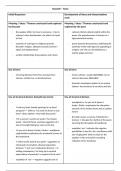
Rossetti – Twice
Initial Responses Development of ideas and interpretations
(red)
Meaning / Ideas / Themes constructed and explored Meaning / Ideas / Themes constructed and
by the poet explored by the poet
- the speaker offers her love to someone → but is - cultural criticism-attack implicit within the
rejected, when heartbroken, she offers her heart poem- the powerlessness of women in a
to God rigid patriarchal society
- rejection of marriage on religious grounds, - poem subverts the premises underlying the
Rossetti’s religion, attitudes towards women’s authority of the male figure by appealing to
rights and independence a higher one who can be idealised as a
worthy judge and lover
- earthly relationships bring sadness and misery
Use of form Use of form
- mirroring between first three and last three - rhyme scheme- usually ABACDBDC, but in
stanzas- earthly love vs devotional love stanza it becomes ABACABAC
- dramatic monologue spoken to an unseen
listener- has elements of narrative and lyric
Use of structural devices (include key terms) Use of structural devices
- - anadiplosis in ‘As you set it down it
broke- /Broke’ emphasises the disruption
- ‘I took my heart (iambic opening) in my hand and pain of her broken heart and its sudden
(anapest)’--> shifts to ‘You took my heart in your nature
hand’- direct address- who holds the power?
- the dash causes a caesura, followed by a
- ‘Yet a woman’s words are weak;/ You should trochee → disrupts the rhythm of the poem
speak’- internal rhyme- perhaps suggestive of a mirroring the disruption of heartbreak
lack of strength hiding her voice in the line
- repetitive ‘nor’- indicates the negative
- ‘As you set it down it broke,/ Broke’- anadiplosis- possibilities in her life- the ‘cornflowers wild’
capitalisation emphasises the emotional trauma of and ‘singing bird’ hold no value for the
the heartbreak speaker→ they are joyful=a mocking
- ‘I smiled at the speech you spoke’- suggestion of reflection of her loneliness
rehearsed conversation, physical separation
between ‘I’ and ‘you’ emphasises distance → is
smiling complacency? or living up to societal
expectations of passivity? or expects this of men?
- repetition of ‘nor’ → negation suggests lack of
Initial Responses Development of ideas and interpretations
(red)
Meaning / Ideas / Themes constructed and explored Meaning / Ideas / Themes constructed and
by the poet explored by the poet
- the speaker offers her love to someone → but is - cultural criticism-attack implicit within the
rejected, when heartbroken, she offers her heart poem- the powerlessness of women in a
to God rigid patriarchal society
- rejection of marriage on religious grounds, - poem subverts the premises underlying the
Rossetti’s religion, attitudes towards women’s authority of the male figure by appealing to
rights and independence a higher one who can be idealised as a
worthy judge and lover
- earthly relationships bring sadness and misery
Use of form Use of form
- mirroring between first three and last three - rhyme scheme- usually ABACDBDC, but in
stanzas- earthly love vs devotional love stanza it becomes ABACABAC
- dramatic monologue spoken to an unseen
listener- has elements of narrative and lyric
Use of structural devices (include key terms) Use of structural devices
- - anadiplosis in ‘As you set it down it
broke- /Broke’ emphasises the disruption
- ‘I took my heart (iambic opening) in my hand and pain of her broken heart and its sudden
(anapest)’--> shifts to ‘You took my heart in your nature
hand’- direct address- who holds the power?
- the dash causes a caesura, followed by a
- ‘Yet a woman’s words are weak;/ You should trochee → disrupts the rhythm of the poem
speak’- internal rhyme- perhaps suggestive of a mirroring the disruption of heartbreak
lack of strength hiding her voice in the line
- repetitive ‘nor’- indicates the negative
- ‘As you set it down it broke,/ Broke’- anadiplosis- possibilities in her life- the ‘cornflowers wild’
capitalisation emphasises the emotional trauma of and ‘singing bird’ hold no value for the
the heartbreak speaker→ they are joyful=a mocking
- ‘I smiled at the speech you spoke’- suggestion of reflection of her loneliness
rehearsed conversation, physical separation
between ‘I’ and ‘you’ emphasises distance → is
smiling complacency? or living up to societal
expectations of passivity? or expects this of men?
- repetition of ‘nor’ → negation suggests lack of