ECONOMICS MICRO NOTES Y12 & Y13
4.1.1 ECONOMIC METHODOLOGY
When an economist creates a model it will always be based on assumptions.
Ceteris paribus - assuming other variables remain constant
Positive statements - objective. Can be tested.
Normative statements - based on value judgment. Subjective and based on opinion.
Economic decisions:
- What to produce
- How to produce it
- For who to produce it
Factors of production and their reward
- Land : rent
- Labour : wage
- Capital : interest
- Enterprise : profit
The economic problem - needs and wants are unlimited, but resources available are limited
Scarcity forces people to make choices
Opportunity cost - the next best alternative forgone
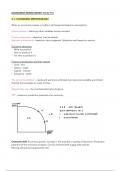
PPF - maximum productive potential of an economy
Outwards shift: Economic growth, increase in the quantity or quality of resources. Productive
potential of the economy increases. Can be achieved with supply side policies
Moving along incurs opportunity cost.
,Factors that cause an outwards shift
- Technological improvements
- Discovery of new resources
- Improvements in education and training
- Increase in working population
Factors that cause an inwards shift
- Natural disasters
- Wars
- Global warming; loss of farmland, rising sea levels, extreme weather
- Prolonged recession; permanent loss of productive capacity if business close down and workers
lose skills
Productive efficiency - resourced used to their productive potential (all points on the PPF)
Allocative efficiency - more of one good cannot be produced without reducing the amount of the
other product available (another name is Pareto efficiency). Not shown on the PPF.
4.1.2 INDIVIDUAL ECONOMIC DECISION MAKING
Assumptions are the key to rational behaviour. This means people make decisions to maximise
their private benefit.
Utility theory - utility is the amount of satisfaction or benefit that a consumer gains from
consuming a good or service. They aim to maximise this utility.
Two types of utility:
- Total utility: what they gain from each consumption
- Marginal utility: what they additionally gain from each extra consumption
Law of diminishing marginal utility - as we consume more units of a good or service, the additional
units consumed give smaller increases in total satisfaction in comparison to the first one.
Imperfect information - consumers not possessing all the information required to make fully
informed decisions. This can be for many reasons such as not being able to calculate the utility,
not being given enough information, being ‘brainwashed’ by advertising…
,This is a potential source of market failure.
Most important type: asymmetric information - one party (usually the seller) has more/superior
information than another (usually the buyer). Imbalance of power. Eg. Car selling.
Bounded rationality - people try to behave rationally, but the ability to do so is severely restricted.
The human mind has limited ability to process and evaluate information, available information is
incomplete or unreliable (rapidly out of date) and time available to make decisions is limited.
Bounded self-control - when individuals have good intentions but lack self-discipline to see them
through. Eg. Regular gym attendance, losing weight, giving up smoking…
Both terms suggest that individuals are predictably irrational.
Types of biases in decision making:
- Rules of thumb: decisions based on previous experiences or bounded rationality (automatic
choice)
- Anchoring: rely on particular pieces of information, especially when they lack knowledge or
experience. Eg. Focuses on price rather than features.
- Availability: make judgments about the probability of events by recalling on recent instances.
- Social norms: what society dictates has a big influence on individual decision-making. Eg. Social
pressure, pressuring ads.
- Altruism and fairness: people are motivated to do the right thing. Eg. Giving to charity, doing
voluntary work… are seen as being irrational in traditional economics but individual consumers
can gain a big sense of satisfaction and extra utility.
Policies developed from the theories of behavioural economics:
- Choice architecture: the way choices are presented to consumers. Eg. Opt-out and opt-in organ
donation. It can include fewer choices.
- Framing: the context of how a choice is presented. Includes word choices. Eg. Monthly
payments might look more affordable than yearly payment.
- Nudges: change the behaviour of consumers without restricting choice. Comes under the
category of choice architecture.
- Default choices, restricted choice and mandated choice
Default choices: consumers are automatically enrolled into a system. Eg. Pension. More likely to
participate if already enrolled. Their choice to take no action.
Restricted choice: the choice of consumer is restricted, but it is still there.
Mandated choice: consumers are required to dictate whether they wish to participate in an
action. Eg. In the UK, everyone who applies or renews their driving licence is asked if they wish to
sign up for organ donation.
4.1.3 PRICE DETERMINATION IN A COMPETITIVE MARKET
Demand - the amount of the good that buyers are willing and able to purchase over a period of
time.
Effective demand - consumers who actually buy the product at P1
, Latent demand - consumers who would like to consume the product but are either not willing or
not able to buy it at the current price
Downwards sloping because:
- Law of diminishing marginal utility
- Income effect: the lower the price, the more you can buy
- Substitution effect: the lower the price, the cheaper it is in comparison to the alternative
Shifts in demand:
- Population
- Advertising
- Substitutes
- Income (disposable)
- Fashion and trends
- Income tax
- Complements
Consumer surplus - difference between what consumers are willing and able to pay and what they
actually pay.
Price elasticity of demand (PED) - the responsiveness of the quantity demanded to a change in the
goods price
PED = ——————————————
Elastic - change in price causes a big change in quantity
Inelastic - change in price does not cause a big change un quantity
Values of PED:
Perfectly inelastic Inelastic Unitary elastic Elastic Perfectly elastic
0 <1 1 >1 ∞
Example of perfect elastic demand: two vending machines placed next to each other
Example of perfect inelastic demand: medical treatment, gasoline as no real substitute
4.1.1 ECONOMIC METHODOLOGY
When an economist creates a model it will always be based on assumptions.
Ceteris paribus - assuming other variables remain constant
Positive statements - objective. Can be tested.
Normative statements - based on value judgment. Subjective and based on opinion.
Economic decisions:
- What to produce
- How to produce it
- For who to produce it
Factors of production and their reward
- Land : rent
- Labour : wage
- Capital : interest
- Enterprise : profit
The economic problem - needs and wants are unlimited, but resources available are limited
Scarcity forces people to make choices
Opportunity cost - the next best alternative forgone
PPF - maximum productive potential of an economy
Outwards shift: Economic growth, increase in the quantity or quality of resources. Productive
potential of the economy increases. Can be achieved with supply side policies
Moving along incurs opportunity cost.
,Factors that cause an outwards shift
- Technological improvements
- Discovery of new resources
- Improvements in education and training
- Increase in working population
Factors that cause an inwards shift
- Natural disasters
- Wars
- Global warming; loss of farmland, rising sea levels, extreme weather
- Prolonged recession; permanent loss of productive capacity if business close down and workers
lose skills
Productive efficiency - resourced used to their productive potential (all points on the PPF)
Allocative efficiency - more of one good cannot be produced without reducing the amount of the
other product available (another name is Pareto efficiency). Not shown on the PPF.
4.1.2 INDIVIDUAL ECONOMIC DECISION MAKING
Assumptions are the key to rational behaviour. This means people make decisions to maximise
their private benefit.
Utility theory - utility is the amount of satisfaction or benefit that a consumer gains from
consuming a good or service. They aim to maximise this utility.
Two types of utility:
- Total utility: what they gain from each consumption
- Marginal utility: what they additionally gain from each extra consumption
Law of diminishing marginal utility - as we consume more units of a good or service, the additional
units consumed give smaller increases in total satisfaction in comparison to the first one.
Imperfect information - consumers not possessing all the information required to make fully
informed decisions. This can be for many reasons such as not being able to calculate the utility,
not being given enough information, being ‘brainwashed’ by advertising…
,This is a potential source of market failure.
Most important type: asymmetric information - one party (usually the seller) has more/superior
information than another (usually the buyer). Imbalance of power. Eg. Car selling.
Bounded rationality - people try to behave rationally, but the ability to do so is severely restricted.
The human mind has limited ability to process and evaluate information, available information is
incomplete or unreliable (rapidly out of date) and time available to make decisions is limited.
Bounded self-control - when individuals have good intentions but lack self-discipline to see them
through. Eg. Regular gym attendance, losing weight, giving up smoking…
Both terms suggest that individuals are predictably irrational.
Types of biases in decision making:
- Rules of thumb: decisions based on previous experiences or bounded rationality (automatic
choice)
- Anchoring: rely on particular pieces of information, especially when they lack knowledge or
experience. Eg. Focuses on price rather than features.
- Availability: make judgments about the probability of events by recalling on recent instances.
- Social norms: what society dictates has a big influence on individual decision-making. Eg. Social
pressure, pressuring ads.
- Altruism and fairness: people are motivated to do the right thing. Eg. Giving to charity, doing
voluntary work… are seen as being irrational in traditional economics but individual consumers
can gain a big sense of satisfaction and extra utility.
Policies developed from the theories of behavioural economics:
- Choice architecture: the way choices are presented to consumers. Eg. Opt-out and opt-in organ
donation. It can include fewer choices.
- Framing: the context of how a choice is presented. Includes word choices. Eg. Monthly
payments might look more affordable than yearly payment.
- Nudges: change the behaviour of consumers without restricting choice. Comes under the
category of choice architecture.
- Default choices, restricted choice and mandated choice
Default choices: consumers are automatically enrolled into a system. Eg. Pension. More likely to
participate if already enrolled. Their choice to take no action.
Restricted choice: the choice of consumer is restricted, but it is still there.
Mandated choice: consumers are required to dictate whether they wish to participate in an
action. Eg. In the UK, everyone who applies or renews their driving licence is asked if they wish to
sign up for organ donation.
4.1.3 PRICE DETERMINATION IN A COMPETITIVE MARKET
Demand - the amount of the good that buyers are willing and able to purchase over a period of
time.
Effective demand - consumers who actually buy the product at P1
, Latent demand - consumers who would like to consume the product but are either not willing or
not able to buy it at the current price
Downwards sloping because:
- Law of diminishing marginal utility
- Income effect: the lower the price, the more you can buy
- Substitution effect: the lower the price, the cheaper it is in comparison to the alternative
Shifts in demand:
- Population
- Advertising
- Substitutes
- Income (disposable)
- Fashion and trends
- Income tax
- Complements
Consumer surplus - difference between what consumers are willing and able to pay and what they
actually pay.
Price elasticity of demand (PED) - the responsiveness of the quantity demanded to a change in the
goods price
PED = ——————————————
Elastic - change in price causes a big change in quantity
Inelastic - change in price does not cause a big change un quantity
Values of PED:
Perfectly inelastic Inelastic Unitary elastic Elastic Perfectly elastic
0 <1 1 >1 ∞
Example of perfect elastic demand: two vending machines placed next to each other
Example of perfect inelastic demand: medical treatment, gasoline as no real substitute