
Syllabus: Electrolysis: Galvanic cell, electrode and electrode reaction, reduction
potential, electrochemical series, the standard hydrogen electrode, measurement of pH.
Electrolyte and non-electrolyte
Water soluble substances are distinguished as Electrolyte and non-electrolytes.
Electrolytes are electrovalent substances that form ions in solution which conduct an
electrical current. Example: NaCl, KNO3 etc.
Non-electrolyte are substances which the covalent bonded substances which produce
neutral molecules in solution. Their water-solution does not conduct an electric current.
Example: Sugar, alcohol etc.
Define electrolysis.
Electrolysis is a technique by which ionic substances are decomposed (broken down)
into simpler substances when an electric current is passed through them.
For example, if electricity is passed through molten lead bromide, the lead bromide is
broken down to form lead and bromine.
What happens during electrolysis:
Positively charged ions move to the negative electrode during electrolysis. They
receive electrons and are reduced.
, Negatively charged ions move to the positive electrode during electrolysis. They
lose electrons and are oxidised.
Mechanism of electrolysis
The cations migrates to the cathode and form a neutral atom by accepting electron from
it. The anions migrates to the anode and yields a neutral atoms by losing electrons to it.
As a results, the lose of electrons by anions and gain of electron by cations at their
respective electrodes, chemical reaction takes place.
Example: The electrolysis hydrochloric acid. In solution, HCl is ionized
HCl ------> H+ + Cl-
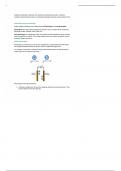
In the electrolytic cell Cl- ions moves toward the anode and H+ ions moves toward the
cathode.
Reactions:
At cathode: H+ + e- ------> H (Reduction) ; H + H ------> H2
-
At anode Cl ------> Cl + e (Oxidation) ; Cl + Cl ------> Cl 2
Short Note on Galvanic Cell
A galvanic cell, or voltaic cell, named after Luigi Galvani, or Alessandro Volta
respectively, is an electrochemical cell that derives electrical energy from spontaneous
redox reactions taking place within the cell. It generally consists of two different metals
connected by a salt bridge, or individual half-cells separated by a porous membrane.


