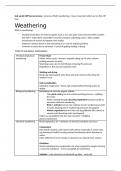
Sub-aerial/cliff face processes = process of both weathering + mass movement which act on the cliff
face
Weathering
What is weathering?
- Gradual break down of rocks by agents such as ice, salt, plant roots and acid which weaken
the cliffs + make them vulnerable to erosion (weaken underlying rocks + allow sudden
movements of erosion to happen more easily)
- Material is broken down in situ (remaining in or near its original position)
- Common at coast due to air/water + cycles of getting wetting + drying
TYPES OF SUB-AERIAL WEATHERING
Mechanical/physical Freeze-thaw
weathering Water enters cacks + freezes, expands taking up 9% extra volume
putting pressure on rocks
Warming causes ice to melt (thaw) removing the pressure
Repetition of this process weakens rocks
Wetting and drying
Rocks (eg clay) expand when they wet and contract when they dry –
weakens rock
Salt crystallisation
Saltwater evaporates + leaves salt crystals behind forcing cracks to
widen
Biological weathering Breakdown of rocks by organic activity
- Thin plant roots grow into cracks exerting pressure + splitting
the rocks
- Water running through decaying vegetation becomes acidic so
increases chemical weathering
- Birds + animals burrow into rockface (create weaknesses/cracks
in rocks allowing rest of weathering processes to happen)
- Marine organisms burrow into rock (eg piddocks (like clams) or
secrete acid dissolving rocks (eg limpets))
Makes as assumption that the rock has joints + bedding
planes/weaknesses
Chemical weathering Rocks exposed to air + moisture so chemical reactions can occur
Carbonation
Rain (weak carbonic acid) reacts with calcium carbonate in some rocks
(eg limestone/chalks) forming calcium bicarbonate which dissolves in
water
More effective in lower temps as rainwater can absorb more carbon
Oxidation
Rocks containing iron compounds rust when exposed to oxygen forming
a rusty red substance – more susceptible to weathering
Solution – rock minerals are dissolved (eg hlite – rock salt)
face
Weathering
What is weathering?
- Gradual break down of rocks by agents such as ice, salt, plant roots and acid which weaken
the cliffs + make them vulnerable to erosion (weaken underlying rocks + allow sudden
movements of erosion to happen more easily)
- Material is broken down in situ (remaining in or near its original position)
- Common at coast due to air/water + cycles of getting wetting + drying
TYPES OF SUB-AERIAL WEATHERING
Mechanical/physical Freeze-thaw
weathering Water enters cacks + freezes, expands taking up 9% extra volume
putting pressure on rocks
Warming causes ice to melt (thaw) removing the pressure
Repetition of this process weakens rocks
Wetting and drying
Rocks (eg clay) expand when they wet and contract when they dry –
weakens rock
Salt crystallisation
Saltwater evaporates + leaves salt crystals behind forcing cracks to
widen
Biological weathering Breakdown of rocks by organic activity
- Thin plant roots grow into cracks exerting pressure + splitting
the rocks
- Water running through decaying vegetation becomes acidic so
increases chemical weathering
- Birds + animals burrow into rockface (create weaknesses/cracks
in rocks allowing rest of weathering processes to happen)
- Marine organisms burrow into rock (eg piddocks (like clams) or
secrete acid dissolving rocks (eg limpets))
Makes as assumption that the rock has joints + bedding
planes/weaknesses
Chemical weathering Rocks exposed to air + moisture so chemical reactions can occur
Carbonation
Rain (weak carbonic acid) reacts with calcium carbonate in some rocks
(eg limestone/chalks) forming calcium bicarbonate which dissolves in
water
More effective in lower temps as rainwater can absorb more carbon
Oxidation
Rocks containing iron compounds rust when exposed to oxygen forming
a rusty red substance – more susceptible to weathering
Solution – rock minerals are dissolved (eg hlite – rock salt)