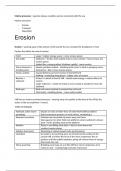
Marine processes = operate along a coastline and are connected with the sea
Marine processes
- Erosion
- Transport
- Deposition
Erosion
Erosion = wearing away of the surface of the land by the sea, includes the breakdown of rock
Factors that affect the rate of erosion
Fetch Larger = higher energy waves = more erosive power
Sea depth Shallower = friction with seabed reduces wave velocity + loses energy, less
erosive power
Seabed has a steep gradient (shallows rapidly) - more erosion
Wave steepness + Steeper gradient seabed – breaking point closer to land so plunging waves,
breaking point destructive = like to have erosive power
Human activity Coastal defences prevent erosion of land behind it
Walking + trampling along beach – higher rates of erosion
Beaches + If there’s a beach in front if cliff – absorb wave energy + reduce effects of
sediment erosion
Larger sediment – harder to erode as more energy is needed to move the
sediment
Rock type Hard rock more resistant to erosion than soft rock
More joints + bedding planes – more easily eroded
Cliff foot or marine erosional processes - wearing away of coastline at the base of the cliff by the
action of the sea (sediment + waves)
TYPES OF EROSION
Hydraulic action (wave Impact on rocks of sheer force of water itself (without debris)
pounding) Exerts enormous pressure on rock surface, weakening it
Abrasion (corrasion) Material sea has picked up wears away rock faces
Also apparent on inter-tidal rock platforms where sediment is drawn
back + forth, grinding away at the platform
Attrition Rocks in sea hitting each other + they’re worn down into
smaller/rounder pieces
Solution (corrosion) Dissolving of calcium-based rocks (eg limestone)
Cavitation Air pocks in an incoming wave are forced into the surface of the
coastal cliff, and then the force of the wave compresses the air
pockets until the bubble implodes, giving off various forms of energy
that erode the rock
Wave quarrying Breaking wave traps air as it hits cliff face, force compresses air in
cracks in rock – creating huge amounts of pressure
Marine processes
- Erosion
- Transport
- Deposition
Erosion
Erosion = wearing away of the surface of the land by the sea, includes the breakdown of rock
Factors that affect the rate of erosion
Fetch Larger = higher energy waves = more erosive power
Sea depth Shallower = friction with seabed reduces wave velocity + loses energy, less
erosive power
Seabed has a steep gradient (shallows rapidly) - more erosion
Wave steepness + Steeper gradient seabed – breaking point closer to land so plunging waves,
breaking point destructive = like to have erosive power
Human activity Coastal defences prevent erosion of land behind it
Walking + trampling along beach – higher rates of erosion
Beaches + If there’s a beach in front if cliff – absorb wave energy + reduce effects of
sediment erosion
Larger sediment – harder to erode as more energy is needed to move the
sediment
Rock type Hard rock more resistant to erosion than soft rock
More joints + bedding planes – more easily eroded
Cliff foot or marine erosional processes - wearing away of coastline at the base of the cliff by the
action of the sea (sediment + waves)
TYPES OF EROSION
Hydraulic action (wave Impact on rocks of sheer force of water itself (without debris)
pounding) Exerts enormous pressure on rock surface, weakening it
Abrasion (corrasion) Material sea has picked up wears away rock faces
Also apparent on inter-tidal rock platforms where sediment is drawn
back + forth, grinding away at the platform
Attrition Rocks in sea hitting each other + they’re worn down into
smaller/rounder pieces
Solution (corrosion) Dissolving of calcium-based rocks (eg limestone)
Cavitation Air pocks in an incoming wave are forced into the surface of the
coastal cliff, and then the force of the wave compresses the air
pockets until the bubble implodes, giving off various forms of energy
that erode the rock
Wave quarrying Breaking wave traps air as it hits cliff face, force compresses air in
cracks in rock – creating huge amounts of pressure