

3.2 Photosynthesis
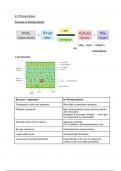
Overview of photosynthesis
* nCO2 + nH2O ⇾ n(CH2O) +
nO2
carbohydrate
Leaf structure
Structure / adaptation for Photosynthesis
Transparent cuticle and epidermis Allow light to penetrate mesophyll
Palisade mesophyll Main photosynthetic tissue, densely packed
with chloroplast
Elongated & arranged vertically ⇾ more light
to be absorbed by chloroplasts
Stomatal pores and air spaces Gaseous exchange
CO2 to diffuse to photosynthesising cells
Spongy mesophyll Chloroplasts for photosynthesis
Large surface area Increased light absorption
Leaves can orientate themselves Perpendicular to the sun to expose the
surface to as much light as possible
, Thin leaves Light penetrates to lower cell layers
Chloroplasts
Chloroplast structure
● Large SA and move within palisade
cells to maximise light absorption
● Thylakoids - membranes with flattened
fluid sacs
○ Stacked forming grana
● Thylakoid membrane - light-dependant
reaction
● Stroma - light-independent reaction
● Small DNA strands and ribosomes coding for & making proteins in the chloroplast
● Outer envelope membrane
Chloroplasts as transducers
● Transducer = converts energy from one form into another
○ Light energy ⇾ chemical energy
● Site of photosynthesis detected by Engelmann in 1887
● Experiment;
○ Shone light through prism to separate wavelengths
○ Exposed to algae with evenly distributed, motile, aerobic bacteria
○ After time the bacteria surrounded algae exposed to blue and red wavelengths
■ More photosynthesis → more O2 → attracting more bacteria
○ Concluded blue and red regions cause the most photosynthetic activity
Photosynthetic pigments
● Chlorophyll
○ Absorb light energy from red and blue-violet wavelengths
○ Molecular structure; head centred around Mg atom and long carbon chain tail
○ Chlorophyll a
■ Yellow-green coloured (reflect yellow-green wavelengths)
○ Chlorophyll b
■ Blue-green coloured (reflect blue-green wavelengths)
● Carotenoids
○ Absorb light energy from blue-violet region
○ β - carotene is orange
○ Xanthophyll is yellow
● Several different pigments - absorb more light energy over greater range of wavelengths
- more light energy for photosynthesis
Overview of photosynthesis
* nCO2 + nH2O ⇾ n(CH2O) +
nO2
carbohydrate
Leaf structure
Structure / adaptation for Photosynthesis
Transparent cuticle and epidermis Allow light to penetrate mesophyll
Palisade mesophyll Main photosynthetic tissue, densely packed
with chloroplast
Elongated & arranged vertically ⇾ more light
to be absorbed by chloroplasts
Stomatal pores and air spaces Gaseous exchange
CO2 to diffuse to photosynthesising cells
Spongy mesophyll Chloroplasts for photosynthesis
Large surface area Increased light absorption
Leaves can orientate themselves Perpendicular to the sun to expose the
surface to as much light as possible
, Thin leaves Light penetrates to lower cell layers
Chloroplasts
Chloroplast structure
● Large SA and move within palisade
cells to maximise light absorption
● Thylakoids - membranes with flattened
fluid sacs
○ Stacked forming grana
● Thylakoid membrane - light-dependant
reaction
● Stroma - light-independent reaction
● Small DNA strands and ribosomes coding for & making proteins in the chloroplast
● Outer envelope membrane
Chloroplasts as transducers
● Transducer = converts energy from one form into another
○ Light energy ⇾ chemical energy
● Site of photosynthesis detected by Engelmann in 1887
● Experiment;
○ Shone light through prism to separate wavelengths
○ Exposed to algae with evenly distributed, motile, aerobic bacteria
○ After time the bacteria surrounded algae exposed to blue and red wavelengths
■ More photosynthesis → more O2 → attracting more bacteria
○ Concluded blue and red regions cause the most photosynthetic activity
Photosynthetic pigments
● Chlorophyll
○ Absorb light energy from red and blue-violet wavelengths
○ Molecular structure; head centred around Mg atom and long carbon chain tail
○ Chlorophyll a
■ Yellow-green coloured (reflect yellow-green wavelengths)
○ Chlorophyll b
■ Blue-green coloured (reflect blue-green wavelengths)
● Carotenoids
○ Absorb light energy from blue-violet region
○ β - carotene is orange
○ Xanthophyll is yellow
● Several different pigments - absorb more light energy over greater range of wavelengths
- more light energy for photosynthesis


