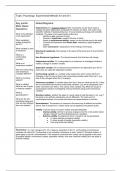
Topic: Psychology- Experimental Methods (IV and DV)
Key points/ Notes/Diagrams:
Main Ideas/
Experiments are a research method where conclusions can be drawn when a
Questions: variable has been deliberately manipulated to observe an effect. One of the most
scientific methods of studying behaviour, it has provided psychology with scientific
What is the definition credibility. The steps of an experimental method are:
of an experiment? - Identify an aim- purpose of study
- Develop a hypothesis- suggest outcome of study
What variable(s) - Select an experimental design- design on who will take part in the study
makes changes to - Conduct the experiment and collect data- collected by psychologists to
the DV? analyse
- Draw conclusions- explanations of the findings of the study.
What variable is used
to measure? Directional hypothesis- More people in the early 2010s were fans of One Direction
than now.
What is a
confounding Non-Directional hypothesis- The interest towards One Direction will change.
variable?
Independent variable- IV is manipulated by a researcher to investigate whether it
What is an makes a change to another variable.
extraneous variable?
Dependent variable- DV is measured and predicted to be dependent upon the IV,
How are confounding hence why it’s called the dependent variable.
and extraneous
variables different? Confounding variable- is a variable under supervision which varies with the IV.
Changes in the DV may be due to the confounding variable rather than the IV (e.g
What is mundane time of day changed when the IV changes).
realism?
Extraneous variables- A variable other than the IV that can influence the DV. If they
What is validity? are not controlled they become confounding variables. (e.g some participants have
What are the 3 types better memories than others. This natural, extra variable may affect the results of
of external validity? psychological research investigating memory therefore acting as the extraneous
variable).
What is
generalisation? Mundane realism- whether the tasks in a study relate to real life tasks or not. (e.g if
the study is too artificial, participants will act differently. The main point of
What are the two psychological studies is to provide info about how people behave in real life).
hypothesis types and
how are they different Generalisation- The tendency to respond in the same way to different but similar
from one another? stimuli. Also if results from a certain study can be applied to the general public.
Validity- involves issues of control, realism and generalisability.
- Internal validity: did the IV produce change to the DV or did another factor
change it instead? (confounding/extraneous variables)
- External validity: the degree to which a research can be generalised.
● To other settings (ecological validity)
● To other groups of people (population validity)
● Over time (historical validity)
Summary: IV- main change to DV. DV- measure, dependent to the IV. confounding and extraneous
variables can affect DV. Confounding is not controlled, extraneous is (also “natural”). Mundane realism- if
tasks apply to real life. Generalisation- if the research conducted from a study can be applied to the public.
Ecological validity- environment, people- population validity, over time- historical validity (all 3 are types of
external validity).
Key points/ Notes/Diagrams:
Main Ideas/
Experiments are a research method where conclusions can be drawn when a
Questions: variable has been deliberately manipulated to observe an effect. One of the most
scientific methods of studying behaviour, it has provided psychology with scientific
What is the definition credibility. The steps of an experimental method are:
of an experiment? - Identify an aim- purpose of study
- Develop a hypothesis- suggest outcome of study
What variable(s) - Select an experimental design- design on who will take part in the study
makes changes to - Conduct the experiment and collect data- collected by psychologists to
the DV? analyse
- Draw conclusions- explanations of the findings of the study.
What variable is used
to measure? Directional hypothesis- More people in the early 2010s were fans of One Direction
than now.
What is a
confounding Non-Directional hypothesis- The interest towards One Direction will change.
variable?
Independent variable- IV is manipulated by a researcher to investigate whether it
What is an makes a change to another variable.
extraneous variable?
Dependent variable- DV is measured and predicted to be dependent upon the IV,
How are confounding hence why it’s called the dependent variable.
and extraneous
variables different? Confounding variable- is a variable under supervision which varies with the IV.
Changes in the DV may be due to the confounding variable rather than the IV (e.g
What is mundane time of day changed when the IV changes).
realism?
Extraneous variables- A variable other than the IV that can influence the DV. If they
What is validity? are not controlled they become confounding variables. (e.g some participants have
What are the 3 types better memories than others. This natural, extra variable may affect the results of
of external validity? psychological research investigating memory therefore acting as the extraneous
variable).
What is
generalisation? Mundane realism- whether the tasks in a study relate to real life tasks or not. (e.g if
the study is too artificial, participants will act differently. The main point of
What are the two psychological studies is to provide info about how people behave in real life).
hypothesis types and
how are they different Generalisation- The tendency to respond in the same way to different but similar
from one another? stimuli. Also if results from a certain study can be applied to the general public.
Validity- involves issues of control, realism and generalisability.
- Internal validity: did the IV produce change to the DV or did another factor
change it instead? (confounding/extraneous variables)
- External validity: the degree to which a research can be generalised.
● To other settings (ecological validity)
● To other groups of people (population validity)
● Over time (historical validity)
Summary: IV- main change to DV. DV- measure, dependent to the IV. confounding and extraneous
variables can affect DV. Confounding is not controlled, extraneous is (also “natural”). Mundane realism- if
tasks apply to real life. Generalisation- if the research conducted from a study can be applied to the public.
Ecological validity- environment, people- population validity, over time- historical validity (all 3 are types of
external validity).