Topic: Psychology- Sampling
Key points/ Notes/Diagrams:
Main Ideas/
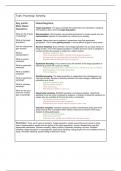
Target population- The group of people the researchers are interested in studying.
Questions: The sample is drawn from the target population.
What are the 5 types Representation- Psychologists use sampling techniques to choose people who are
of sampling? representative (typical) of a population as a whole (e.g a sample).
What is the target Access- Before data can be gathered, researchers must find appropriate
population? participants. This is called gaining access. It can be difficult to gain in some areas.
How do researchers Random Sampling- Every member of the target population has an equal chance of
gain access? being chosen. A list of the target population is created and each name is assigned a
number and then the sample is created by a lottery method.
What is - Reduces researcher bias.
representation? - Time consuming to obtain a full list of the target population.
- Sample may be unrepresentative because of random selection.
What is random - People invited to take part may not respond.
sampling?
Systematic Sampling- This is where every nth member of the target population is
What is systematic selected (e.g every 5th house of a street).
sampling? - Reduces researcher bias- researcher has no influence of who is selected.
- Representative of the target population.
What is stratified - Time consuming.
sampling?
Stratified sampling- The target population is categorised into subcategories (e.g
What is opportunity male and female). Sample is randomly selected from each category reflecting the
sampling? population as a whole.
- Reduces researcher bias.
What is volunteer - Representative sample.
sampling? - Time consuming.
- Not always possible to carry out.
What are the pros
and cons of each Opportunity sampling- Stratified sampling is not always possible. Opportunity
type of sampling? sampling is the one most conducted by students. It consists of taking the sample from
people who are available at the time the study is conducted.
- Convenient and time efficient.
- Unrepresentative of target population.
- Researchers can choose specific people to ask- bias.
Volunteer sampling- Volunteer sampling consists of participants being part of the
study because they volunteered when asked or they saw an advert of the study.
Sample of willing participants.
- Easy to collect participants
- Less time consuming
- Volunteer bias- people more helpful than average people.
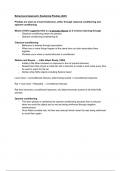
Summary: There are 5 types of sampling. Target population- people researchers are curious to study
about. Representation- people who are typical of the whole population. Access- Researchers must find
appropriate participants. Random sampling- lottery method, Systematic sampling- nth term, Stratified
sampling- target population in subcategories, Opportunity sampling- taking people who are available at time of
study, Volunteer sampling- people willing to take part in study.
Key points/ Notes/Diagrams:
Main Ideas/
Target population- The group of people the researchers are interested in studying.
Questions: The sample is drawn from the target population.
What are the 5 types Representation- Psychologists use sampling techniques to choose people who are
of sampling? representative (typical) of a population as a whole (e.g a sample).
What is the target Access- Before data can be gathered, researchers must find appropriate
population? participants. This is called gaining access. It can be difficult to gain in some areas.
How do researchers Random Sampling- Every member of the target population has an equal chance of
gain access? being chosen. A list of the target population is created and each name is assigned a
number and then the sample is created by a lottery method.
What is - Reduces researcher bias.
representation? - Time consuming to obtain a full list of the target population.
- Sample may be unrepresentative because of random selection.
What is random - People invited to take part may not respond.
sampling?
Systematic Sampling- This is where every nth member of the target population is
What is systematic selected (e.g every 5th house of a street).
sampling? - Reduces researcher bias- researcher has no influence of who is selected.
- Representative of the target population.
What is stratified - Time consuming.
sampling?
Stratified sampling- The target population is categorised into subcategories (e.g
What is opportunity male and female). Sample is randomly selected from each category reflecting the
sampling? population as a whole.
- Reduces researcher bias.
What is volunteer - Representative sample.
sampling? - Time consuming.
- Not always possible to carry out.
What are the pros
and cons of each Opportunity sampling- Stratified sampling is not always possible. Opportunity
type of sampling? sampling is the one most conducted by students. It consists of taking the sample from
people who are available at the time the study is conducted.
- Convenient and time efficient.
- Unrepresentative of target population.
- Researchers can choose specific people to ask- bias.
Volunteer sampling- Volunteer sampling consists of participants being part of the
study because they volunteered when asked or they saw an advert of the study.
Sample of willing participants.
- Easy to collect participants
- Less time consuming
- Volunteer bias- people more helpful than average people.
Summary: There are 5 types of sampling. Target population- people researchers are curious to study
about. Representation- people who are typical of the whole population. Access- Researchers must find
appropriate participants. Random sampling- lottery method, Systematic sampling- nth term, Stratified
sampling- target population in subcategories, Opportunity sampling- taking people who are available at time of
study, Volunteer sampling- people willing to take part in study.