HPNA ACHPN Test 100% Correct solved
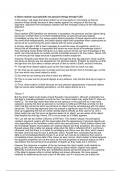
HPNA ACHPN Test 100% Correct solved 1. Which of the following is one of the four elements of the best standard for assessing capacity? A. Mini-Mental Status Examination B. Repeat back method C. Ability to communicate choice D. Ability to read and write Chapter 1 - Correct Answer ️️ -C. Ability to communicate choice Standards for assessing capacity may vary from state to state but generally are based on four elements. Patients must have the ability to: (1) understand the relevant information about proposed diagnostic tests and treatment, (2) appreciate their situation with respect to their underlying values and current medical condition, (3) use reason to make a decision, and (4) communicate their choice. 2. In the absence of advance directives, which answer best demonstrates substituted judgment? A. The surrogate expresses the patient's wishes and values. B. The surrogate makes a decision based on what is in the best interest. C. The surrogate makes a shared decision with other family members. D. The surrogate makes a decision based on his/her own values. Chapter 1 - Correct Answer ️️ -A. The surrogate expresses the patient's wishes and values. When a patient lacks capacity and does not have advance directives for preferred health care within the context of the serious illness, substituted judgment is needed. It can best be determined by the APRN asking the surrogate decision maker what the patient would have wanted if he/she could communicate 3. What is an important first step in the advance care planning? A. Inquire who is the healthcare surrogate or power of attorney (POA). B. Be aware of the patient's comfort. C. Ask the patient about his/her values and preferences. D. Establish common terms to ensure understanding. Chapter 1 - Correct Answer ️️ -D. Establish common terms to ensure understanding. Inquiries about advance care planning are necessary and part of the comprehensive assessment. The assessment starts with establishing common terms to ensure understanding of medical terminology associated with end of life. 4. In the nursing process, which of the following is an example of a systematic analysis and interpretation of subjective and objective data? A. Assessment B. Diagnosis C. Outcomes identification D. Planning Chapter 1 - Correct Answer ️️ -B. Diagnosis The APRN formulates the palliative care differential diagnosis by systematically analyzing, comparing, and interpreting diagnostic data with normal standards, once the chief complaint, history, and physical examination have been established. 5. Which of the following is NOT a goal of palliative sedation at end of life? A. Hasten death B. Induce unconsciousness C. Relieve distressing symptoms D. Alleviate intractable pain Chapter 1 - Correct Answer ️️ -A. Hasten death Palliative sedation is used to relieve intractable symptoms in terminal illness. It is performed by administering doses of pharmacotherapies to induce unconsciousness while relieving distressing symptoms and intractable pain. Prior to initiating, the APRN follows organizational policies and procedures for palliative sedation, which includes discussing the procedure with patient and family, including expected outcomes, the possibility of death, and informed consent. 6. When the APRN participates in end of life discussions prior to withdrawal of life sustaining therapies, which intervention is a priority before extubation? A. Pre-medicate the patient to prevent pain. B. Arrange a family meeting to prepare the family for possible outcomes. C. Encourage family members to stay at bedside. D. Offer spiritual support. Chapter 1 - Correct Answer ️️ -B. Arrange family meeting to prepare family for possible outcomes. Withdrawal of the ventilator is an option for patients with prolonged mechanical ventilation when all attempts at weaning have failed, and it is deemed futile to continue the therapy. Prior to extubation, arrange a family meeting to prepare them for possible outcomes and to determine the family's desired level of involvement and religious preferences and rituals. Opioids are initiated at signs of distress, starting low and titrating slowly. Premedication or medication during and following withdrawal of mechanical ventilation with opioids and benzodiazepines is useful if the patient is experiencing distress before withdrawal. 7. When deactivating a left ventricular assist device (LVAD) at the end of life, which action is an initial priority? A. Facilitate communication with the patient, family, and attending provider/cardiologist. B. Facilitate deactivation of LVAD with the device company. C. Facilitate spiritual support. D. Check advance directives to confirm patient's wishes. Chapter 1 - Correct Answer ️️ -A. Facilitate communication with patient, family, and attending provider/cardiologist. Patients with decision-making capacity and their surrogate can request deactivation of LVAD when it is considered burdensome or no longer beneficial. Priorities for the APRN include effective communication with the patient and family in the presence of the attending provider/cardiologist and in coordination with the interdisciplinar
Written for
- Institution
- HPNA ACHPN
- Module
- HPNA ACHPN
Document information
- Uploaded on
- May 29, 2024
- Number of pages
- 276
- Written in
- 2023/2024
- Type
- Exam (elaborations)
- Contains
- Questions & answers
Subjects
-
hpna achpn test 100 correct solved