Topic 12.1: Atomic structure – Electrons in atom
The quantized nature of energy transitions is related to the energy states of electrons in atoms and molecules.
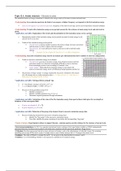
• Understanding: In an emission spectrum, the limit of convergence at higher frequency corresponds to the first ionization energy.
▪ Limit of convergence in an emission spectrum: frequency of the limit of converge can be used to determine ionization enthalpy.
• Understanding: Trends in first ionization energy across periods account for the existence of main energy levels and sub-levels in
atoms.
• Applications and skills: Explanation of the trends and discontinuities in first ionization energy across a period.
▪ Discontinuity trends in first ionization energy across periods accounts for main energy levels
and sub-levels in an atom
▪ Trends in first ionization energy across period
• Overall trend: as atomic number increases, the nuclear charge increases and atomic
radii decreases to attract valence electrons stronger
• Discontinuity: it is more difficult to remove electrons in full or half-full stable
orbitals
▪ Example: Be has a higher IE than B as 2s2 is a stable arrangement
• Understanding: Successive ionization energy data for an element give information that shows relations to electron configurations.
▪ Trends in successive ionization energy of an element
• Overall trend: successive ionization energy of an element increases with the
ionization number as it becomes increasingly difficult to remove electrons
from increasingly positive ions according to Coulomb’s law
• Large “jumps”: large jump from ionization energy is associated with
removal of electrons energy levels of different principal quantum number (n)
▪ The presence of large “jumps” in energy required for successive ionization is the reason
why all elements have a stable ionization state (i.e. Ti does not have a +5 state due to a
large jump in IE going from IE4 to IE5)
• Applications and skills: Solving problems using 𝐸 = ℎ𝑣.
▪ 𝐸 = ℎ𝑣 (Plank’s constant | h=6.626 x 10⁻³⁴ J s)
▪ 𝑐 = 𝑣𝜆 (Speed of light | c=2.998 x 10⁸ m s-1)
▪ Process of solving problems using E=hv
▪ Identify constants h, c
▪ Identify available parameter (e.g. E, h or c)
▪ Determine required parameter through substitution
• Applications and skills: Calculation of the value of the first ionization energy from spectral data which gives the wavelength or
frequency of the convergence limit.
ℎ𝑐
▪ If given wavelength (𝜆): 𝐸 =
𝜆
▪ If given frequency (v): 𝐸 = ℎ𝑣
• Applications and skills: Deduction of the group of an element from its successive ionization energy data.
▪ Process of deducing element from successive ionization energy data
• Identify the “big jumps” in the successive ionization energy
• From that, identify the group consisting of ions before the corresponding “big jump”
• Nature of science: Experimental evidence to support theories—emission spectra provide evidence for the existence of energy levels.
• International-mindedness: In 2012 two separate international teams working at the Large Hadron Collider at CERN independently
announced that they had discovered a particle with behaviour consistent with the previously predicted “Higgs boson”.
• Utilization: Electron microscopy has led to many advances in biology, such as the ultrastructure of cells and viruses. The scanning
tunnelling microscope (STM) uses a stylus of a single atom to scan a surface and provide a 3-D image at the atomic level.
• Guidance: The value of Planck’s constant (h) and 𝐸 = ℎ𝑣 are given in the data booklet in sections 1 and 2.
• Guidance: Use of the Rydberg formula is not expected in calculations of ionization energy.