
Paper 1 2023
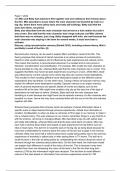
Q5) Milo and Betty had watched a film together and were talking to their friends about
the film. Milo described a scene where the main character had travelled by train to a
big city, where there were yellow taxis and really tall buildings. Betty said that the
taxis were black, not yellow.
Betty also described how the main character had arrived at a train station but said it
was a town. She said that the main character had a large suitcase, but Milo claimed
that there was no suitcase, just a bag. Betty disagreed with milo, she said because the
main character was staying in the town for several weeks, it must have been a
suitcase.
Discuss, using reconstructive memory (Barlett,1932), including schema theory, Milo’s
and Betty’s recall of the film. (8)
Reconstructive memory can be used to explain Milo’s and Bety’s recall of the film. This
theory proposes that retrieval of stored memories is an active process of reconstruction
based on what usually happens and is influenced by past experiences and cultural norms.
This means that memory is reconstructed whenever it is recalled and is more prone to
distortion, transformation and simplification. For example, Milo recalls the main character as
having travelled to a big city, whereas Betty said that the main character was in a town. This
suggests that Betty may have had past experiences occurring in a town, whilst Milo’s recall
was influenced by current cultural norms where big cities are common travel destinations.
This resulted in them recalling different travel destinations based on the different cultural
expectations they had before. On the other hand, Tulving’s theory of long term memory may
explain the different travel destinations recalled. Episodic memory is an explicit memory
store of personal experiences and specific details of events and objects such as the
emotions felt at the time. Milo might have recalled a big city as this was one of the type of
destinations he had been to before. Similarly, Betty said that the main character was
travelling to a town because she might have had an episodic memory of a film character who
travelled to a town, hence she may have confused them with the one in the film she watched
together with Milo.
Schema theory proposes that schemas which are packers of stored information about a
specific event or object learned through previous experiences, dictate how information is
recalled. Confabulation is when we draw on schemas to fill in gaps in our memory to make it
into a coherent story. This puts pressure on our mind to remember things in a way that fits in
with the schema, removing or changing details. Milo described a big city with yellow taxis
and really tall buildings, whereas Betty said that the taxis were black not yellow. Milo may
have had a schema about black taxis based on past experiences he had before such as
rides in black taxis. This led him to recall the taxis in the big city as being black because he
may have confabulated his memory about the colour of the taxi due to gaps in his memory.
Likewise, Betty may have had a schema about taxis usually being yellow due to her previous
experiences of travelling in yellow taxis or often seeing them in TV shows. This led her to
recall the taxis in the town as being yellow by confabulating her memory about the colour of
the taxis through her schemas about yellow taxis. On the other hand, the multi-store model
can explain their difference in recall of the colour of the taxi. This is because it may have
resulted from them not rehearsing the colour of the taxis in the film into their long term
memory (LTM) as this information might have decayed. This led them to recall different
colours of the taxis based on information from previous experiences stored in LTM.
Q5) Milo and Betty had watched a film together and were talking to their friends about
the film. Milo described a scene where the main character had travelled by train to a
big city, where there were yellow taxis and really tall buildings. Betty said that the
taxis were black, not yellow.
Betty also described how the main character had arrived at a train station but said it
was a town. She said that the main character had a large suitcase, but Milo claimed
that there was no suitcase, just a bag. Betty disagreed with milo, she said because the
main character was staying in the town for several weeks, it must have been a
suitcase.
Discuss, using reconstructive memory (Barlett,1932), including schema theory, Milo’s
and Betty’s recall of the film. (8)
Reconstructive memory can be used to explain Milo’s and Bety’s recall of the film. This
theory proposes that retrieval of stored memories is an active process of reconstruction
based on what usually happens and is influenced by past experiences and cultural norms.
This means that memory is reconstructed whenever it is recalled and is more prone to
distortion, transformation and simplification. For example, Milo recalls the main character as
having travelled to a big city, whereas Betty said that the main character was in a town. This
suggests that Betty may have had past experiences occurring in a town, whilst Milo’s recall
was influenced by current cultural norms where big cities are common travel destinations.
This resulted in them recalling different travel destinations based on the different cultural
expectations they had before. On the other hand, Tulving’s theory of long term memory may
explain the different travel destinations recalled. Episodic memory is an explicit memory
store of personal experiences and specific details of events and objects such as the
emotions felt at the time. Milo might have recalled a big city as this was one of the type of
destinations he had been to before. Similarly, Betty said that the main character was
travelling to a town because she might have had an episodic memory of a film character who
travelled to a town, hence she may have confused them with the one in the film she watched
together with Milo.
Schema theory proposes that schemas which are packers of stored information about a
specific event or object learned through previous experiences, dictate how information is
recalled. Confabulation is when we draw on schemas to fill in gaps in our memory to make it
into a coherent story. This puts pressure on our mind to remember things in a way that fits in
with the schema, removing or changing details. Milo described a big city with yellow taxis
and really tall buildings, whereas Betty said that the taxis were black not yellow. Milo may
have had a schema about black taxis based on past experiences he had before such as
rides in black taxis. This led him to recall the taxis in the big city as being black because he
may have confabulated his memory about the colour of the taxi due to gaps in his memory.
Likewise, Betty may have had a schema about taxis usually being yellow due to her previous
experiences of travelling in yellow taxis or often seeing them in TV shows. This led her to
recall the taxis in the town as being yellow by confabulating her memory about the colour of
the taxis through her schemas about yellow taxis. On the other hand, the multi-store model
can explain their difference in recall of the colour of the taxi. This is because it may have
resulted from them not rehearsing the colour of the taxis in the film into their long term
memory (LTM) as this information might have decayed. This led them to recall different
colours of the taxis based on information from previous experiences stored in LTM.


