

Chapter 3 - Interdependence and the Gains from Trade
The Parabble for the Modern Economy
Production Possibilities
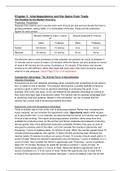
Suppose that a farmer and a rancher each work 8 hours per day and can devote this time to
growing potatoes, raising cattle, or a combination of the two. These are the production
figures for each person:
Minutes needed to make 1 ounce Amount produced in 8 hours
of:
Meat Potatoes Meat Potatoes
Farmer 60 min/oz 15 min/oz 8 oz 32 oz
Rancher 20 min/oz 10 min/oz 24 oz 48 oz
The Rancher who is more productive in both activities can produce an ounce of potatoes in
10 minutes and an ounce of meat in 20 minutes, while the farmer can only produce an ounce
of meat in 60 minutes and an ounce of potatoes in 15 minutes. If the farmer and rancher
choose to be self-sufficient, rather than trade with each other, then each consumer exactly
what he or she produces. Check Page 50 for a full explanation.
Comparative Advantage: The Driving Force of Specialization
Absolute Advantage
Economist use the term absolute advantage when comparing the productivity of one person,
firm, or nation to that of another. The producer that requires a smaller quantity of inputs to
produce a good is said to have an absolute advantage in producing that good. In our
example, time is the only input, so we can determine the absolute advantage by looking at
how much time each type of production takes. The rancher has an absolute advantage both
in producing meat and potatoes. Based on this information, we can conclude that the
rancher has a lower cost of producing potatoes and meat.
Opportunity Cost and Comparative Advantage
There is another way to look at the cost of producing potatoes. Rather than comparing the
inputs required, we can compare the opportunity costs. Opportunity cost is what we give
up to get another item. In our example, we assumed that the farmer and rancher each spend
8 hours a day working. Time spent producing potatoes, therefore, takes away from time
available for producing meat. As the rancher and farmer reallocate time between producing
the two goods, they move along their production possibility frontiers; they give up units of
one good to produce units of the other. Let’s first consider the rancher’s opportunity cost.
Producing 1 ounce of potatoes takes 10 minutes of work. When the rancher spends those 10
minutes producing potatoes, she spends 10 fewer minutes producing meat. Because the
rancher needs 20 minutes to produce an ounce of meat, 10 minutes of work would yield a ½
ounce of meat. Hence the rancher's opportunity cost of producing 1 ounce of potatoes is a ½
ounce of meat. Now consider the farmer's opportunity cost. Producing 1 ounce of potatoes
takes him 15 minutes. Because he needs 60 minutes to produce 1 ounce of meat, 15
minutes of work would yield a ¼ ounce of meat. Hence the farmer's opportunity cost of 1
ounce of potatoes is a ¼ of an ounce of meat. Notice the opportunity cost of meat is the
inverse of the opportunity cost of potatoes. Because 1 ounce of potatoes costs the rancher
The Parabble for the Modern Economy
Production Possibilities
Suppose that a farmer and a rancher each work 8 hours per day and can devote this time to
growing potatoes, raising cattle, or a combination of the two. These are the production
figures for each person:
Minutes needed to make 1 ounce Amount produced in 8 hours
of:
Meat Potatoes Meat Potatoes
Farmer 60 min/oz 15 min/oz 8 oz 32 oz
Rancher 20 min/oz 10 min/oz 24 oz 48 oz
The Rancher who is more productive in both activities can produce an ounce of potatoes in
10 minutes and an ounce of meat in 20 minutes, while the farmer can only produce an ounce
of meat in 60 minutes and an ounce of potatoes in 15 minutes. If the farmer and rancher
choose to be self-sufficient, rather than trade with each other, then each consumer exactly
what he or she produces. Check Page 50 for a full explanation.
Comparative Advantage: The Driving Force of Specialization
Absolute Advantage
Economist use the term absolute advantage when comparing the productivity of one person,
firm, or nation to that of another. The producer that requires a smaller quantity of inputs to
produce a good is said to have an absolute advantage in producing that good. In our
example, time is the only input, so we can determine the absolute advantage by looking at
how much time each type of production takes. The rancher has an absolute advantage both
in producing meat and potatoes. Based on this information, we can conclude that the
rancher has a lower cost of producing potatoes and meat.
Opportunity Cost and Comparative Advantage
There is another way to look at the cost of producing potatoes. Rather than comparing the
inputs required, we can compare the opportunity costs. Opportunity cost is what we give
up to get another item. In our example, we assumed that the farmer and rancher each spend
8 hours a day working. Time spent producing potatoes, therefore, takes away from time
available for producing meat. As the rancher and farmer reallocate time between producing
the two goods, they move along their production possibility frontiers; they give up units of
one good to produce units of the other. Let’s first consider the rancher’s opportunity cost.
Producing 1 ounce of potatoes takes 10 minutes of work. When the rancher spends those 10
minutes producing potatoes, she spends 10 fewer minutes producing meat. Because the
rancher needs 20 minutes to produce an ounce of meat, 10 minutes of work would yield a ½
ounce of meat. Hence the rancher's opportunity cost of producing 1 ounce of potatoes is a ½
ounce of meat. Now consider the farmer's opportunity cost. Producing 1 ounce of potatoes
takes him 15 minutes. Because he needs 60 minutes to produce 1 ounce of meat, 15
minutes of work would yield a ¼ ounce of meat. Hence the farmer's opportunity cost of 1
ounce of potatoes is a ¼ of an ounce of meat. Notice the opportunity cost of meat is the
inverse of the opportunity cost of potatoes. Because 1 ounce of potatoes costs the rancher



