Betsy Edwards
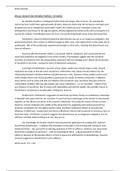
Discuss research into infradian rhythms. (16 marks)
An infradian rhythm is a biological rhythm that lasts longer than 24 hours, for example the
menstrual cycle (which lasts approximately 28 days). Research shows that the hormones oestrogen and
progesterone act as endogenous pacemakers within the menstrual cycle; oestrogen causes the
development and release of the egg (ovulation), whilst progesterone thickens the uterus to prepare it to
receive the embryo. If fertilisation does not occur, the womb lining breaks away as the menstrual flow.
McClintock’s research demonstrated that pheromones may act as an exogenous zeitgebers. She
gained pheromones from women at different stages of their cycle, and rubbed them on the upper lips of
participants. 68% of the participants experienced changes to their cycle, showing that pheromones may
have an influence.
Seasonal affective disorder (SAD) is a circannual rhythm. Symptoms such as persistently low
mood and anhedonia are triggered in the winter months. Psychologists suggest that the increased
secretion of melatonin from the pineal glands associated with less daylight hours affects the production
of serotonin in the brain, causing the onset of depressive symptoms.
A strength of McClintock’s research is that similar studies have found similar results. Russell
replicated the study to find the same conclusions, whilst Mora and Cabrera found evidence for the
relationship between infradian rhythms and pheromones in rats. However, these studies involve such
small samples that it may not be possible to generalise the results to women universally. In addition,
many factors such as stress and diet can influence the menstrual cycle, and these may have acted as
confounding variables; this may also explain why some replications – i.e. by Trevathan – failed to find
any evidence of synchrony. Due to issues with replicability and internal validity, the scientific nature of
McClintock’s conclusions is questionable, limiting the research.
Furthermore, McClintock’s suggestion of menstrual synchrony having an evolutionary advantage
is disputed. She argues that for our ancestors it may have been advantageous for women to menstruate
together, as this allows new-borns to be cared for collectively, increasing the chance of their survival.
However, Schank challenges the validity of this perspective by suggesting that menstrual synchrony
produces competition for the highest quality males, therefore limiting the fitness of any potential
offspring. Furthermore, raising many new-borns collectively may put extra pressure on resources such as
food and water. McClintock’s research suggests that pheromones act as exogenous zeitgebers, but we
still have a limited understanding as to why this occurs.
Our knowledge of infradian rhythms has had practical applications to treating SAD. Eastman
found that phototherapy – a lightbox that stimulates strong light in the morning and evening to reset
melatonin levels – was successful at relieving symptoms in 60% of sufferers. However, the same study
found that a negative ion generator – with no physiological effect – relived symptoms in 30% of
sufferers. Because of the placebo effect it is hard to assess the effectiveness of phototherapy, however
research suggests it is beneficial for some sufferers.
Word count: 175 + 307
Discuss research into infradian rhythms. (16 marks)
An infradian rhythm is a biological rhythm that lasts longer than 24 hours, for example the
menstrual cycle (which lasts approximately 28 days). Research shows that the hormones oestrogen and
progesterone act as endogenous pacemakers within the menstrual cycle; oestrogen causes the
development and release of the egg (ovulation), whilst progesterone thickens the uterus to prepare it to
receive the embryo. If fertilisation does not occur, the womb lining breaks away as the menstrual flow.
McClintock’s research demonstrated that pheromones may act as an exogenous zeitgebers. She
gained pheromones from women at different stages of their cycle, and rubbed them on the upper lips of
participants. 68% of the participants experienced changes to their cycle, showing that pheromones may
have an influence.
Seasonal affective disorder (SAD) is a circannual rhythm. Symptoms such as persistently low
mood and anhedonia are triggered in the winter months. Psychologists suggest that the increased
secretion of melatonin from the pineal glands associated with less daylight hours affects the production
of serotonin in the brain, causing the onset of depressive symptoms.
A strength of McClintock’s research is that similar studies have found similar results. Russell
replicated the study to find the same conclusions, whilst Mora and Cabrera found evidence for the
relationship between infradian rhythms and pheromones in rats. However, these studies involve such
small samples that it may not be possible to generalise the results to women universally. In addition,
many factors such as stress and diet can influence the menstrual cycle, and these may have acted as
confounding variables; this may also explain why some replications – i.e. by Trevathan – failed to find
any evidence of synchrony. Due to issues with replicability and internal validity, the scientific nature of
McClintock’s conclusions is questionable, limiting the research.
Furthermore, McClintock’s suggestion of menstrual synchrony having an evolutionary advantage
is disputed. She argues that for our ancestors it may have been advantageous for women to menstruate
together, as this allows new-borns to be cared for collectively, increasing the chance of their survival.
However, Schank challenges the validity of this perspective by suggesting that menstrual synchrony
produces competition for the highest quality males, therefore limiting the fitness of any potential
offspring. Furthermore, raising many new-borns collectively may put extra pressure on resources such as
food and water. McClintock’s research suggests that pheromones act as exogenous zeitgebers, but we
still have a limited understanding as to why this occurs.
Our knowledge of infradian rhythms has had practical applications to treating SAD. Eastman
found that phototherapy – a lightbox that stimulates strong light in the morning and evening to reset
melatonin levels – was successful at relieving symptoms in 60% of sufferers. However, the same study
found that a negative ion generator – with no physiological effect – relived symptoms in 30% of
sufferers. Because of the placebo effect it is hard to assess the effectiveness of phototherapy, however
research suggests it is beneficial for some sufferers.
Word count: 175 + 307