

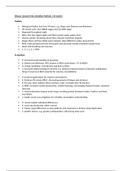
Discuss research into ultradian rhythms. (16 marks)
Outline:
Biological rhythm, less than 24 hours, e.g. sleep cycle (Dement and Kleitman)
90 minute cycle, four NREM stages and one REM stage
Repeated throughout night
EEGs, first two stages (alpha and theta waves) easily woken from
Muscle activity, breathing, blood flow reduced, heartbeat irregular
Stages three and four (delta waves) deeper sleep difficult to wake, sleep inertia
REM: body paralysed yet eye movement fast and brain activity resembles awake brain
Heart and breathing rate increase
1, 2, 3, 4, 3, 2, REM
Evaluation:
P: increased understanding of dreaming
E: Dement and Kleitman, 90% awoken in REM recall dream, 7% in NREM
A: strong correlation, vivid dreams and brain activity
L: increased understanding of memory, e.g. Dement proposes theory of dynamic stabilisation,
firing of neurons in REM essential for memory consolidation
P: practical applications for workers and students
E: Kleitman 90 minute BRAC, alternating periods of fatigue and alertness
E: Ericsson, best violinists three practices a day, no longer than 90 minutes
A: BRAC increases worker productivity, student learning, encouraging frequent breaks, maximise
alertness
C: many professions impose much longer working periods between breaks, rhythms not fixed,
overridden
L: implies social cues zeitgebers for ultradian, incomplete understanding
P: cannot explain individual differences
E: some nap during day, others cannot
E: Tucker, large differences in sleep patterns and responses to 36 hour sleep deprivation
L: another factors, e.g. genetic predisposition, influencing sleep cycle
Outline:
Biological rhythm, less than 24 hours, e.g. sleep cycle (Dement and Kleitman)
90 minute cycle, four NREM stages and one REM stage
Repeated throughout night
EEGs, first two stages (alpha and theta waves) easily woken from
Muscle activity, breathing, blood flow reduced, heartbeat irregular
Stages three and four (delta waves) deeper sleep difficult to wake, sleep inertia
REM: body paralysed yet eye movement fast and brain activity resembles awake brain
Heart and breathing rate increase
1, 2, 3, 4, 3, 2, REM
Evaluation:
P: increased understanding of dreaming
E: Dement and Kleitman, 90% awoken in REM recall dream, 7% in NREM
A: strong correlation, vivid dreams and brain activity
L: increased understanding of memory, e.g. Dement proposes theory of dynamic stabilisation,
firing of neurons in REM essential for memory consolidation
P: practical applications for workers and students
E: Kleitman 90 minute BRAC, alternating periods of fatigue and alertness
E: Ericsson, best violinists three practices a day, no longer than 90 minutes
A: BRAC increases worker productivity, student learning, encouraging frequent breaks, maximise
alertness
C: many professions impose much longer working periods between breaks, rhythms not fixed,
overridden
L: implies social cues zeitgebers for ultradian, incomplete understanding
P: cannot explain individual differences
E: some nap during day, others cannot
E: Tucker, large differences in sleep patterns and responses to 36 hour sleep deprivation
L: another factors, e.g. genetic predisposition, influencing sleep cycle


