

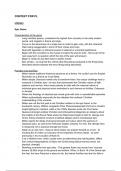
CONTEXT FOR PL
Literary
Epic Genre
Characteristics of the genre
- Long narrative poems, considered the highest form of poetry in the early modern
period, and majestic in theme and style.
- Focus on the adventures of a single hero in order to gain unity, with this character
often being exaggerated in terms of their virtues and vices.
- Deal with legendary or historical events of national or universal significance.
- Begin with the invocation to the muses to inspire the poet to write - this is part of the
‘epic argument’ (a question which the rest of the epic will answer).
- Begin in media res but flash back to earlier events
- Epic similes - so long that the vehicle (the thing being compared to the thing being
described) almost eclipses the tenor (thing being described).
Paradise Lost and Epic
- Milton rejects traditional historical adventure as a theme. He couldn't use the English
Revolution as a theme as it had failed.
- Milton adopts Classical models only to transform them. His unique challenge was to
compose a Christian epic—an epic that represented the Christian values of faith,
patience and service, which were patently at odds with the classical values of
individual glory and physical action embodied in such heroes as Achilles, Odysseus
or Aeneas.
- Where the theology of classical epic mixed gods with men in unpredictable episodes,
Milton systematically expounds the key debates that underpin Christian
understanding of the universe
- Milton was not the first poet to set Christian matters in the epic frame: in the
fourteenth century, William Langland's Piers Plowmanpresented Christ as a chivalric
knight fighting for mankind, while in the 1590s Spenser wrote into The Faerie
Queene (amongst endless Christian and philosophical allegories) an allegory about
the knights of the Round Table where the Redcrosse Knight is both St. George and
Christ, linking medieval romance to biblical allegory and to neoclassical epic.
- Milton rejects the ideals of physical strength and valour which the warriors of
Classical epics, as well as the Arthurian knights, embody. For him, the ultimate hero
is measured not in physical strength but moral.
- Satan as an epic hero - Ease at which Satan can present himself as a hero - M
mocking this to make us conscious of the emptiness of heroic ideals - as seen
previously in his invocation of Book IX.
- S as a Hellenic hero, which usually seen as determined and individualistic, differs
from critical interpretations of Adam and Christ being biblical heroes (moral, not
physical, strength)
- Rewriting moments from epic tales - The garland Adam has woven from 'choicest
flowers' (9.840) drops to the ground and withers. When, in Book 18 of the Greek epic
the Iliad, the hero Patroclus is about to die, the helmet Achilles has lent him falls to
, the dust. Milton echoes this moment, but Adam's demise is not caused by his desire
to kill more warriors and gain more glory. Like Eve, he acts out of love.
Pastoral Genre
- History of the pastoral poem - the Bible and Classical Texts:
- Celebrating rural life through the figures of shepherds and herdsmen.
- Engage with ethics, political uncertainties and religion.
- Using the pastoral world to comment obliquely on contemporary events.
- Concept of the idyllic landscape being permeated by violence.
- Pastoral poetry - Spenser’s The Faerie Queene combined lyrical pastoral laments for
lost love with satires on the Church, corruption etc. - influenced Milton’s Lycidas.
- In 17th century poetry, the pagan and Christian worlds are combined to view the
garden and countryside in moral terms. There is ambivalence in Marvell’s garden - it
is a place of repose where man may find his best thoughts, but also evidence of
man’s fallen nature and corrupt ambition.
- The word ‘paradise’ itself derives from an ancient Persian word meaning a walled
garden - enclosed space under attack.
Tragic genre
- Satan as a tragic hero
Petrarchan lover
- Suffers from unrequited love, loves from afar
- Idealises - falls in love with an ideal, a vision of perfection, rather than a human being
with strengths and weaknesses
- Idolizes - turns the lover into an idol, object of worship, puts the lover on a pedestal,
worships her from afar, compares her to a goddess or something holy
- Not true love, but infatuation - in love with the idea of love rather than a real person,
in love with longing rather than having
- Not a sexual love
- Uses blazon to catalogue physical beauty and characteristics, conceits, and
elaborate, flowery, exaggerated, embellished, artificial language.
Courtly lover:
- Falling in love is accompanied by great emotional disturbances: the lover is
bewildered, helpless; love struck, tortured by mental and physical pain, and exhibits
certain “symptoms” such as sighing, trembling, loss of sleep and appetite, and
weeping
- He (always a HE) agonises over his condition and indulges in endless
self-questioning and reflections on the nature of love and his own “wretched state”.
- His condition improves when he is accepted and aspires to great deeds.
Machiavellian stereotype
- Satan - moral expediency and deviousness
Milton’s previous literary output
- Milton wrote a variety of literature including lyric poetry, sonnets, long poems, a
masque, a pastoral elegy, prose, as well as his epic: ‘Lycidas’ - a pastoral elegy,
Literary
Epic Genre
Characteristics of the genre
- Long narrative poems, considered the highest form of poetry in the early modern
period, and majestic in theme and style.
- Focus on the adventures of a single hero in order to gain unity, with this character
often being exaggerated in terms of their virtues and vices.
- Deal with legendary or historical events of national or universal significance.
- Begin with the invocation to the muses to inspire the poet to write - this is part of the
‘epic argument’ (a question which the rest of the epic will answer).
- Begin in media res but flash back to earlier events
- Epic similes - so long that the vehicle (the thing being compared to the thing being
described) almost eclipses the tenor (thing being described).
Paradise Lost and Epic
- Milton rejects traditional historical adventure as a theme. He couldn't use the English
Revolution as a theme as it had failed.
- Milton adopts Classical models only to transform them. His unique challenge was to
compose a Christian epic—an epic that represented the Christian values of faith,
patience and service, which were patently at odds with the classical values of
individual glory and physical action embodied in such heroes as Achilles, Odysseus
or Aeneas.
- Where the theology of classical epic mixed gods with men in unpredictable episodes,
Milton systematically expounds the key debates that underpin Christian
understanding of the universe
- Milton was not the first poet to set Christian matters in the epic frame: in the
fourteenth century, William Langland's Piers Plowmanpresented Christ as a chivalric
knight fighting for mankind, while in the 1590s Spenser wrote into The Faerie
Queene (amongst endless Christian and philosophical allegories) an allegory about
the knights of the Round Table where the Redcrosse Knight is both St. George and
Christ, linking medieval romance to biblical allegory and to neoclassical epic.
- Milton rejects the ideals of physical strength and valour which the warriors of
Classical epics, as well as the Arthurian knights, embody. For him, the ultimate hero
is measured not in physical strength but moral.
- Satan as an epic hero - Ease at which Satan can present himself as a hero - M
mocking this to make us conscious of the emptiness of heroic ideals - as seen
previously in his invocation of Book IX.
- S as a Hellenic hero, which usually seen as determined and individualistic, differs
from critical interpretations of Adam and Christ being biblical heroes (moral, not
physical, strength)
- Rewriting moments from epic tales - The garland Adam has woven from 'choicest
flowers' (9.840) drops to the ground and withers. When, in Book 18 of the Greek epic
the Iliad, the hero Patroclus is about to die, the helmet Achilles has lent him falls to
, the dust. Milton echoes this moment, but Adam's demise is not caused by his desire
to kill more warriors and gain more glory. Like Eve, he acts out of love.
Pastoral Genre
- History of the pastoral poem - the Bible and Classical Texts:
- Celebrating rural life through the figures of shepherds and herdsmen.
- Engage with ethics, political uncertainties and religion.
- Using the pastoral world to comment obliquely on contemporary events.
- Concept of the idyllic landscape being permeated by violence.
- Pastoral poetry - Spenser’s The Faerie Queene combined lyrical pastoral laments for
lost love with satires on the Church, corruption etc. - influenced Milton’s Lycidas.
- In 17th century poetry, the pagan and Christian worlds are combined to view the
garden and countryside in moral terms. There is ambivalence in Marvell’s garden - it
is a place of repose where man may find his best thoughts, but also evidence of
man’s fallen nature and corrupt ambition.
- The word ‘paradise’ itself derives from an ancient Persian word meaning a walled
garden - enclosed space under attack.
Tragic genre
- Satan as a tragic hero
Petrarchan lover
- Suffers from unrequited love, loves from afar
- Idealises - falls in love with an ideal, a vision of perfection, rather than a human being
with strengths and weaknesses
- Idolizes - turns the lover into an idol, object of worship, puts the lover on a pedestal,
worships her from afar, compares her to a goddess or something holy
- Not true love, but infatuation - in love with the idea of love rather than a real person,
in love with longing rather than having
- Not a sexual love
- Uses blazon to catalogue physical beauty and characteristics, conceits, and
elaborate, flowery, exaggerated, embellished, artificial language.
Courtly lover:
- Falling in love is accompanied by great emotional disturbances: the lover is
bewildered, helpless; love struck, tortured by mental and physical pain, and exhibits
certain “symptoms” such as sighing, trembling, loss of sleep and appetite, and
weeping
- He (always a HE) agonises over his condition and indulges in endless
self-questioning and reflections on the nature of love and his own “wretched state”.
- His condition improves when he is accepted and aspires to great deeds.
Machiavellian stereotype
- Satan - moral expediency and deviousness
Milton’s previous literary output
- Milton wrote a variety of literature including lyric poetry, sonnets, long poems, a
masque, a pastoral elegy, prose, as well as his epic: ‘Lycidas’ - a pastoral elegy,


