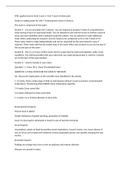
CALT study guide.docx
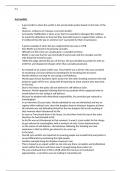
Chall's Reading Stages - correct answer Pre-reading ( Stage 0) Learning to Read (Decoding-1 & Fluency - 2) Reading to learn (Multiple view points - 4 & Construction 5 & Reconstruction 6) Chall's Reading Stage 0 - correct answer Pre-reading: Read common signs and labels; write own names; learns letters and some sounds Chall's Reading Stage 1 - correct answer Decoding: letter sound correspondences; knows about 1,000 most common words in language; can read simple texts Chall's Reading Stage 2 - correct answer Fluency: use context clues and decoding to read Chall's Reading Stage 3 - correct answer Learning the New: uses reading as a tool to learn new information Chall's Reading Stage 4 - correct answer Multiple Viewpoints: read from a variety of viewpoints Chall's Reading Stage 5 - correct answer Construction & Reconstruction: They analyze what they read ADHD - correct answer Attention deficit hyperactivity disorder: issues with executive function Executive function - correct answer Core components are goal setting, planning, organization of behaviors over time, flexibility, attention and memory systems, and self-regulation ALTA - correct answer Academic Language Therapy Association 1986—The Academic Language Therapy Association (ALTA) was formed to certify individuals who were trained to deliver phonetic, multisensory remediation to students with dyslexia and/or written-language disorders. ESL - correct answer English as a second language IDEA - correct answer Individuals with Disabilities education act: legislation that states all persons with a disability have a right to free and public education. (Least restrictive environment) IEP - correct answer Individualized education plan IMSLEC - correct answer International Multi-sensory structured literacy education council: was formed to accredit MSL training programs. MSL - correct answer Multi-sensory structured language MSLE - correct answer Multi-sensory structured language education NICHD - correct answer National Institute of Child Health and Human Development VAKT - correct answer Visual Auditory Kinesthetic Tactile WRAT - correct answer Wide Range Achievement Test M. Balmuth - correct answer Wrote "Roots of phonics: A historical introduction." (1992) Judith Birsh - correct answer Wrote "Multi-sensory teaching of basic language skills" (2005) Dr. Samuel Orton - correct answer coined the phrase " strephosymbolia" or twisted symbols Strephosymbolia - correct answer twisted symbols Adolf Kussmaul - correct answer used the phrase "word blindness" (1877) Rudolf Berlin - correct answer used the term dyslexia to describe the loss of reading abilities in stroke victims. (1887) included dyslexia in aphasia disorders. Dejerine - correct answer identified reading difficulties caused by damage to the angular gyrus ( 1892) Dr. James Hinshelwood - correct answer an ophthalmologist, reported the sudden onset of word blindness in a 58 year-old man. He advocated an alphabetic method of instruction for students with "word blindness Dr. W. Pringle Morgan - correct answer first to describe a 14 year old boy, Percy F., who was intelligent, had good eyesight, but could not read. He was the first to describe this as a developmental, rather than acquired, disorder. Mildred McGinnis - correct answer used multisensory intervention for children and adults with oral language disorders. Brocca - correct answer identified the language area in the left hemisphere of the brain in 1861. Bradley & Bryant - correct answer discovered importance of phonological awareness; two components of reading: decoding & comprehension Weakness in ____ interferes with decoding - correct answer Phonological awareness Norman Geschwind - correct answer theorized dyslexia resulted from damage to the brain in fetal development (1950's) Isabelle Liberman - correct answer Developed Phonological Awareness Hierarchy 1. words in sentences 2. syllables in words Author of "Phonology & the problems of learning to read and write" -- clarified the role of the alphabetic principle and its relationship to phonemic and phonological awareness in reading. Bonita Blachman - correct answer professor at Syracuse University - has done a great deal of research on phonology / reading. Reid Lyon - correct answer latest researcher on coding Chief, Learning Disabilities Unit, National Institutes of health Sally Shaywitz - correct answer Connecticut Longitudinal study prevalence of dyslexia: is it developmental delay or ongoing disorder. (1983) 2002 - fMRI images of good readers more activity in left hemisphere Joseph Torgesen - correct answer Principal investigator; reading researcher for NICHD Jeanne Chall - correct answer Wrote "Learning to Read" (1996) theorized 5 Stages of reading
Written for
- Institution
- CALT
- Module
- CALT
Document information
- Uploaded on
- May 4, 2024
- Number of pages
- 6
- Written in
- 2023/2024
- Type
- Exam (elaborations)
- Contains
- Questions & answers
Subjects
-
calt study guidedocx