You will receive a 4 page fully detailed assignment answer to the following question: M2: Explain how one destructive and one non-destructive test procedure produces useful results.
Part of Assignment 5 - Testing Engineering Materials
BTEC Level 3 Extended Diploma in Engineering: Unit 10 – Properties and Applications of Engineering Systems
Know the structure of and classify engineering materials
Atomic structure: element; atom eg nucleus, electron; compound; molecule; mixture; bonding mechanisms eg covalent, ionic, metallic
Structure of metals: lattice structure; grain structure; crystals; crystal growth; alloying eg interstitial, substitutional; phase equilibrium diagrams eg eutectic, solid solution, combination; intermetallic compounds
Structure of polymeric materials: monomer; polymer; polymer chains eg linear, branched, cross-linked;
crystallinity; glass transition temperature
Structure of ceramics: amorphous; crystalline; bonded
Structure of composites: particulate; fibrous; laminated
Structure of smart materials: crystalline; amorphous; metallic
Classification of metals: ferrous eg plain carbon steel, cast iron (grey, white, malleable, wrought iron), stainless and heat-resisting steels (austenitic, martensitic, ferritic); non-ferrous eg aluminium, copper, gold, lead, silver, titanium, zinc; non-ferrous alloys eg aluminium-copper heat treatable – wrought and cast, non-heat-treatable – wrought and cast, copper-zinc (brass), copper-tin (bronze), nickel-titanium alloy.
Classification of non-metals (synthetic): thermoplastic polymeric materials eg acrylic, polytetrafluoroethylene (PTFE), polythene, polyvinyl chloride (PVC), nylon, polystyrene; thermosetting polymeric materials eg phenol-formaldehyde, melamine formaldehyde, urea-formaldehyde; elastomers; ceramics eg glass, porcelain, cemented carbides; composites eg laminated, fibre reinforced (carbon fibre, glass reinforced plastic (GRP)), concrete, particle reinforced, sintered; smart materials eg electro rheostatic (ER) fluids, magneto-rheostatic (MR) fluids, piezoelectric crystals.
Classification of non-metals (natural): eg wood, rubber, diamond
Know material properties and the effects of processing on the structure and behaviour of engineering materials
Mechanical properties: strength (tensile, shear, compressive); hardness; toughness; ductility; malleability; elasticity; brittleness
Physical properties: density; melting temperature
Thermal properties: expansivity; conductivity
Electrical and magnetic properties: conductivity; resistivity; permeability; permittivity
Effects of processing metals: recrystallisation temperature; grain structure eg hot working, cold working, grain growth; alloying elements in steel eg manganese, phosphorous, silicon, sulphur, chromium, nickel
Effects of processing thermoplastic polymers: polymer processing temperature; process parameters eg mould temperature, injection pressure, injection speed, mould clamping force, mould open and closed time
Effects of processing thermoplastic polymers: polymer processing temperature; process parameters eg mould temperature, injection pressure, injection speed, mould clamping force, mould open and closed time
Effects of processing thermosetting polymers: process parameters eg moulding pressure and time, mould temperature, curing
Effects of processing ceramics: eg water content of clay, sintering pressing force, firing temperature
Effects of processing composites: fibres eg alignment to the direction of stress, ply direction; de-lamination; matrix/reinforcement ratio on tensile strength; particle reinforcement on cermets
Effects of post-production use: smart materials eg impact (piezoelectric), electric field (electro-rheostatic), magnetic field (magneto-rheostatic), temperature (shape memory alloys), colour change (temperature or viscosity)
Be able to use information sources to select materials for engineering uses
Information sources: relevant standard specifications eg British Standards (BS), European Standards (EN), International Standards (ISO); material manufacturers’ and stockholders’ information eg data sheets, catalogues, websites, CD ROMs
Design criteria: properties eg mechanical, physical, thermal, electrical and magnetic; surface finish; durability eg corrosion resistance, solvent resistance, impact resistance, wear resistance
Cost criteria: initial cost eg raw material, processing, environmental impact, energy requirements; processing eg forming, machining, casting, joining (thermal, adhesive, mechanical); quantity; mode of delivery eg bulk, just-in-time (JIT); recycling
Availability criteria: standard forms eg sheet and plate, bar-stock, pipe and tube, sectional, extrusions, ingots, castings, forgings, pressings, granular, powder, liquid
Know about the modes of failure of engineering materials
Principles of ductile and brittle fracture: effects of gradual and impact loading eg tensile, compressive, shear; effects of grain size; transition temperature; appearance of fracture surfaces
Principles of fatigue: cyclic loading; effects of stress concentrations eg internal, external; effects of surface finish; appearance of fracture surfaces
Principles of creep: primary; secondary; tertiary; effects of temperature; strain versus time curve; creep limit; effect of grain size; effect of variations in the applied stress
Tests: destructive eg tensile, hardness, impact, ductility, fatigue, creep; non-destructive eg dye penetrant, ultrasonic, radiographic (x-ray, gamma ray), magnetic powder, visual
Degradation processes: on metals eg oxidation, erosion, stress corrosion; on polymers eg solvent attack, radiation and ageing; on ceramics eg thermal shock, sustained high temperature
Content preview
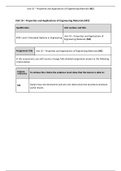
Unit 10 – Properties and Applications of Engineering Materials (M2)
Unit 10 – Properties and Applications of Engineering Materials (M2)
Qualification Unit number and title
Unit 10 – Properties and Applications of
BTEC Level 3 Extended Diploma in Engineering
Engineering Materials (M2)
Assignment title Unit 10 – Properties and Applications of Engineering Materials (M2)
In this assessment, you will receive a 4 page fully detailed assignment answer to the following
criteria below.
Criteria To achieve the criteria the evidence must show that the learner is able to:
reference
M2 Explain how one destructive and one non-destructive test procedure produces
useful results.