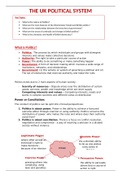
THE UK POLITICAL SYSTEM
Key Topics:
What is the nature of Politics?
What are the main features of the Westminster Model and British politics?
What are the relationships between the branches of government?
What are the areas of continuity and change in British politics?
What is the character and health of British democracy?
What is Politics?
Politics: The process by which individuals and groups with divergent
interests and values make collective decisions
Authority: The right to take a particular course of action
Power: The ability to do something or make something happen
Governance: A form of decision making which involves a wide range of
institutions, networks, and relationships
Government: (1) The activity or system of governing a political unit (2)
The set of institutions that exercise authority and make the rules
Politics exists due to 2 main aspects of human society:
- Scarcity of resources – Dispute arises over the distribution of certain
goods, services, wealth and knowledge which are short supply
- Competing interests and values – Competing interests, needs and
wants in complex societies and different views on distribution
Power or Conciliation:
The conduct of politics can be split into 2 broad perspectives:
1. Politics is about power. Power is the ability to achieve a favoured
outcome either through coercion or using authority. Politics concerns the
distribution of power: who makes the rules and where does their authority
come from?
2. Politics is about conciliation. There is a focus on conflict resolution,
negotiation and compromise – a way of reaching a decision in a divided
society without violence.
Legitimate Power:
Absolute Power:
where other accept an
the unlimited ability
individual’s right to
to do as one wishes
make decisions –
(only exists in
because of an election POWER
theory)
Coercive Power: Persuasive Power:
pressing others into the ability to persuade
complying, using others that a course of
laws and penalties action is right
Key Topics:
What is the nature of Politics?
What are the main features of the Westminster Model and British politics?
What are the relationships between the branches of government?
What are the areas of continuity and change in British politics?
What is the character and health of British democracy?
What is Politics?
Politics: The process by which individuals and groups with divergent
interests and values make collective decisions
Authority: The right to take a particular course of action
Power: The ability to do something or make something happen
Governance: A form of decision making which involves a wide range of
institutions, networks, and relationships
Government: (1) The activity or system of governing a political unit (2)
The set of institutions that exercise authority and make the rules
Politics exists due to 2 main aspects of human society:
- Scarcity of resources – Dispute arises over the distribution of certain
goods, services, wealth and knowledge which are short supply
- Competing interests and values – Competing interests, needs and
wants in complex societies and different views on distribution
Power or Conciliation:
The conduct of politics can be split into 2 broad perspectives:
1. Politics is about power. Power is the ability to achieve a favoured
outcome either through coercion or using authority. Politics concerns the
distribution of power: who makes the rules and where does their authority
come from?
2. Politics is about conciliation. There is a focus on conflict resolution,
negotiation and compromise – a way of reaching a decision in a divided
society without violence.
Legitimate Power:
Absolute Power:
where other accept an
the unlimited ability
individual’s right to
to do as one wishes
make decisions –
(only exists in
because of an election POWER
theory)
Coercive Power: Persuasive Power:
pressing others into the ability to persuade
complying, using others that a course of
laws and penalties action is right