SEX 31 BEHAVIOUR
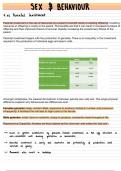
4 a Parental Investment
Parental investment is the use of resources by a parent to bene t future or existing o spring. Investing
resources in o spring is costly to the parent. The bene ts are that it can result in increased numbers of
o spring and their improved chance of survival, thereby increasing the evolutionary tness of the
parent.
Parental investment begins with the production of gametes. There is an inequality in the investment
required in the production of individual eggs and sperm cells.
Amongst vertebrates, the clearest dimorphism is between gamete (sex cell) size. This single physical
di erence explains why behavioural sex di erences exist.
Females gametes: large, nutrient- lled, expensive to produce, limited in number, and produced
infrequently. If fertilised this will lead to high costs to the female.
Male gametes: small, have no nutrients, cheap to produce, constantly made throughout life.
Reproductive Capability: females are thus classed as the ‘slow sex’ and males the ‘fast sex’.
there is greater investmentfemales Female investment in the egg structure in
by
non mammals and during gestation in mammals
Parental investment is costly but increases the probability of production and
survival of young
Mammals also invest in lactation
, r B K Selection
The r selected r strategists and K selected K strategists organisms is
classification of
based on the level of parental investment in offspring and the number of offspring
produced
r selection tends to occur in UNSTABLE environments where the species has not
reached its reproductive capacity
K selection tends to occur in STABLE environments
• r/K selection theory relates to the selection of combinations of traits in an organism that trade o
between quantity and quality of o spring.
◦They focus upon either increased quantity of o spring at
the expense of individual parental investment.
◦Or reduced quantity of o spring with a corresponding
increased parental investment.
◦Varies widely, seemingly to promote success in particular
environments.
4 a Parental Investment
Parental investment is the use of resources by a parent to bene t future or existing o spring. Investing
resources in o spring is costly to the parent. The bene ts are that it can result in increased numbers of
o spring and their improved chance of survival, thereby increasing the evolutionary tness of the
parent.
Parental investment begins with the production of gametes. There is an inequality in the investment
required in the production of individual eggs and sperm cells.
Amongst vertebrates, the clearest dimorphism is between gamete (sex cell) size. This single physical
di erence explains why behavioural sex di erences exist.
Females gametes: large, nutrient- lled, expensive to produce, limited in number, and produced
infrequently. If fertilised this will lead to high costs to the female.
Male gametes: small, have no nutrients, cheap to produce, constantly made throughout life.
Reproductive Capability: females are thus classed as the ‘slow sex’ and males the ‘fast sex’.
there is greater investmentfemales Female investment in the egg structure in
by
non mammals and during gestation in mammals
Parental investment is costly but increases the probability of production and
survival of young
Mammals also invest in lactation
, r B K Selection
The r selected r strategists and K selected K strategists organisms is
classification of
based on the level of parental investment in offspring and the number of offspring
produced
r selection tends to occur in UNSTABLE environments where the species has not
reached its reproductive capacity
K selection tends to occur in STABLE environments
• r/K selection theory relates to the selection of combinations of traits in an organism that trade o
between quantity and quality of o spring.
◦They focus upon either increased quantity of o spring at
the expense of individual parental investment.
◦Or reduced quantity of o spring with a corresponding
increased parental investment.
◦Varies widely, seemingly to promote success in particular
environments.