

PROTEINS
2 a The Proteome
Proteome The entire set of proteins expressed
by a genome
The proteome is larger than the number of genes particularly in eukaryotes
because more than one protein can be produced from a single gene as
a result of alternative RNA splicing
Not all genes are expressed as proteins in a particular cell. Genes that do not code for proteins are
called non-coding RNA genes and include those that are transcribed to produce tRNA, rRNA, and RNA
molecules that control the expression of other genes.
The set of proteins expressed by a given cell type can vary over time and under di erent conditions.
Some factors a ecting the set of proteins expressed by a given cell type are the metabolic activity of
the cell, cellular stress, the response to signalling molecules, and diseased versus healthy cells.
2 b The synthesis 31 Transport of proteins
c Intracellular Membranes
Prokaryotic cells
These cells do not have intracellular membrane structures in their cytoplasm Many of
the functions
of these structures are carried out by the plasma
membrane so this places a limit on the maximum rate of the metabolic
processes in the prokaryotic cell
This metabolic limit in turn restricts the maximum size that
prokaryotic cells can attain
, Eukaryotic cells
Eukaryotic cells can be much larger than prokaryotic cells Because of their
size eukaryotes have a relatively small surface area to volume ratio
This means that the plasma membrane of eukaryotic cells is therefore too
small an area to carry out all the vital functions carried out by
membranes The total rate of all these processes would be too slow to
provide materials to support the cell This increase in size can only be
supported because the eukaryotes have a system of internal membranes
which increases the total area of membrane available for the vital
metabolic processes
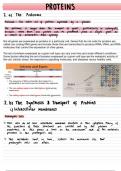
EAKEREAFATE EftEUWMm
The endoplasmic reticulum ER forms a network of membrane tubules
continuous with the nuclear membrane
Lipids and proteins are synthesised in the ER
The endoplasmic reticulum provides channels for transport
Rough ER the rough endoplasmic reticulum has RIBOSOMES ATTACHED Ribosomes
are small spherical structures and are the site of protein synthesis
Smooth ER site of a series of enzyme induced reactions synthesising lipids
steroids and metabolic NO RIBOSOMES
pathways ATTACHED
HESKETH
vesicles transport materials between membrane compartments or to the plasma
membrane
2 a The Proteome
Proteome The entire set of proteins expressed
by a genome
The proteome is larger than the number of genes particularly in eukaryotes
because more than one protein can be produced from a single gene as
a result of alternative RNA splicing
Not all genes are expressed as proteins in a particular cell. Genes that do not code for proteins are
called non-coding RNA genes and include those that are transcribed to produce tRNA, rRNA, and RNA
molecules that control the expression of other genes.
The set of proteins expressed by a given cell type can vary over time and under di erent conditions.
Some factors a ecting the set of proteins expressed by a given cell type are the metabolic activity of
the cell, cellular stress, the response to signalling molecules, and diseased versus healthy cells.
2 b The synthesis 31 Transport of proteins
c Intracellular Membranes
Prokaryotic cells
These cells do not have intracellular membrane structures in their cytoplasm Many of
the functions
of these structures are carried out by the plasma
membrane so this places a limit on the maximum rate of the metabolic
processes in the prokaryotic cell
This metabolic limit in turn restricts the maximum size that
prokaryotic cells can attain
, Eukaryotic cells
Eukaryotic cells can be much larger than prokaryotic cells Because of their
size eukaryotes have a relatively small surface area to volume ratio
This means that the plasma membrane of eukaryotic cells is therefore too
small an area to carry out all the vital functions carried out by
membranes The total rate of all these processes would be too slow to
provide materials to support the cell This increase in size can only be
supported because the eukaryotes have a system of internal membranes
which increases the total area of membrane available for the vital
metabolic processes
EAKEREAFATE EftEUWMm
The endoplasmic reticulum ER forms a network of membrane tubules
continuous with the nuclear membrane
Lipids and proteins are synthesised in the ER
The endoplasmic reticulum provides channels for transport
Rough ER the rough endoplasmic reticulum has RIBOSOMES ATTACHED Ribosomes
are small spherical structures and are the site of protein synthesis
Smooth ER site of a series of enzyme induced reactions synthesising lipids
steroids and metabolic NO RIBOSOMES
pathways ATTACHED
HESKETH
vesicles transport materials between membrane compartments or to the plasma
membrane


