

Written by students who passed Immediately available after payment Read online or as PDF Wrong document? Swap it for free 4.6 TrustPilot
logo-home
Document preview thumbnail
Preview 1 out of 11 pages
Exam (elaborations)

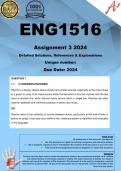
ENG1516 Assignment 3 (COMPLETE ANSWERS) 2024

Document preview thumbnail
Preview 1 out of 11 pages

ENG1516 Assignment 3 (COMPLETE ANSWERS) 2024 - DUE 2024 ;100% TRUSTED workings, explanations and solutions. for assistance Whats-App.......0.6.7..1.7.1..1.7.3.9...... Question 1 1.1 In your own words, define rhyme. (2) 1.2 In your own words, explain the difference between end rhyme and internal rhyme. (4) 1.3 Nursery rhymes and poetry, according to Tut 501, are useful tools in assisting young learners acquire basic language and mathematical skills. Write a short paragraph in which you explain how this is achieved. (5) 1.4 Poems are made up of several poetic elements such as the rhythm. In your own words, define rhythm and explain how it is important when teaching poetry to Foundation Phase learners. (4) [15] Question 2 2.1 Read through p. 102 of the Tutorial letter 501 and discuss the importance of sense imagery when teaching poetry to children. (5) 2.2 Read carefully the five different types of imageries on p. 102 of the Tutorial letter 501. Explain how each imagery is important when teaching poetry to Foundation Phase learners. (3x5) [20] Question 3 Read through the story and answer the questions that follow. The Three Little Pigs Retold by Annie Flora Steel (1922), illustrated by L. Lesley Brooke from the 1904 version. Downloaded by Corona Virus () lOMoARcPSD| 2 ENG1516 Once upon a time there was an old pig who had three little pigs and not enough to feed them. So when they were old enough, she sent them out into the world to seek their fortunes. The first little pig was very lazy. He didn’t want to work at all and he built his house out of straws. The second little pig worked a little harder but he was somewhat lazy too and he built his house out of sticks. Then, they sang and danced and played together the rest of the day. The third little pig worked hard all day and built his house with bricks. It was a sturdy house complete with a fine fire place and chimney. It looked like it could withstand the strongest winds. The next day, a wolf happened to pass by the lane where the three little pigs lived; and he saw the straw house, and he smelled the pig inside. He thought the pig would make a mighty fine meal and his mouth began to water. So he knocked on the door and said: Little Pig! Little Pig! Let me in! Let me in! But the little pig saw the wolf’s big paws through the keyhole, so he answered back! No! No! No! Not by the hairs on my chinny chin chin! Then the wolf showed his teeth and said: Then I’ll huff and I’ll puff and I’ll blow your house down. So he huffed and he puffed and he blew the house down! The wolf opened his jaws very wide and bit down as hard as he could, but the first little pig escaped and ran away to hide with the second little pig. Downloaded by Corona Virus () lOMoARcPSD| 3 ENG1516 The wolf continued down the lane and he passed by the second house made of sticks; and he saw the house, and smelled the pigs inside, and his mouth began to water as he thought about the fine dinner they would make. So he knocked on the door and said: Little pigs! Little pigs! Let me in! Let me in! But the little pigs saw the wolf’s spotty ears through the keyhole, so they answered back! No! No! No! Not by the hairs on our chinny chin chin! Then the wolf showed his teeth and said: Then I’ll huff and I’ll puff and I’ll blow your house down. So he huffed and he puffed and he blew the house down! The wolf was greedy and he tried to catch both pigs at once, but he was too greedy and got neither! His big jaws clamped down on nothing but air and the two little pigs scrambled away as fast as their little hooves would carry them. The wolf chased them down the lane and he almost caught them. But they made it to the brick house and slammed the door closed before the wolf could catch them. The three little pigs were very frightened, they knew the wolf wanted to eat them. And that was very, very true. The wolf hadn’t eaten all day and he had worked up a large appetite chasing the pigs around and now he could smell all the three of them inside and he knew that the three little pigs would make a lovely feast. Downloaded by Corona Virus () lOMoARcPSD| 4 ENG1516 So the wolf knocked on the door and said: Little pigs! Little pigs! Let me in! Let me in! But the little pigs saw the wolf’s narrow eyes through the keyhole, so they answered back! No! No! No! Not by the hairs on our chinny chin chin! Then the wolf showed his teeth and said: Then I’ll huff and I’ll puff and I’ll blow your house down. Well! He huffed and he puffed. He puffed and he huffed. And he huffed, huffed, and he puffed, puffed; but he could not blew the house down. At last, he was so out of breath that he couldn’t huff and he couldn’t puff anymore. So he stopped to rest and thought a bit. But this was too much. The wolf danced about with rage and swore he would come down the chimney and eat up the little pig for his supper. But while he was climbing on to the roof the little pig made up a blazing fire and put on a big pot full of water to boil. Then, just as the wolf was coming down the chimney, the little piggy pulled off the lid, and plop! in he fell the wolf into the scalding water. So the little piggy put on the cover again, boiled the wolf up, and the three little pigs ate him for supper. Downloaded by Corona Virus () lOMoARcPSD| 5 ENG1516 Source: 3.1 The story of The Three Little Pigs can make for an effective teaching tool for developing empathy skill in young learners. Write a paragraph of 5 sentences in which you explain how this could be achieved. (5) 3.2Explain how reading literature is important in developing children’s skills. (2) 3.3 Various literary genres exist for different children’s age groups, for which age group(s) would you consider the above story an effective appropriate reading? Give 3 reasons for your answer. (2x3) 3.4 Reading story books might not be as appealing to boys as they may to girls, due to societal conditioning. Provide two ways one could use to encourage boys’ reading interest in class.

Content preview

ENG1516
Assignment 3 2024
Detailed Solutions, References & Explanations

Unique number:

Due Date: 2024
QUESTION 1

1.1. (2 ANSWERS PROVIDED)

Rhyme is a literary device where words have similar sounds, especially at the end of lines
in a poem or song. End rhyme occurs when the last word in one line rhymes with the last
word in another line, while internal rhyme occurs within a single line. Rhymes are often
used for aesthetic and rhythmic purposes in poetry and music.

OR

Rhyme refers to the similarity of sounds between words, particularly at the end of lines in
poems or songs. It can also occur within a line, creating a pattern of repetition and musicality
in the language.


Terms of use
By making use of this document you agree to:
• Use this document as a guide for learning, comparison and reference purpose,
• Not to duplicate, reproduce and/or misrepresent the contents of this document as your own work,
• Fully accept the consequences should you plagiarise or misuse this document.


Disclaimer
Extreme care has been used to create this document, however the contents are provided “as is” without
any representations or warranties, express or implied. The author assumes no liability as a result of
reliance and use of the contents of this document. This document is to be used for comparison, research
and reference purposes ONLY. No part of this document may be reproduced, resold or transmitted in any
form or by any means.

Connected book
 image
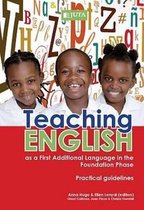
Publisher: Unknown ISBN: 9780702188749 Edition: Unknown

Document information

Uploaded on
April 21, 2024
Number of pages
11
Written in
2023/2024
Type
Exam (elaborations)
Contains
Questions & answers
£3.56
Purchased by 20 students

Wrong document? Swap it for free Within 14 days of purchase and before downloading, you can choose a different document. You can simply spend the amount again.
Written by students who passed
Immediately available after payment
Read online or as PDF

Seller avatar
Reputation scores are based on the amount of documents a seller has sold for a fee and the reviews they have received for those documents. There are three levels: Bronze, Silver and Gold. The better the reputation, the more your can rely on the quality of the sellers work.
EduPal
4.2
(14389)
Sold
154233
Followers
36026
Items
5179
Last sold
1 hour ago

Reviews from verified buyers


Why students choose Stuvia

Created by fellow students, verified by reviews

Quality you can trust: written by students who passed their exams and reviewed by others who've used these revision notes.

Didn't get what you expected? Choose another document

No problem! You can straightaway pick a different document that better suits what you're after.

Pay as you like, start learning straight away

No subscription, no commitments. Pay the way you're used to via credit card and download your PDF document instantly.

Student with book image

“Bought, downloaded, and smashed it. It really can be that simple.”

Alisha Student

Working on your references?

Create accurate citations in APA, MLA and Harvard with our free citation generator.

Working on your references?

Frequently asked questions


