
A level biology
Year 1
Carbohydrates
Monosaccharides:
Glucose (C6H12O6)
Galactose
Fructose
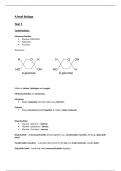
Structures:
Made of carbon, hydrogen and oxygen.
Monosaccharides are monomers.
Monomer
Single repeating unit that makes up a polymer.
Polymer
Many monomers joined together to make a larger molecule.
Disaccharides:
Glucose + glucose = maltose
Glucose + galactose = lactose
Glucose + fructose = sucrose
Disaccharide – 2 monosaccharides joined together via a condensation reaction, forming a glycosidic
bond.
Condensation reaction – a reaction that results in the loss of a small molecule, usually water.
Glycosidic bond – bond that holds monosaccharides together.
,Example:
Loss of water molecule (H2O).
Forms glycosidic bond on oxygen.
Hydrolysis is the reverse of condensation reactions, breaks the glycosidic bonds.
Hydrolysis – using water to split a larger molecule into its constituent monomers.
Polysaccharides:
Polysaccharides – many (more than 2) monosaccharides joined together via condensation
reactions.
Starch:
Carbohydrate store of plants
Made of:
Amylose, long unbranched chains, 1-6 glycosidic bonds, coiled into spirals (80%)
Amylopectin, long branched chains, 1-4 and 1-6 glycosidic bonds (20%)
Features of starch
Insoluble, so it does not affect water potential.
Coiled structure, makes molecule compact for storage.
Polymer of alpha glucose, when hydrolysed it provides energy for respiration.
Branched ends, can be hydrolysed faster.
Large molecule, so can't diffuse out of the cell / cross cell membrane.
,Test for starch
Add sample to test tube or spotting tile.
Add 2-3 drops of iodine solution.
If starch is present, there will be a colour change from brown to blue/black.
Glycogen:
Energy store in animals and bacteria.
Polysaccharide of alpha glucose.
Stored in the liver, and as granules in muscles as muscles are active so will need respiratory
substrates readily available.
Shorter, more branched chains than starch.
Features of glycogen:
Insoluble, so it does not affect water potential.
Large molecule, so can’t diffuse out of cells.
Coiled structure, makes molecule compact for storage.
Polymer of alpha glucose, when hydrolysed it provides energy for respiration.
Highly branched / more highly branched than starch, (1-4 and 1-6 glycosidic bonds) makes it
easier to hydrolyse into alpha glucose monomers due to a larger surface area.
Fast hydrolysis of glycogen is important for animals as they are more active than plants so need to
do more respiration.
Metabolism – all the chemical reactions that take place inside of a cell.
Cellulose:
Major component of plant cell walls.
Features of cellulose
Straight, long and unbranched chains of beta glucose.
Every other beta glucose is rotated 180 degrees so hydroxyl groups are adjacent.
Chains run parallel to each other, linked by hydrogen bonds to make microfibrils.
Microfibrils link together to provide strength and rigidity for plant cell wall.
, Singular hydrogen bonds are weak forces, but many hydrogen bonds provide strength.
Chemical tests:
All monosaccharides as well as lactose and maltose are ‘reducing sugars’.
Sucrose is a ‘non reducing sugar’.
Test for reducing sugar:
Add sample to a test tube.
Add equal volume of Benedict’s reagent.
Heat mixture gently in water bath for 5 minutes and observe colour change.
Positive test result is blue to red.
Test results vary depending on concentration of reducing sugar.
Order of concentration from lowest to highest goes:
Blue, green, yellow, orange, red
Test for non-reducing sugar:
Test for reducing sugar as normal, if no change is observed then your sample must contain a
non-reducing sugar.
Add sample to new test tube.
Add dilute hydrochloric acid (HCl) and heat mixture gently in water bath for 5 minutes, HCl
will hydrolyse glycosidic bonds in sucrose forming glucose and fructose.
Add sodium hydrogen carbonate to neutralise the acid.
Add Benedict’s reagent.
Observe colour change.
Positive result, blue to red.
Both tests can be made quantitive by using a colorimeter rather than observing colour change:
Increases accuracy as it is not subjective.
Standardises the test method.
Other potential method of testing is:
Filter and dry precipitate formed.
Weigh dry mass.
Lipids
Are a good source of energy.
Can be used as protection for vital organs.
Provide waterproofing.
Provide insulation.
Triglycerides:
Made of 3 fatty acids and a glycerol.
Hydrophobic tails.
Formed via condensation reactions.
Produces ester bonds which holds lipids together.
Year 1
Carbohydrates
Monosaccharides:
Glucose (C6H12O6)
Galactose
Fructose
Structures:
Made of carbon, hydrogen and oxygen.
Monosaccharides are monomers.
Monomer
Single repeating unit that makes up a polymer.
Polymer
Many monomers joined together to make a larger molecule.
Disaccharides:
Glucose + glucose = maltose
Glucose + galactose = lactose
Glucose + fructose = sucrose
Disaccharide – 2 monosaccharides joined together via a condensation reaction, forming a glycosidic
bond.
Condensation reaction – a reaction that results in the loss of a small molecule, usually water.
Glycosidic bond – bond that holds monosaccharides together.
,Example:
Loss of water molecule (H2O).
Forms glycosidic bond on oxygen.
Hydrolysis is the reverse of condensation reactions, breaks the glycosidic bonds.
Hydrolysis – using water to split a larger molecule into its constituent monomers.
Polysaccharides:
Polysaccharides – many (more than 2) monosaccharides joined together via condensation
reactions.
Starch:
Carbohydrate store of plants
Made of:
Amylose, long unbranched chains, 1-6 glycosidic bonds, coiled into spirals (80%)
Amylopectin, long branched chains, 1-4 and 1-6 glycosidic bonds (20%)
Features of starch
Insoluble, so it does not affect water potential.
Coiled structure, makes molecule compact for storage.
Polymer of alpha glucose, when hydrolysed it provides energy for respiration.
Branched ends, can be hydrolysed faster.
Large molecule, so can't diffuse out of the cell / cross cell membrane.
,Test for starch
Add sample to test tube or spotting tile.
Add 2-3 drops of iodine solution.
If starch is present, there will be a colour change from brown to blue/black.
Glycogen:
Energy store in animals and bacteria.
Polysaccharide of alpha glucose.
Stored in the liver, and as granules in muscles as muscles are active so will need respiratory
substrates readily available.
Shorter, more branched chains than starch.
Features of glycogen:
Insoluble, so it does not affect water potential.
Large molecule, so can’t diffuse out of cells.
Coiled structure, makes molecule compact for storage.
Polymer of alpha glucose, when hydrolysed it provides energy for respiration.
Highly branched / more highly branched than starch, (1-4 and 1-6 glycosidic bonds) makes it
easier to hydrolyse into alpha glucose monomers due to a larger surface area.
Fast hydrolysis of glycogen is important for animals as they are more active than plants so need to
do more respiration.
Metabolism – all the chemical reactions that take place inside of a cell.
Cellulose:
Major component of plant cell walls.
Features of cellulose
Straight, long and unbranched chains of beta glucose.
Every other beta glucose is rotated 180 degrees so hydroxyl groups are adjacent.
Chains run parallel to each other, linked by hydrogen bonds to make microfibrils.
Microfibrils link together to provide strength and rigidity for plant cell wall.
, Singular hydrogen bonds are weak forces, but many hydrogen bonds provide strength.
Chemical tests:
All monosaccharides as well as lactose and maltose are ‘reducing sugars’.
Sucrose is a ‘non reducing sugar’.
Test for reducing sugar:
Add sample to a test tube.
Add equal volume of Benedict’s reagent.
Heat mixture gently in water bath for 5 minutes and observe colour change.
Positive test result is blue to red.
Test results vary depending on concentration of reducing sugar.
Order of concentration from lowest to highest goes:
Blue, green, yellow, orange, red
Test for non-reducing sugar:
Test for reducing sugar as normal, if no change is observed then your sample must contain a
non-reducing sugar.
Add sample to new test tube.
Add dilute hydrochloric acid (HCl) and heat mixture gently in water bath for 5 minutes, HCl
will hydrolyse glycosidic bonds in sucrose forming glucose and fructose.
Add sodium hydrogen carbonate to neutralise the acid.
Add Benedict’s reagent.
Observe colour change.
Positive result, blue to red.
Both tests can be made quantitive by using a colorimeter rather than observing colour change:
Increases accuracy as it is not subjective.
Standardises the test method.
Other potential method of testing is:
Filter and dry precipitate formed.
Weigh dry mass.
Lipids
Are a good source of energy.
Can be used as protection for vital organs.
Provide waterproofing.
Provide insulation.
Triglycerides:
Made of 3 fatty acids and a glycerol.
Hydrophobic tails.
Formed via condensation reactions.
Produces ester bonds which holds lipids together.


