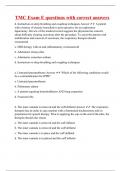
TMC Exam E questions with correct answers|100% verified|49 pages
TMC Exam E questions with correct answers d. Instruction on deep breathing and coughing techniques Answer A patient with a history of chronic bronchitis is post-operative for an exploratory laparotomy. Review of the medical record suggests the physician has concern about difficulty clearing secretions after the procedure. To assist the patient with mobilization and removal of secretions, the respiratory therapist should recommend a. MDI therapy with an anti-inflammatory corticosteroid b. Administer tetracycline c. Administer cromolyn sodium d. Instruction on deep breathing and coughing techniques a. Untreated pneumothorax Answer Which of the following conditions would be a contraindication for IPPB? a. Untreated pneumothorax b. Pulmonary edema c. A patient requiring bronchodilation AND lung expansion d. Fractured ribs b. The inner cannula is removed and the cuff deflated Answer The respiratory therapist has an order to cap a patient with a fenestrated tracheostomy tube in preparation for speech therapy. Prior to applying the cap on the end of the tube, the therapist should also ensure a. The inner cannula is removed and the cuff inflated b. The inner cannula is removed and the cuff deflated c. The inner cannula is in place and the cuff deflated d. The inner cannula is in placed and the cuff inflated a. Size 7.0 mm ET tube with a large volume, low pressure cuff Answer A 75-kg (165-lbs) male is in acute ventilatory failure. In preparation for mechanical ventilatory support, the patient is to be orally intubated. Which of the following artificial airways would be most appropriate for this patient? a. Size 7.0 mm ET tube with a large volume, low pressure cuff b. Size 7.5 mm fenestrated tracheostomy tube c. Size 8.0 mm ET tube with a small volume, high pressure cuff d. Jackson tracheostomy tube c. Body box Answer Which of the following devices is needed to determine a patient's airway resistance? a. Turbine pneumotachometer b. Wheatstone bridge helium analyzer c. Body box d. Geissler tube nitrogen analyzer d. Examine chest rise and auscultate breath sounds Answer A patient is receiving manual ventilatory support with a bag-valve connected to a size 8.0 mm ET tube. While transporting the patient from CT scan back to the intensive care unit, the respiratory therapist notices oxygen saturation has dropped to 88% and that the bag-valve is easier to squeeze than normal. Suspecting mal-positioning of the ET tube, the respiratory therapist should first a. Perform diagnostic chest percussion b. Obtain an arterial blood gas c. Call for a chest radiograph d. Examine chest rise and auscultate breath sounds d. Obtain a chest radiograph Answer A 48-year-old patient has just been orally intubated prior to being placed on volume-controlled ventilation. The respiratory therapist should do which of the following to best confirm proper placement of the endotracheal tube? a. Auscultate breath sounds b. Assess chest rise symmetry c. Examine tube markings near the lips d. Obtain a chest radiograph d. Return to full mechanical ventilation Answer After 20 minutes into a spontaneous breathing trial (SBT) a mechanically ventilated female patient becomes anxious. Her baseline heart rate has increased by 20 /min. What should the respiratory therapist do? a. Calculate the RSBI b. Increase the FiO2 and continue to monitor c. Measure MIP d. Return to full mechanical ventilation b. Hemoglobin level Answer What is needed to determine arterial oxygen content? a. PvO2 b. Hemoglobin level c. Oxygen index d. P/F ratio c. Elevated left ventricular filling pressure with low QT Answer A patient presents to the emergency room with fulminating pulmonary edema. Which of the following would be experienced with this emergency? a. Hypovolemia b. A good response to supplemental O2 c. Elevated left ventricular filling pressure with low QT d. CVP 10 torr and PAP 10 torr d. Small pneumothorax Answer Which of the following conditions would benefit most from a thoracentesis? a. Pericardial contusion b. Atelectasis c. Complete opacification of the right lung d. Small pneumothorax a. Ventricular tachycardia with a pulse Answer Which of the following conditions would benefit most from cardioversion? a. Ventricular tachycardia with a pulse b. Frequent PVCs c. Asystole d. Ventricular fibrillation
Document information
- Uploaded on
- April 16, 2024
- Number of pages
- 49
- Written in
- 2023/2024
- Type
- Exam (elaborations)
- Contains
- Questions & answers