You will receive a 3 page fully detailed assignment answer to the following question: D2: Determine the cost of an accident in the workplace from given data.
Part of Assignment 3 - Reporting and Recording Accidents and Incidents
BTEC Level 3 Engineering: Unit 1 – Health and Safety in the Engineering Workplace
Justify methods used to deal with hazards in the workplace.
Health and Safety at Work Act 1974
Health and Safety Executive (HSE)
Methods for dealing with hazards that are described within a range of legal requirements (i.e.
Health and Safety Legislation/Regulations).
The roles and responsibilities of employer and employees in relation to dealing with hazards,
as specified by legal requirements.
Consequences of not complying with guidance for dealing with hazards, as specified by legal
requirements.
How workplace policies can be used to implement methods for dealing with hazards and
demonstrate compliance with legal requirements.
Understand the key features of health and safety legislation and regulations
legislation eg Health and Safety at Work Act 1974, Employment
Act 2002, Factories Act 1961, Fire Precautions Act 1971; regulations eg Employment Equality (Age)
Regulations 2006, Management of Health and Safety at Work Regulations 1999, Provision and Use of
Work Equipment Regulations (PUWER) 1998, Control of Substances Hazardous to Health (COSHH)
Regulations 2002, Lifting Operations and Lifting Equipment Regulations 1998, Manual Handling
Operations Regulations 1992, Personal Protective Equipment at Work Regulations 1992, Confined Spaces Regulations 1997, Electricity at Work Regulations 1989, Control of Noise at Work Regulations 2005, Reporting of Injuries, Diseases and Dangerous Occurrences Regulations (RIDDOR) 1995, Working Time Regulations 1998, Workplace (Health, Safety and Welfare) Regulations 1992, Health and Safety (First Aid) Regulations 1981, Supply of Machinery (Safety) (Amendment) Regulations 2005 (SI 2005/831) Roles and responsibilities of those involved: employers; employees; Health and Safety Executive (HSE) eg span of authority, right of inspection, guidance notes and booklets; others eg management, subcontractors, public, suppliers, customers, visitors.
Roles and responsibilities of those involved: employers; employees; Health and Safety Executive (HSE) eg span of authority, right of inspection, guidance notes and booklets; others eg management, subcontractors, public, suppliers, customers, visitors.
How to identify and control hazards in the workplace
Within the workplace: methods to identify hazards eg statements, analysis of significant risks, prediction of results or outcomes of those risks, use of accident data, careful consideration of work methods.
Working environment: consideration of the workplace and its potential for harm eg confined spaces,
working over water or at heights, electrical hazards, chemicals, noise.
Hazards which become risks: identification of trivial or significant risk; potential to cause harm; choosing appropriate control measures; electrical safety eg identify and control hazards, cause of injury, effects of electricity on the body, circuit overloading; mechanical safety eg identify and control hazards, cause of injury, rotating equipment, sharp edges; safety devices eg residual current device (RCD), fuses, guards, fail safe, sensors.
Be able to carry out a risk assessment and identify control measures
Risk assessments: items/area to be assessed eg machine operation, work area; five steps (principal hazards, who is likely to be injured/harmed, evaluate the risks and decide on adequacy of precautions, recording findings, review assessment).
Use of control measures: eg remove need (design out), use of recognised procedures, substances control, guarding, lifting assessments and manual handling assessments, regular inspection, use of Personal Protective Equipment (PPE), training of personnel, other personal procedures for health, safety and welfare.
Understand the methods used when reporting and recording accidents and incidents
Principles: why employers keep records of serious accidents, incidents and emergencies; responsibilities of competent persons; cost of accidents eg direct, indirect, human consequences; trends eg major causes, fatal and serious injury, methods of classification, statistics.
Recording and reporting procedures: regulations on accident recording and reporting eg Reporting of Injuries, Diseases and Dangerous Occurrences Regulations (RIDDOR) 1995, accident book, company procedures; procedures to deal with near misses or dangerous occurrences.
what is the estimated percentage of people in the uk who are affected by manual handling injuries?
health and safety regulations in engineering workshop
list of health and safety legislation
health and safety at work act
health and safety at work act employees responsibilities
health and safety at work regulations 1999
management of health and safety at work regulations 1999 risk assessment
list of health and safety legislation
workplace health safety and welfare regulations 1992
benefits of the management of health and safety at work regulations 1999
HSE
roles and responsibilities of employees and employers
what are my responsibilities as an employee?
health and safety at work act 1974 employees responsibilities section 7
engineering and environmental health and safety
btec level 3 national engineering teaching resource pack pdf
btec level 3 engineering unit 1 assignment 3
pearson btec level 3 unit 1 health and safety
assignment 3 Reporting and Recording Accidents and Incidents
Content preview
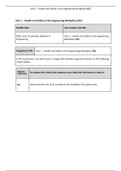
Unit 1 – Health and Safety in the Engineering Workplace (D2)
Unit 1 – Health and Safety in the Engineering Workplace (D2)
Qualification Unit number and title
BTEC Level 3 Subsidiary Diploma in Unit 1 – Health and Safety in the Engineering
Engineering Workplace (D2)
Assignment title Unit 1 – Health and Safety in the Engineering Workplace (D2)
In this assessment, you will receive a 3 page fully detailed assignment answer to the following
criteria below.
Criteria To achieve the criteria the evidence must show that the learner is able to:
reference
D2 Determine the cost of an accident in the workplace from given data.