
APPROACHES
Origins of psychology:
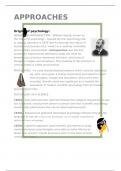
WUNDT AND INTROSPECTION – Wilhelm Wundt, known as
the ‘father of psychology’, opened the first psychology lab
in Leipzig, Germany in 1879 (aim to describe the nature of
human consciousness (the ‘mind’) in a carefully controlled
and scientific environment). Introspection was the first
systematic experimental attempt to study the mind by
breaking up conscious awareness into basic structures of
thoughts, images and sensations. This isolating of the structure of
consciousness is called structuralism
PROCEDURES – he used standardised procedures which could be replicated,
eg. ppts. were given a ticking metronome and asked to report
their thoughts, images and sensations, which were then
recorded. Wundt’s work was significant as it marked the
separation of modern scientific psychology from its broader
psychological roots
PSYCHOLOGY AS A SCIENCE –
1900s - early behaviourists rejected introspection (Watson argued that it was
too subjective, varying from person to person and that ‘scientific psychology’
should study phenomena that can be observed/measured)
1930s - behaviourist approach dominated psychology (Skinner brought the
language of natural sciences into psychology, use of carefully controlled lab
studies and focus on learning)
1950s - cognitive approach used scientific procedures to study
mental processes (psychologists were able to make inferences
about how ‘private’ mental processes work on the basis of tests
conducted in labs)
, 1990s - biological approach introduced technological advances (recording
brain activity, using scanning techniques such as fMRI and EEG, and advanced
genetic research)
The learning approach – behaviourism:
ASSUMPTIONS – all behaviours are learnt from the environment, focus on
observable behaviour, basic processes of learning are the same in all species
(so behaviourists carry out experiments on animals and extrapolate results to
humans), psychology should be scientific and objective, so behaviourists
mainly use lab experiments
CLASSICAL CONDITIONING – learning through association, first demonstrated
by Pavlov. He showed how a neutral stimulus can come to elicit a new learned
response (conditioned response) through association (eg. Watson and Rayner
(1920) Little Albert, associated rat with loud
banging noise and became scared of white rat)
Stimulus generalisation – if a stimulus is
similar to the CS, the association will still be
made
Stimulus discrimination – when the characteristics of the CS and an
object are too different to be generalised
Temporal contiguity – UCS and NS need to be presented
simultaneously for an association to be made
Extinction – if the CS is repeatedly presented without UCS (eg. bell
rang without food), the CR will slowly disappear
Spontaneous recovery – sometimes the previous CS will elicit the CR
at a later time
OPERANT CONDITIONING – learning through
consequences, Skinner said learning is
active, consequences (pleasant or
unpleasant) follow behaviour. Operant
conditioning is proactive
2
Origins of psychology:
WUNDT AND INTROSPECTION – Wilhelm Wundt, known as
the ‘father of psychology’, opened the first psychology lab
in Leipzig, Germany in 1879 (aim to describe the nature of
human consciousness (the ‘mind’) in a carefully controlled
and scientific environment). Introspection was the first
systematic experimental attempt to study the mind by
breaking up conscious awareness into basic structures of
thoughts, images and sensations. This isolating of the structure of
consciousness is called structuralism
PROCEDURES – he used standardised procedures which could be replicated,
eg. ppts. were given a ticking metronome and asked to report
their thoughts, images and sensations, which were then
recorded. Wundt’s work was significant as it marked the
separation of modern scientific psychology from its broader
psychological roots
PSYCHOLOGY AS A SCIENCE –
1900s - early behaviourists rejected introspection (Watson argued that it was
too subjective, varying from person to person and that ‘scientific psychology’
should study phenomena that can be observed/measured)
1930s - behaviourist approach dominated psychology (Skinner brought the
language of natural sciences into psychology, use of carefully controlled lab
studies and focus on learning)
1950s - cognitive approach used scientific procedures to study
mental processes (psychologists were able to make inferences
about how ‘private’ mental processes work on the basis of tests
conducted in labs)
, 1990s - biological approach introduced technological advances (recording
brain activity, using scanning techniques such as fMRI and EEG, and advanced
genetic research)
The learning approach – behaviourism:
ASSUMPTIONS – all behaviours are learnt from the environment, focus on
observable behaviour, basic processes of learning are the same in all species
(so behaviourists carry out experiments on animals and extrapolate results to
humans), psychology should be scientific and objective, so behaviourists
mainly use lab experiments
CLASSICAL CONDITIONING – learning through association, first demonstrated
by Pavlov. He showed how a neutral stimulus can come to elicit a new learned
response (conditioned response) through association (eg. Watson and Rayner
(1920) Little Albert, associated rat with loud
banging noise and became scared of white rat)
Stimulus generalisation – if a stimulus is
similar to the CS, the association will still be
made
Stimulus discrimination – when the characteristics of the CS and an
object are too different to be generalised
Temporal contiguity – UCS and NS need to be presented
simultaneously for an association to be made
Extinction – if the CS is repeatedly presented without UCS (eg. bell
rang without food), the CR will slowly disappear
Spontaneous recovery – sometimes the previous CS will elicit the CR
at a later time
OPERANT CONDITIONING – learning through
consequences, Skinner said learning is
active, consequences (pleasant or
unpleasant) follow behaviour. Operant
conditioning is proactive
2


