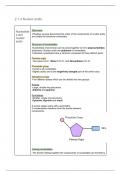
2.1.4 Nucleic acids
Nucleotide Discovery
s and -Phoebus Levene discovered the order of the components of nucleic acids
and called the structure nucleotides.
nucleic
acids
Structure of nucleotides
-Nucleotides (monomers) can be joined together to form polynucleotides
(polymers). Nucleic acids are polymers of nucleotides.
-Individual nucleotides have a structure composed of three distinct parts:
Pentose sugar
-Two types occur: ribose C H O , and deoxyribose C H O .
5 10 5 5 10 4
Phosphate group
-Found in all nucleotides.
-Slightly acidic and is the negatively charged part of the amino acid.
Nitrogenous base
-Five different bases which can be divided into two groups:
Purines
-Large, double ring structures
-Adenine and guanine
Pyrimidines
-Smaller, single ring structures
-Cytosine, thymine and uracil
A purine always pairs with a pyrimidine.
2 condensation reactions form the bonds between
components.
Joining nucleotides
-The bonds holding together the components of nucleotides are formed by
, 2 condensation reactions.
-Two individual nucleotides can be joined by a condensation reaction to
form a dinucleotide. If this process is repeated many times a
polynucleotide is formed, joined by phosphodiester bonds.
Role of nucleotides
Many biologically important molecules containing nucleotides include:
-Deoxyribonucleic acid which contains the genetic information of cells.
-Ribonucleic acid which is involved in protein synthesis.
-Adenosine mono/di/triphosphate, all of which are coenzymes
important in releasing energy.
Adenosine triphosphate
ATP is a phosphorylated molecule. It is a short term energy store found
in all cells, and is easily transported within cells.
-ATP can be hydrolysed to release energy and form adenosine
diphosphate.
-ADP can be reconverted to ATP by the addition of phosphate groups
by phosphorylation.
Polynucleo -Deoxyribonucleic acid is a double stranded polymer of nucleotides
made from the pentose sugar deoxyribose and organic bases adenine,
tides - guanine, cytosine and thymine.
DNA
DNA organisation
Eukaryotes
Majority of DNA inside nucleus
Each large molecule of DNA is wound around histone proteins into
chromosomes
Loop of DNA, without histone proteins, inside mitochondria and
chloroplasts
Prokaryotes
DNA is a loop inside the cytoplasm - not a nucleus
Not wound around histones
A histone is a globular protein. DNA coils/folds around it, which helps
DNA condense and pack down into chromosomes.
Properties of DNA
Stable molecule
-Each polynucleotide strand is held together by covalent bonds called
phosphodiester bonds. These are strong and give the backbone
Nucleotide Discovery
s and -Phoebus Levene discovered the order of the components of nucleic acids
and called the structure nucleotides.
nucleic
acids
Structure of nucleotides
-Nucleotides (monomers) can be joined together to form polynucleotides
(polymers). Nucleic acids are polymers of nucleotides.
-Individual nucleotides have a structure composed of three distinct parts:
Pentose sugar
-Two types occur: ribose C H O , and deoxyribose C H O .
5 10 5 5 10 4
Phosphate group
-Found in all nucleotides.
-Slightly acidic and is the negatively charged part of the amino acid.
Nitrogenous base
-Five different bases which can be divided into two groups:
Purines
-Large, double ring structures
-Adenine and guanine
Pyrimidines
-Smaller, single ring structures
-Cytosine, thymine and uracil
A purine always pairs with a pyrimidine.
2 condensation reactions form the bonds between
components.
Joining nucleotides
-The bonds holding together the components of nucleotides are formed by
, 2 condensation reactions.
-Two individual nucleotides can be joined by a condensation reaction to
form a dinucleotide. If this process is repeated many times a
polynucleotide is formed, joined by phosphodiester bonds.
Role of nucleotides
Many biologically important molecules containing nucleotides include:
-Deoxyribonucleic acid which contains the genetic information of cells.
-Ribonucleic acid which is involved in protein synthesis.
-Adenosine mono/di/triphosphate, all of which are coenzymes
important in releasing energy.
Adenosine triphosphate
ATP is a phosphorylated molecule. It is a short term energy store found
in all cells, and is easily transported within cells.
-ATP can be hydrolysed to release energy and form adenosine
diphosphate.
-ADP can be reconverted to ATP by the addition of phosphate groups
by phosphorylation.
Polynucleo -Deoxyribonucleic acid is a double stranded polymer of nucleotides
made from the pentose sugar deoxyribose and organic bases adenine,
tides - guanine, cytosine and thymine.
DNA
DNA organisation
Eukaryotes
Majority of DNA inside nucleus
Each large molecule of DNA is wound around histone proteins into
chromosomes
Loop of DNA, without histone proteins, inside mitochondria and
chloroplasts
Prokaryotes
DNA is a loop inside the cytoplasm - not a nucleus
Not wound around histones
A histone is a globular protein. DNA coils/folds around it, which helps
DNA condense and pack down into chromosomes.
Properties of DNA
Stable molecule
-Each polynucleotide strand is held together by covalent bonds called
phosphodiester bonds. These are strong and give the backbone