
India 2F A level ALL
Study online at https://quizlet.com/_d3n4lb
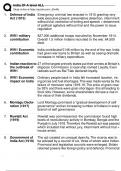
1. Defence of India Emergency criminal law enacted in 1915 granting very
Act (1915) wide executive powers: preventative detention, internment
without trial, restriction of writing and speech + detainment
of political agitators without trial and the power to issue
regulation
2. WW1 military 827,000 additional troops recruited by November 1914.
contribution Overall 1.5 million Indians recruited to the war. 64,500
died.
3. WW1 Economic India contributed £146 million by the end of the war. India
contribution had given war loans to Britain as well as seeing dramatic
increases in military expenditure.
4. Indian reaction to 27 of the largest princely states put their armies at Britain's
the outbreak of disposal. Commission a royal ship named Loyalty. Even
WW1 radicals such as Bal Tilak declared loyalty.
5. WW1 Economic Ordinary people back in India felt increased taxation, ris-
impact on India ing prices and fuel shortages. This was made worse by the
failure of monsoon rains 1918-19. The price of grain rose
by 93% and there were grain shortages- this all leading to
food riots. However, some shareholders did see a rise in
the value of their dividends.
6. Montagu Decla- Lord Montagu promised a "gradual development of self
ration (1917) governance" and an increasing number of Indians in every
branch of self governance
7. Rowlatt Act Rowlatt was commissioned- the commission found high
(1919) levels of revolutionary activity in Bombay, Bengal and the
Punjab in July 1918. Therefore the Rowlatt act was passed
which included trial without jury, internment without trial +
house arrest.
8. Government of The act created an unequal dyarchy. The viceroy was to
India Act (1919) be advised by a council of six, three of whom were Indian.
Provincial and legislative councils were enlarged. Britain
retained powers like foreign policy and defence. Provincial
, India 2F A level ALL
Study online at https://quizlet.com/_d3n4lb
assemblies enfranchised women and seats were reserved
for minority groups.
9. Amritsar Mas- In opposition to the Rowlatt Act, Hartals were organised
sacre (1919) for 30 March and 6 April 1919- there was hindu/muslim
co-operation and no serious unrest. Two organisers were
put under house arrest which turned action violent and
three europeans were killed. On April 13 it was Baisakhi
Day, an important religious festival. Many congregated in
Jallianwala Bagh, where Dyer and his men marched into
the narrow entrance, firing 1650 round of live ammunition,
injuring 1500 and killing 400.
10. Dyer's actions af- Dyer then established Martial Law in India. Any Indian
ter Amritsar Mas- passing an Indian had to salaam, public floggings were
sacre common to the guilty and the innocent. The crawling order
was enacted which meant Indians passing along the street
where Marcia Sherwood was beaten had to crawl in the
filth which was especially offensive to Hindus due to caste
purity.
11. Response to Am- Hunter commission found Dyer acted out of order and that
ritsar Massacre there was no evidence of an organised revolution- Dyer
was forced to admit he had not warned before he fired
and would've used machine guns if he could. In India the
Punjab sub-committee of the INC set up it's own enquiry,
publishing verified witness statements and graphic pho-
tos.
12. The Lucknow In 1916 Congress and the Muslim League reached an
Pact and the Role agreement about self government: separate electorates
of Jinnah for all communities until/unless they requested a joint one.
Jinnah (a secularist) was uneasy about the sense of Is-
lamic identity separate electorates gave people and he
worked with congress to reach agreements.
13. Home Rule brought ordinary Indians into the nationalist movement.
Leagues 1916 Tilak's Home Rule League operated in Western India
and grew to 32,000 members rapidly. Annie Besant's All
India League grew more slowly, but steadily. Home rule
Study online at https://quizlet.com/_d3n4lb
1. Defence of India Emergency criminal law enacted in 1915 granting very
Act (1915) wide executive powers: preventative detention, internment
without trial, restriction of writing and speech + detainment
of political agitators without trial and the power to issue
regulation
2. WW1 military 827,000 additional troops recruited by November 1914.
contribution Overall 1.5 million Indians recruited to the war. 64,500
died.
3. WW1 Economic India contributed £146 million by the end of the war. India
contribution had given war loans to Britain as well as seeing dramatic
increases in military expenditure.
4. Indian reaction to 27 of the largest princely states put their armies at Britain's
the outbreak of disposal. Commission a royal ship named Loyalty. Even
WW1 radicals such as Bal Tilak declared loyalty.
5. WW1 Economic Ordinary people back in India felt increased taxation, ris-
impact on India ing prices and fuel shortages. This was made worse by the
failure of monsoon rains 1918-19. The price of grain rose
by 93% and there were grain shortages- this all leading to
food riots. However, some shareholders did see a rise in
the value of their dividends.
6. Montagu Decla- Lord Montagu promised a "gradual development of self
ration (1917) governance" and an increasing number of Indians in every
branch of self governance
7. Rowlatt Act Rowlatt was commissioned- the commission found high
(1919) levels of revolutionary activity in Bombay, Bengal and the
Punjab in July 1918. Therefore the Rowlatt act was passed
which included trial without jury, internment without trial +
house arrest.
8. Government of The act created an unequal dyarchy. The viceroy was to
India Act (1919) be advised by a council of six, three of whom were Indian.
Provincial and legislative councils were enlarged. Britain
retained powers like foreign policy and defence. Provincial
, India 2F A level ALL
Study online at https://quizlet.com/_d3n4lb
assemblies enfranchised women and seats were reserved
for minority groups.
9. Amritsar Mas- In opposition to the Rowlatt Act, Hartals were organised
sacre (1919) for 30 March and 6 April 1919- there was hindu/muslim
co-operation and no serious unrest. Two organisers were
put under house arrest which turned action violent and
three europeans were killed. On April 13 it was Baisakhi
Day, an important religious festival. Many congregated in
Jallianwala Bagh, where Dyer and his men marched into
the narrow entrance, firing 1650 round of live ammunition,
injuring 1500 and killing 400.
10. Dyer's actions af- Dyer then established Martial Law in India. Any Indian
ter Amritsar Mas- passing an Indian had to salaam, public floggings were
sacre common to the guilty and the innocent. The crawling order
was enacted which meant Indians passing along the street
where Marcia Sherwood was beaten had to crawl in the
filth which was especially offensive to Hindus due to caste
purity.
11. Response to Am- Hunter commission found Dyer acted out of order and that
ritsar Massacre there was no evidence of an organised revolution- Dyer
was forced to admit he had not warned before he fired
and would've used machine guns if he could. In India the
Punjab sub-committee of the INC set up it's own enquiry,
publishing verified witness statements and graphic pho-
tos.
12. The Lucknow In 1916 Congress and the Muslim League reached an
Pact and the Role agreement about self government: separate electorates
of Jinnah for all communities until/unless they requested a joint one.
Jinnah (a secularist) was uneasy about the sense of Is-
lamic identity separate electorates gave people and he
worked with congress to reach agreements.
13. Home Rule brought ordinary Indians into the nationalist movement.
Leagues 1916 Tilak's Home Rule League operated in Western India
and grew to 32,000 members rapidly. Annie Besant's All
India League grew more slowly, but steadily. Home rule


