
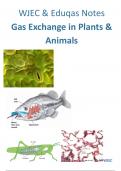
WJEC & Eduqas Notes
Gas Exchange in Plants &
Animals
WJEC
,Unit 1
Eduqas Component 3 (A-Level Only)
1
STUDY CHECKLIST AND ASSESSMENT
OBJECTIVES
Instructions
Regular revision throughout the year is essential. It’s vital you keep a track of what you
understand and what you don’t understand. This booklet is designed to help you do this.
Use the following key to note how well you understand the work after your revision. Put the
letter R, A or G in the table. If you place an R or an A then you should make a note of what
you are struggling with and the end of this book under the relevant section and seek help
with this.
Key
R = Red. I am not confident about my knowledge and understanding
A = Amber. I am fairly confident about my knowledge and understanding
G = green. I am very confident about my knowledge and understanding
2
, The following points are what you need to know, revise an
answer questions on.
Adaptations for Gas Exchange In Animals & Plants
1. Can you describe the general principles of gas exchange?
2. Can you describe and list the features of a gas exchange surface and related this to Fick’s law?
3. Can you explain the importance of volume, surface area and surface area to volume ratio to gas
exchange?
4. Can you calculate the volume, surface area and surface area to volume ratio for a cube and a sphere?
5. Can you explain the relationship between the volume of an organism and its oxygen requirement?
6. Can you explain the relationship between the surface area of an organism and its supply of oxygen?
7. Can you explain why unicellular organisms like amoeba and multicellular organisms like the earthwo
and the flatworm can survive with gas exchange occurring across their body surface?
8. Can you explain why some animals need specialised gas exchange organs?
9. Can you label/describe the gas exchange organ for a fish?
10. Can you label/describe the gas exchange organ for an Insect?
11. Can you label/describe the gas exchange organ for a human?
12. Can you interpret histology images of the human lung?
13. Can you describe and explain the ventilation mechanism in a fish?
14. Can you describe and explain the ventilation mechanism in an insect?
15. Can you describe and explain the ventilation mechanism in a human?
16. Can you describe the relationship between volume and pressure?
17. Can you describe and explain the counter current exchange mechanism in a bony fish?
18. Can you describe and explain the parallel flow mechanism in a cartilaginous fish?
19. Can you describe/explain how amphibian’s carryout gas exchange?
20. Can you label a drawing/histology image of a dicotyledonous leaf?
21. Can you explain how a dicotyledonous leaf is adapted for efficient photosynthesis?
22. Can you explain how a dicotyledonous leaf is adapted for efficient gas exchange?
, 23. Can you explain the role of stomata in gas exchange and the mechanism by which they open and clo
3
Assessment Objective Description
AO1 Demonstrate knowledge and understanding of scientific ideas, proces
AO2 Apply knowledge and understanding of scientific ideas, processes, tech
procedures: • In a theoretical context
• In a practical context
• When handling qualitative data
• When handling quantitative data
AO3 Analyse, interpret and evaluate scientific information, ideas and evide
to: • Make judgments and reach conclusions
• Develop and refine practical design and procedures
4
WORD BANK
Below is a list of some key words and phrases you will need to learn and understand in this gas exchange
topic.
24. Intercostal muscles
1. Air space
25. Lamellae
2. Alveolus
26. Light intensity
3. Amoeba
27. Lower epidermis
4. Angiosperm
28. Malate
5. Bony fish
29. Operculum
6. Bronchi
30. Palisade mesophyll cells 31. Parallel
7. Bronchiole
flow
8. Buccal cavity
32. Phloem
9. Cartilaginous fish
33. Pleural cavity
10. Concentration gradient 11. Counter
34. Ribs
current flow 12. Cuticle
35. Spiracle
13. Cuticle
36. Spongey mesophyll cells 37.
14. Diaphragm
Squamous epithelium 38. Stomata
15. Dicotyledonous
39. Surface area
16. Diffusion
40. Surface area to volume ration 41.
17. Earthworm
Surfactant
18. Elastic fibers
42. Trachea
19. Flatworm 43. Tracheal system 44. Upper epidermis
20. Gas exchange surface. 21. Gill arch 45. Vascular bindle 46. Ventilation 47.
22. Gills Xylem
23. Guard cells
Gas Exchange in Plants &
Animals
WJEC
,Unit 1
Eduqas Component 3 (A-Level Only)
1
STUDY CHECKLIST AND ASSESSMENT
OBJECTIVES
Instructions
Regular revision throughout the year is essential. It’s vital you keep a track of what you
understand and what you don’t understand. This booklet is designed to help you do this.
Use the following key to note how well you understand the work after your revision. Put the
letter R, A or G in the table. If you place an R or an A then you should make a note of what
you are struggling with and the end of this book under the relevant section and seek help
with this.
Key
R = Red. I am not confident about my knowledge and understanding
A = Amber. I am fairly confident about my knowledge and understanding
G = green. I am very confident about my knowledge and understanding
2
, The following points are what you need to know, revise an
answer questions on.
Adaptations for Gas Exchange In Animals & Plants
1. Can you describe the general principles of gas exchange?
2. Can you describe and list the features of a gas exchange surface and related this to Fick’s law?
3. Can you explain the importance of volume, surface area and surface area to volume ratio to gas
exchange?
4. Can you calculate the volume, surface area and surface area to volume ratio for a cube and a sphere?
5. Can you explain the relationship between the volume of an organism and its oxygen requirement?
6. Can you explain the relationship between the surface area of an organism and its supply of oxygen?
7. Can you explain why unicellular organisms like amoeba and multicellular organisms like the earthwo
and the flatworm can survive with gas exchange occurring across their body surface?
8. Can you explain why some animals need specialised gas exchange organs?
9. Can you label/describe the gas exchange organ for a fish?
10. Can you label/describe the gas exchange organ for an Insect?
11. Can you label/describe the gas exchange organ for a human?
12. Can you interpret histology images of the human lung?
13. Can you describe and explain the ventilation mechanism in a fish?
14. Can you describe and explain the ventilation mechanism in an insect?
15. Can you describe and explain the ventilation mechanism in a human?
16. Can you describe the relationship between volume and pressure?
17. Can you describe and explain the counter current exchange mechanism in a bony fish?
18. Can you describe and explain the parallel flow mechanism in a cartilaginous fish?
19. Can you describe/explain how amphibian’s carryout gas exchange?
20. Can you label a drawing/histology image of a dicotyledonous leaf?
21. Can you explain how a dicotyledonous leaf is adapted for efficient photosynthesis?
22. Can you explain how a dicotyledonous leaf is adapted for efficient gas exchange?
, 23. Can you explain the role of stomata in gas exchange and the mechanism by which they open and clo
3
Assessment Objective Description
AO1 Demonstrate knowledge and understanding of scientific ideas, proces
AO2 Apply knowledge and understanding of scientific ideas, processes, tech
procedures: • In a theoretical context
• In a practical context
• When handling qualitative data
• When handling quantitative data
AO3 Analyse, interpret and evaluate scientific information, ideas and evide
to: • Make judgments and reach conclusions
• Develop and refine practical design and procedures
4
WORD BANK
Below is a list of some key words and phrases you will need to learn and understand in this gas exchange
topic.
24. Intercostal muscles
1. Air space
25. Lamellae
2. Alveolus
26. Light intensity
3. Amoeba
27. Lower epidermis
4. Angiosperm
28. Malate
5. Bony fish
29. Operculum
6. Bronchi
30. Palisade mesophyll cells 31. Parallel
7. Bronchiole
flow
8. Buccal cavity
32. Phloem
9. Cartilaginous fish
33. Pleural cavity
10. Concentration gradient 11. Counter
34. Ribs
current flow 12. Cuticle
35. Spiracle
13. Cuticle
36. Spongey mesophyll cells 37.
14. Diaphragm
Squamous epithelium 38. Stomata
15. Dicotyledonous
39. Surface area
16. Diffusion
40. Surface area to volume ration 41.
17. Earthworm
Surfactant
18. Elastic fibers
42. Trachea
19. Flatworm 43. Tracheal system 44. Upper epidermis
20. Gas exchange surface. 21. Gill arch 45. Vascular bindle 46. Ventilation 47.
22. Gills Xylem
23. Guard cells


