

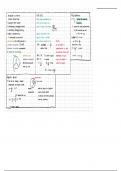
an object in uniform radians key equations:
circular motion has ↳ the angle subtended at the • T-f (period of rotation)
constant linear speed centre of a circle by an are frequency
s
• continuously changing direction equal in length to the radius. f = amount of revolutions/rotations
r
• constantly changing velocity I:& e. g 36 revolutions per min
• object is accelerating angular displacement is the f = 36 ÷ 60 = 0.6
↳ centripetal acceleration change in angle, in radians, • speed (v) → v=wr
centripetal force acts in same direction as as it rotates around a circle. Top Tip: W = 2T for 2¥
centripetal acceleration. F = ma] DO = arc length = AS put calculator in
• "mittal force:
radius of circle r F = mw²r
centripetal acceleration is perpendicular degrees/radians if using
r
to direction of travel/velocity. trig functions (sin, cos, tan)
v centripetal force 360. = 2T To convert degrees depending on if you a=w²r or a- v2
r
F a centripetal acceleration 180' = I to radians want your answer in
a both directed towards 1 "=# ⑥ ×, = 0rad radians or degrees.
F a
^ centre of circle.
0° = 0rad ✗ 18¥
Angular speed angular speed
→ the rate of change in angular r linear speed
DO
displacement with respect to time.
W=p♀ (s-1) angular when an object is in uniform
displacement circular motion, speed
is constant but velocity changes
W = ¥= 2 "5:44; 300-cycle
direction constantly.
I
V = Linear speed
circular motion has ↳ the angle subtended at the • T-f (period of rotation)
constant linear speed centre of a circle by an are frequency
s
• continuously changing direction equal in length to the radius. f = amount of revolutions/rotations
r
• constantly changing velocity I:& e. g 36 revolutions per min
• object is accelerating angular displacement is the f = 36 ÷ 60 = 0.6
↳ centripetal acceleration change in angle, in radians, • speed (v) → v=wr
centripetal force acts in same direction as as it rotates around a circle. Top Tip: W = 2T for 2¥
centripetal acceleration. F = ma] DO = arc length = AS put calculator in
• "mittal force:
radius of circle r F = mw²r
centripetal acceleration is perpendicular degrees/radians if using
r
to direction of travel/velocity. trig functions (sin, cos, tan)
v centripetal force 360. = 2T To convert degrees depending on if you a=w²r or a- v2
r
F a centripetal acceleration 180' = I to radians want your answer in
a both directed towards 1 "=# ⑥ ×, = 0rad radians or degrees.
F a
^ centre of circle.
0° = 0rad ✗ 18¥
Angular speed angular speed
→ the rate of change in angular r linear speed
DO
displacement with respect to time.
W=p♀ (s-1) angular when an object is in uniform
displacement circular motion, speed
is constant but velocity changes
W = ¥= 2 "5:44; 300-cycle
direction constantly.
I
V = Linear speed


