Academic Skills: Book
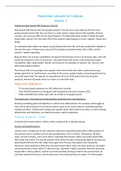
1A: What is Research?
Research is a process we use to understand our world in a way that goes
far beyond simple description, common sense or anecdote by extending
our knowledge to find answers to our questions
process = an An on-going, often continuous series of actions intended
to achieve a specific result. This often requires the researcher to follow an
established set of (usually) routine procedures.
question acquire knowledge extend understanding of the social
world
Characteristics of research:
1. The question
2. The research process
3. The answer
The nature of research is:
- Structured and purposeful
- Rigorous (thorough and careful)
not just data collection and analysis, but design and ethical
considerations as well
- Robust and defensible
defend conclusions
- Systematic
people, cases, data sets etc. all treated in the same way
not just simply gathering information or facts
Research quality:
- Reliability or dependability
can my results be replicated by other researchers using the same
methods?
social sciences can never expect exactly the same results, but it
should be similar for similar groups
dependability = all date is included, no data is lost through
unreliable audio recorders or inaccurate transcribers
transparency = research process is recorded
- Validity and credibility
Am I researching the thing that I think I am
are the data I’m gathering relevant to my research question?
credibility = believability of researcher’s interpretations of the data
- Generalizability and transferability
are results true for or relevant to wider population
- Ethical practice
possible impact on research participants
Useful things:
- Research is a process
- Has to be planned, doesn’t happen by accident
, - Facts and data are not the same as knowledge
- Description is not the same as explanation
1B: knowledge, theories, paradigms, perspectives
Ontology = the science of what is, of the kinds and structures of
objects, properties, events, processes and relations in every area of
reality
Epistemology = theory of knowledge and how we know things
Social sciences is different from natural sciences because we are
studying something we are a part from.
Five ways of knowing not just collection of facts:
- Belief: we believe it to be true
- Authoritative knowledge: someone tells us it’s true
- Experiential knowing
- Theoretical knowing: have a theory or set of ideas
- Empirical knowledge: based on available research evidence
Knowledge can only be partial because of the nature of the social world
Different ontology views: what can we know?
- Objectivism = social phenomena that make up our social world
exist on their own, apart from and independent of the social actors
(humans) who are involved
objective observation
often taken by natural scientists (animals, plants, chemicals etc.)
social perspective family: defined by law or custom, life events:
marriage, birth etc.
Family represents a particular set of relationships and behaviors to
which individual members conform to differing degrees
- Constructivism = the social phenomena making up our social
world are only real in the sense that they are constructed ideas
which are continually being reviewed and reworked by those
involved in them through social interaction and reflection
constructive perspective family: product of meaning given to it by
the participants in particular time, space and culture what do
people understand as family? What does it mean to be a parent?
(continually being reviewed)
- Realism = social worlds has a reality that is separate from the
social actors involved in it, it can be known through the senses as
well as the effects of ‘hidden’ structures and mechanisms.
realistic perspective family: there are hidden mechanisms and
structures present in order for the family to take a particular form
need for security, physical care etc.
Different epistemological views: how do we know?
- Positivism = knowledge is based on what can be observed and
recorded
objective, hypothesis to test data, use quantitative data,
measurements of the social world, causal relationships
1A: What is Research?
Research is a process we use to understand our world in a way that goes
far beyond simple description, common sense or anecdote by extending
our knowledge to find answers to our questions
process = an An on-going, often continuous series of actions intended
to achieve a specific result. This often requires the researcher to follow an
established set of (usually) routine procedures.
question acquire knowledge extend understanding of the social
world
Characteristics of research:
1. The question
2. The research process
3. The answer
The nature of research is:
- Structured and purposeful
- Rigorous (thorough and careful)
not just data collection and analysis, but design and ethical
considerations as well
- Robust and defensible
defend conclusions
- Systematic
people, cases, data sets etc. all treated in the same way
not just simply gathering information or facts
Research quality:
- Reliability or dependability
can my results be replicated by other researchers using the same
methods?
social sciences can never expect exactly the same results, but it
should be similar for similar groups
dependability = all date is included, no data is lost through
unreliable audio recorders or inaccurate transcribers
transparency = research process is recorded
- Validity and credibility
Am I researching the thing that I think I am
are the data I’m gathering relevant to my research question?
credibility = believability of researcher’s interpretations of the data
- Generalizability and transferability
are results true for or relevant to wider population
- Ethical practice
possible impact on research participants
Useful things:
- Research is a process
- Has to be planned, doesn’t happen by accident
, - Facts and data are not the same as knowledge
- Description is not the same as explanation
1B: knowledge, theories, paradigms, perspectives
Ontology = the science of what is, of the kinds and structures of
objects, properties, events, processes and relations in every area of
reality
Epistemology = theory of knowledge and how we know things
Social sciences is different from natural sciences because we are
studying something we are a part from.
Five ways of knowing not just collection of facts:
- Belief: we believe it to be true
- Authoritative knowledge: someone tells us it’s true
- Experiential knowing
- Theoretical knowing: have a theory or set of ideas
- Empirical knowledge: based on available research evidence
Knowledge can only be partial because of the nature of the social world
Different ontology views: what can we know?
- Objectivism = social phenomena that make up our social world
exist on their own, apart from and independent of the social actors
(humans) who are involved
objective observation
often taken by natural scientists (animals, plants, chemicals etc.)
social perspective family: defined by law or custom, life events:
marriage, birth etc.
Family represents a particular set of relationships and behaviors to
which individual members conform to differing degrees
- Constructivism = the social phenomena making up our social
world are only real in the sense that they are constructed ideas
which are continually being reviewed and reworked by those
involved in them through social interaction and reflection
constructive perspective family: product of meaning given to it by
the participants in particular time, space and culture what do
people understand as family? What does it mean to be a parent?
(continually being reviewed)
- Realism = social worlds has a reality that is separate from the
social actors involved in it, it can be known through the senses as
well as the effects of ‘hidden’ structures and mechanisms.
realistic perspective family: there are hidden mechanisms and
structures present in order for the family to take a particular form
need for security, physical care etc.
Different epistemological views: how do we know?
- Positivism = knowledge is based on what can be observed and
recorded
objective, hypothesis to test data, use quantitative data,
measurements of the social world, causal relationships