
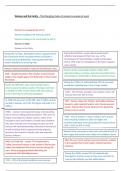
Women and the family – The Changing status of women & women at work
Women in propaganda (p.121-2)
Women working in the towns (p.123-4)
Women working in the countryside (p.124-5)
Women in WW2
Women in the Party
During the Civil War, Zhenotdel (women’s department of During the Civil War, women jobs in government
the Communist Party) recruited women to fill jobs in reflected stereotypes of their role, e.g., in the
nursing and food distribution, showing the belief that Commissariat of Social Welfare, Health or Education.
women should be in nurturing roles. And in 1918, only 5% of delegates to the Party Congress
were women.
Women mainly presented in maternal and domestic roles.
Women in the countryside worked a ‘triple shift’ –
1928 – Sergei Eisenstein’s film October mocked female agricultural labour on farms, domestic household chores
soldiers who fought against the Bolsheviks in the October and working on handicrafts to bring extra family income.
Revolution.
During the 1920s it is estimated that 39% of men used
Under the NEP there were only 8 female factory prostitutes indicating that it was a large market.
drivers across the whole country. This figure had risen
to 50,000 by 1940. Tractor drivers still only made up 1928 – 12% of Party members were women, only a 2%
0.5% of the total rural female population. increase from the 10% in 1918.
In 1928, the last years of the NEP, only 3 million women 1937 - famous statue the ‘Worker and Kolkhoz Woman’
worked in industry. By 1940, that figure had leapt to 13 showed a male industrial worker and a female peasant
million. worker. Showed that Soviets believed men played the
primary role in society.
1930s – women were expected to play a homemaking
role as well as holding political positions. They were no
longer encouraged to employ nannies, rather to be 1940 – 41% of workers in heavy industry were women
exemplary wives and mothers. Female Party members and increasing numbers of places in higher and
who were married were encouraged to give up work technical education were being offered to women (from
and join the obshchesttvennitsa movement (movement 20% in 1929 to 40% in 1940)
of wife activists) and be expected to help organise
nurseries, be involved in charity work and supervise Women in the same jobs as men were only paid 60-65% of
factory canteens. their wages and women were subject to workplace abuse.
After the war, heroic women were presented as symbols
WW2 and Cold War – poster ‘The Motherland is
of the equality that Soviet leaders claimed had been
Calling’ presented women as the symbol of the Russian
achieved.
nation and celebrated the work of women during the
wars. Soviet propaganda linked defending the
motherland with defending women. During the 1960s, around 45% of industrial jobs
belonged to women, however they were restricted to
work in light industry and low-skilled labour.
1955 – 49% of the Soviet workforce were women.


