
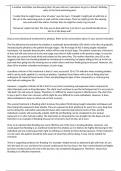
A mother and father are discussing their 10-year-old son’s reluctance to go to a friend’s birthday
party at the local swimming pool.
‘I really think he might have a fear of water’ says his mum. ‘I thought I might just sit with him in
the car at the swimming pool car park until he calms down. Then we might go into the viewing
area and watch the others. Perhaps then he might be ready to go in pool’.
‘Nonsense’ replies his dad. The only way to deal with fear is to face it; we should literally throw
him in at the deep end!’
Discuss two behavioural treatments for phobias. Refer to the conversation above in your answer (16marks)
The first behavioural treatment for phobias is systematic desensitisation (SD) which is the idea of gradually
introducing the phobia to the patient through stages. The first stage of this is being taught relaxation
techniques, for example deep breaths, which will be used at each stage. The patient constructs a hierarchy
of fear and will only move on to the next stage once they’re fully relaxed at the previous stage. It uses the
idea that you cannot be both afraid and relaxed at the same time. The mother therefore uses SD as she
suggests that their son should gradually be introduced to swimming; he begins sitting in the car in the car
park and then going into the viewing area to watch others and then finally going in the pool. However, she
does fail to mention relaxation techniques at each stage.
A positive criticism of this treatment is that it’s very successful. SD is 75% effective when treating phobias
and it can be easily applied to a variety of phobias. Capafons found those with a fear of flying who had
undergone SD reported lower levels of fear and physiological signs of fear compared to a control group
who had not undergone SD.
However, a negative criticism of SD is that it is very time consuming and expensive when compared to
other therapies such as drug therapies. The client must continue to use the techniques but it is very easy to
‘slip back’ into old ways of coping. Therefore, it’s difficult to assess long-term effectiveness. The client has
to pay a part in their own recovery which might be very difficult for some individuals. However, it does
allow individuals to have an active role in their recovery.
The second treatment is flooding which involves the patient firstly being taught relaxation techniques and
then being fully exposed to their phobia. They are exposed to their phobia at its worst for a very long time
but by doing this, adrenaline naturally decreases after experiencing extreme levels of fear and the
individual’s anxiety will eventually subside. Both SD and flooding can be completed in vivo (actual
exposure) or in vitro (virtual reality). The dad insists on throwing the son straight into the deep end and
therefore is an example of flooding because he is forced to face his fear all at once.
Choy et al reported that flooding was more effective out of the two in treating phobias. However, one
could argue that flooding is an unethical treatment for phobias as it is likely to be highly distressing for the
individual and one could argue their right to withdraw is denied to them during exposure. If this treatment
is to be used, the patient should be fully aware of what they will be doing. It may not be suitable for
everyone.
There is supporting evidence for flooding. For example, Wolpe forced an adolescent girl with fears of cars
into the back of a car and drove her around continuously for four hours: her fear reached hysterical heights
but then receded and by the end of the journey, had completely disappeared. Therefore, shows that
flooding is an effective treatment.
party at the local swimming pool.
‘I really think he might have a fear of water’ says his mum. ‘I thought I might just sit with him in
the car at the swimming pool car park until he calms down. Then we might go into the viewing
area and watch the others. Perhaps then he might be ready to go in pool’.
‘Nonsense’ replies his dad. The only way to deal with fear is to face it; we should literally throw
him in at the deep end!’
Discuss two behavioural treatments for phobias. Refer to the conversation above in your answer (16marks)
The first behavioural treatment for phobias is systematic desensitisation (SD) which is the idea of gradually
introducing the phobia to the patient through stages. The first stage of this is being taught relaxation
techniques, for example deep breaths, which will be used at each stage. The patient constructs a hierarchy
of fear and will only move on to the next stage once they’re fully relaxed at the previous stage. It uses the
idea that you cannot be both afraid and relaxed at the same time. The mother therefore uses SD as she
suggests that their son should gradually be introduced to swimming; he begins sitting in the car in the car
park and then going into the viewing area to watch others and then finally going in the pool. However, she
does fail to mention relaxation techniques at each stage.
A positive criticism of this treatment is that it’s very successful. SD is 75% effective when treating phobias
and it can be easily applied to a variety of phobias. Capafons found those with a fear of flying who had
undergone SD reported lower levels of fear and physiological signs of fear compared to a control group
who had not undergone SD.
However, a negative criticism of SD is that it is very time consuming and expensive when compared to
other therapies such as drug therapies. The client must continue to use the techniques but it is very easy to
‘slip back’ into old ways of coping. Therefore, it’s difficult to assess long-term effectiveness. The client has
to pay a part in their own recovery which might be very difficult for some individuals. However, it does
allow individuals to have an active role in their recovery.
The second treatment is flooding which involves the patient firstly being taught relaxation techniques and
then being fully exposed to their phobia. They are exposed to their phobia at its worst for a very long time
but by doing this, adrenaline naturally decreases after experiencing extreme levels of fear and the
individual’s anxiety will eventually subside. Both SD and flooding can be completed in vivo (actual
exposure) or in vitro (virtual reality). The dad insists on throwing the son straight into the deep end and
therefore is an example of flooding because he is forced to face his fear all at once.
Choy et al reported that flooding was more effective out of the two in treating phobias. However, one
could argue that flooding is an unethical treatment for phobias as it is likely to be highly distressing for the
individual and one could argue their right to withdraw is denied to them during exposure. If this treatment
is to be used, the patient should be fully aware of what they will be doing. It may not be suitable for
everyone.
There is supporting evidence for flooding. For example, Wolpe forced an adolescent girl with fears of cars
into the back of a car and drove her around continuously for four hours: her fear reached hysterical heights
but then receded and by the end of the journey, had completely disappeared. Therefore, shows that
flooding is an effective treatment.


