
Unit 9 - Computer Networks
Unit 9 - Computer Networks
Wireless Technologies
Infrared
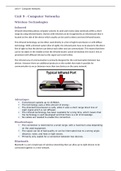
Infrared networking allows computer systems to send and receive data wirelessly within a short
range by using infrared beams. Devices with infrared can be recognised by an infrared port that is
located on the side of the device which usually can be used to detect and send infrared beams.
This infrared technology can be either used directly in a line-of-sight transmission or with difuse
technology. With a directed system (line-of-sight), the infrared ports have to be placed in the direct
line of sight so that the devices can detect each other and can communicate. This means that there
can be no object in the middle so that the infrared beams cannot be blocked; this issue is less as
prominent with difused infrared as this signal can travel further.
The infrared way of communicaton is primarily designed for the communicaton between two
devices. However there are additonal products on the market that make it possible for
communicaton to occur between more than two devices on the same network.
Advantages
Transmission speeds up to 16 Mbit/s
The technology uses a little amount of energy.
The directed transmission is safe, while it uses a short range direct line of
sight signal which is not difused.
The infrared technology has been available for a long time, which means that
the technology is well developed and that there is a lot of knowledge.
No cables are needed to enable the connection.
Disadvantages
The connection is restricted to a small range, with a maximum area depending
on the used equipment.
The signal can be of bad quality or can be interrupted due to a wrong angle,
distance, noise, and heat or light waves.
Primarily only usable for a connection between two devices.
Bluetooth
Bluetooth is a very simple type of wireless networking that can allow up to eight devices to be
connected together in a mini-network.


