
Lexi Thomas Unit 1 P3
Organisational Structure and Strategic Planning
Ikea is a global business with over three hundred stores across the world with
an annual turnover of over €28billion. Ikea prides its company on providing low
costing, modern fat pack furniture to a large afordable consumer market. The
business is marketed heavily around its aspect of providing its furniture in fat
pack boxes, which commenced in the early 1950’s just a decade after the
company was founded in 1943 in Sweden.
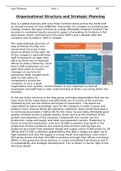
The organisational structure of
Ikea is formed of a fat, non-
hierarchical structure in few
layers as shown to the right. All
of the company’s administration
staf is housed in an open plan
office so there are no separate
offices to show a hierarchy. All of
Ikea’s staf employees can call
upon their store or country
manager at any time for
assistance when needed which
adds to their policy of
transparency across the
company. In such a large
organisation such as Ikea, communication is very important so that all
employees and staf have a clear understanding of what is occurring within the
business.
At the top of the structure is the Ikea group and Ingka stakeholders that are the
main drive of the organisation and efectively are in control of the business.
Followed by this are the entities and board of supervisors. This board are
responsible for planning strategic aims for the company in order to grow and
produce more revenue whilst also pleasing customers. Ikea’s prominent goal is
to continuously provide a ‘better life for the many’ by providing afordable good
quality furniture so this is always heavily driven and is at the forefront of the
growth and expansion of the company. Underneath this section are the
production, range and supply and retail and expansion sectors. Production is
home to forty-four production units and 18,400 co-workers that assist in the
production of Ikea’s products and ensuring that all items sold by Ikea are
produced up to their high standard. Range and supply covers 9,500 products, 28
offices and 15,100 co-workers guaranteeing that Ikea’s ranges are again up to
high standard and that the supply is strong. Retail and expansion cover Ikea’s
303 group stores and their 101,500 co-workers amongst their offices and stores.
Within in the group functions sections, it covers everything from fnance and IT
to sustainability and strategic development. This is shown in the far right of the
structure above.
Organisational Structure and Strategic Planning
Ikea is a global business with over three hundred stores across the world with
an annual turnover of over €28billion. Ikea prides its company on providing low
costing, modern fat pack furniture to a large afordable consumer market. The
business is marketed heavily around its aspect of providing its furniture in fat
pack boxes, which commenced in the early 1950’s just a decade after the
company was founded in 1943 in Sweden.
The organisational structure of
Ikea is formed of a fat, non-
hierarchical structure in few
layers as shown to the right. All
of the company’s administration
staf is housed in an open plan
office so there are no separate
offices to show a hierarchy. All of
Ikea’s staf employees can call
upon their store or country
manager at any time for
assistance when needed which
adds to their policy of
transparency across the
company. In such a large
organisation such as Ikea, communication is very important so that all
employees and staf have a clear understanding of what is occurring within the
business.
At the top of the structure is the Ikea group and Ingka stakeholders that are the
main drive of the organisation and efectively are in control of the business.
Followed by this are the entities and board of supervisors. This board are
responsible for planning strategic aims for the company in order to grow and
produce more revenue whilst also pleasing customers. Ikea’s prominent goal is
to continuously provide a ‘better life for the many’ by providing afordable good
quality furniture so this is always heavily driven and is at the forefront of the
growth and expansion of the company. Underneath this section are the
production, range and supply and retail and expansion sectors. Production is
home to forty-four production units and 18,400 co-workers that assist in the
production of Ikea’s products and ensuring that all items sold by Ikea are
produced up to their high standard. Range and supply covers 9,500 products, 28
offices and 15,100 co-workers guaranteeing that Ikea’s ranges are again up to
high standard and that the supply is strong. Retail and expansion cover Ikea’s
303 group stores and their 101,500 co-workers amongst their offices and stores.
Within in the group functions sections, it covers everything from fnance and IT
to sustainability and strategic development. This is shown in the far right of the
structure above.


