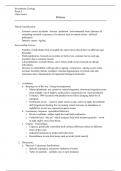
Invertebrate Zoology
Week 5
Chris Foster
Defense
Threat Classification;
- Extrinsic causes: accidents / disease / predation / environmental stress [absence of
something essential or presence of a stressor such as natural toxins / artificial
pollutants]
- Intrinsic causes: Ageing
Survivorship Curves;
- Number of individuals born at roughly the same time [cohort] alive at different ages
thereafter.
- Field populations; focused on juveniles or fairly even, constant rate at each age,
mortality due to extrinsic factors
- Lab populations; exclude threats, curve where death occurs focused on old-age
individuals.
- Increase in vulnerability with age due to ageing / senescence. Ageing occurs when
extrinsic mortality factors excluded / internal degeneration of system cells and
molecules due to denaturation of important biological molecules.
1. Avoidance;
a. Keeping out of the way / being inconspicuous;
o Marine/planktonic use extensive vertical migration, downward migration away
from sunlight / up at night to surface [less conspicuous for visual predators]
o Evidence; 1986 occurred with planktivorous fishes changing behavior of
copepods
o Freshwater invert. – inactive under stones in day, active at night. Invertebrate
drift [organisms floating free in running water] increases in abundance at
nightfall as inverts are exposed on upper stones.
b. Locomotory response /specialized behavior;
o Bivalve mollusks, sudden rapid foot and shell contraction
o Cuttlefish have “ink sac” which contains fluid with melanin granules – swim
at right angles away from threat.
c. Crypsis / Camouflage;
o Cepacea; genetically controlled shell colours [different colours at different
times of the year]
o Industrial melanism in moths and lichen trees
o Resemblance to non-food items such as sticks [stick insects]
2. Dissuasion;
a. Physical: Calcareous fortifications;
o Spicules [sponges], calcareous skeletons of corals
o Tubes of annelids – multiple eyes to spot predators
Week 5
Chris Foster
Defense
Threat Classification;
- Extrinsic causes: accidents / disease / predation / environmental stress [absence of
something essential or presence of a stressor such as natural toxins / artificial
pollutants]
- Intrinsic causes: Ageing
Survivorship Curves;
- Number of individuals born at roughly the same time [cohort] alive at different ages
thereafter.
- Field populations; focused on juveniles or fairly even, constant rate at each age,
mortality due to extrinsic factors
- Lab populations; exclude threats, curve where death occurs focused on old-age
individuals.
- Increase in vulnerability with age due to ageing / senescence. Ageing occurs when
extrinsic mortality factors excluded / internal degeneration of system cells and
molecules due to denaturation of important biological molecules.
1. Avoidance;
a. Keeping out of the way / being inconspicuous;
o Marine/planktonic use extensive vertical migration, downward migration away
from sunlight / up at night to surface [less conspicuous for visual predators]
o Evidence; 1986 occurred with planktivorous fishes changing behavior of
copepods
o Freshwater invert. – inactive under stones in day, active at night. Invertebrate
drift [organisms floating free in running water] increases in abundance at
nightfall as inverts are exposed on upper stones.
b. Locomotory response /specialized behavior;
o Bivalve mollusks, sudden rapid foot and shell contraction
o Cuttlefish have “ink sac” which contains fluid with melanin granules – swim
at right angles away from threat.
c. Crypsis / Camouflage;
o Cepacea; genetically controlled shell colours [different colours at different
times of the year]
o Industrial melanism in moths and lichen trees
o Resemblance to non-food items such as sticks [stick insects]
2. Dissuasion;
a. Physical: Calcareous fortifications;
o Spicules [sponges], calcareous skeletons of corals
o Tubes of annelids – multiple eyes to spot predators