DEEL 3 DYNAMICS OF GLOBAL
STRATEGY
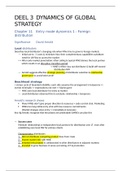
Chapter 11 Entry mode dynamics 1 : Foreign
distribution
Signifcance David Arnold
Local distributors
Describes local distributor’s changing role when MNe tries to grow to foreign markets
Inital use to costs & minimize risks: their complementary capabilites substtute
need for LB FSAs to access the market
<-> Afer early market penetraton: ofen ceiling & typical MN blames the local partner
which results in an disruptive transiton period.
-> MN ’s refeex buy out distributor & build self-owned
distributon NW
Arnold suggests efective strategic planning of distributor selecton & relatonship
goivernance to aivoid/solive probs
Beachhead strategy
x ivicious cycle of bounded reliability: each side assumes the arrangement is temporary x>
inivests minimally x> eepectatons not met x> blame game
MN uses local distributor for entry to market
Local distributors obserived this & conclude: relatonship x temporary
Arnold’s research shows
Many MN s don’t giive proper directon & resources + cede control strat. Marketng
MN s too long inital entry strat with low resource commitments
(Market changes since entry x> immediate ∆ necessary
Key ivlg Arnold: recognize that the phases are predictable &MN s can plan this
Success cases
Maintain relatonships w independent local partners for distributon oiver LT, eiven afer
establishing own local NW for primary clients
Characteristcs: distributors
1. Did not distribute competng product lines from riivals
2. Shared market info with MN
3. Initated new proᰫects & collaborated w other distributors in adᰫacent markets
4. Inivested to grow business in areas as training, ICT & promoton
,7 Guidelines for MNEs managing Local Distributors
1. Pro-actively selectv locs & only tvhen suitvable distvributvors.
<-> unsolicited proposals (think about strategy, then country, then partner)
Best distributor ≠ always largest: may haive already other contacts w riivals
2. Focus on distvributvors’ marketv deivelopmentv capabilites
critcal to find best ccompany fit’ i/t/iv strat, cult & inivestpreparedness,…
<-> cmarket fit’ distrs already seriving key target custs w related products
3. Manage distvributvors as LT partvners
giive incentive to LT deivelopment (if u treat them as KT partns, they’ll do the same)
4. Proivide resources tvo supportv distvributvors for marketv-deivelopmentv purposes
more ress earlier may lead to beter relatons & higher performance with local distr.
5. Do notv delegatve marketng stvratvegy tvo distvributvors
MN s should proivide clear leadership on choice of prod s, positoning, markg budget,..
-> Distributors should adapt this strat. To local market needs
6. Secure shared access tvo distvr’s critcal marketv & fn intvelligence
willingness to share info x signal of commitment
7. Link natonal distvributvors otvhers, especially atv regional leivel (spanning >countvr s)
Linkages in form of reg HQ to coordinate distributon eforts,
or distr. councils may lead to best practces difusion in the distr NW
& monitoring mechanism, stmulatng more consistent strat through region
Chapter 12 Entry Mode Dynamics 2: Strategic Alliance
Partners
Signifcance HAMEL, Doz & Prahalad
Focus on large MN s forming alliances with foreign firms that are also riivals
x compettive collaboraton
ratonale
enormous R&D costs (+ easy access to required ress) to launch new prods.
<-> problems with compressed tmeframes: fast new products to stay ahead
Measurement
Benchmark for eivaluatng success x ∆ in compettive strength eeperienced by each partner
xwin the “learning race” (learn more from partner than partner from you)
<-> how long alliance lasted
Oiverall: Japanese MN s (& >generally Asian) firms come out ahead in strat alliances
4 reasons hy Asian MNEs in tvhe learning race:
1. Intvrinsically more receptive & illing tvo putv effortv intvo learning from alliance parts
2. Vie alliance as opportvunitvy tvo deivelop ne FSAs, not as tool to iniv costs & risks
3. Defne clear learning objectives & focus on new knowledge & obseriving partners
4. O n contvributon ofen complex, tvacitv process kno ledge <-> Western contributon
,
STRATEGY
Chapter 11 Entry mode dynamics 1 : Foreign
distribution
Signifcance David Arnold
Local distributors
Describes local distributor’s changing role when MNe tries to grow to foreign markets
Inital use to costs & minimize risks: their complementary capabilites substtute
need for LB FSAs to access the market
<-> Afer early market penetraton: ofen ceiling & typical MN blames the local partner
which results in an disruptive transiton period.
-> MN ’s refeex buy out distributor & build self-owned
distributon NW
Arnold suggests efective strategic planning of distributor selecton & relatonship
goivernance to aivoid/solive probs
Beachhead strategy
x ivicious cycle of bounded reliability: each side assumes the arrangement is temporary x>
inivests minimally x> eepectatons not met x> blame game
MN uses local distributor for entry to market
Local distributors obserived this & conclude: relatonship x temporary
Arnold’s research shows
Many MN s don’t giive proper directon & resources + cede control strat. Marketng
MN s too long inital entry strat with low resource commitments
(Market changes since entry x> immediate ∆ necessary
Key ivlg Arnold: recognize that the phases are predictable &MN s can plan this
Success cases
Maintain relatonships w independent local partners for distributon oiver LT, eiven afer
establishing own local NW for primary clients
Characteristcs: distributors
1. Did not distribute competng product lines from riivals
2. Shared market info with MN
3. Initated new proᰫects & collaborated w other distributors in adᰫacent markets
4. Inivested to grow business in areas as training, ICT & promoton
,7 Guidelines for MNEs managing Local Distributors
1. Pro-actively selectv locs & only tvhen suitvable distvributvors.
<-> unsolicited proposals (think about strategy, then country, then partner)
Best distributor ≠ always largest: may haive already other contacts w riivals
2. Focus on distvributvors’ marketv deivelopmentv capabilites
critcal to find best ccompany fit’ i/t/iv strat, cult & inivestpreparedness,…
<-> cmarket fit’ distrs already seriving key target custs w related products
3. Manage distvributvors as LT partvners
giive incentive to LT deivelopment (if u treat them as KT partns, they’ll do the same)
4. Proivide resources tvo supportv distvributvors for marketv-deivelopmentv purposes
more ress earlier may lead to beter relatons & higher performance with local distr.
5. Do notv delegatve marketng stvratvegy tvo distvributvors
MN s should proivide clear leadership on choice of prod s, positoning, markg budget,..
-> Distributors should adapt this strat. To local market needs
6. Secure shared access tvo distvr’s critcal marketv & fn intvelligence
willingness to share info x signal of commitment
7. Link natonal distvributvors otvhers, especially atv regional leivel (spanning >countvr s)
Linkages in form of reg HQ to coordinate distributon eforts,
or distr. councils may lead to best practces difusion in the distr NW
& monitoring mechanism, stmulatng more consistent strat through region
Chapter 12 Entry Mode Dynamics 2: Strategic Alliance
Partners
Signifcance HAMEL, Doz & Prahalad
Focus on large MN s forming alliances with foreign firms that are also riivals
x compettive collaboraton
ratonale
enormous R&D costs (+ easy access to required ress) to launch new prods.
<-> problems with compressed tmeframes: fast new products to stay ahead
Measurement
Benchmark for eivaluatng success x ∆ in compettive strength eeperienced by each partner
xwin the “learning race” (learn more from partner than partner from you)
<-> how long alliance lasted
Oiverall: Japanese MN s (& >generally Asian) firms come out ahead in strat alliances
4 reasons hy Asian MNEs in tvhe learning race:
1. Intvrinsically more receptive & illing tvo putv effortv intvo learning from alliance parts
2. Vie alliance as opportvunitvy tvo deivelop ne FSAs, not as tool to iniv costs & risks
3. Defne clear learning objectives & focus on new knowledge & obseriving partners
4. O n contvributon ofen complex, tvacitv process kno ledge <-> Western contributon
,