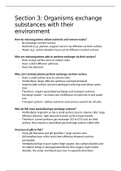
Section 3: Organisms exchange
substances with their
environment
How do microorganisms obtain nutrients and remove waste?
- By exchange via their surface.
- Nutrients (e.g. glucose, oxygen) move in by difusion via their surface.
- Waste (e.g. carbon dioxide) move out by difusion via their surface.
Why are microorganisms able to perform exchange via their surface?
- Have a large surface area to volume rato.
- Have a short difusion pathway.
- Have low demand.
Why can’t animals/plants perform exchange via their surface
- Have a small surface area to volume rato.
- Multcellular (large difusion pathway and high demand).
- Impermeable surface (prevent pathogens entering and reduce water
loss).
- Therefore, require specialised exchange and transport systems.
- Exchange system = increase rate of difusion of nutrients in and waste
out.
- Transport system = deliver nutrients and remove waste from all cells.
Why do fsh have specialised gas exchange systems?
- Multcellular organism so has a small surface area to volume rato, large
difusion distance, high demand body surface impermeable.
- Therefore, cannot perform gas exchange (O2 in/CO2 out) via their
surface, they require a specialised gas exchange system called Gills.
Structure of gills in fsh?
- Many gill filaments and gill lamellae = large surface area.
- Gill lamellae have a thin wall (short difusion distance) and are
permeable.
- Ventlaton brings in pure water (high oxygen, low carbon dioxide) and
circulaton brings in deoxygenated blood (low oxygen, high carbon
dioxide), the water and blood pass over in opposite directons
substances with their
environment
How do microorganisms obtain nutrients and remove waste?
- By exchange via their surface.
- Nutrients (e.g. glucose, oxygen) move in by difusion via their surface.
- Waste (e.g. carbon dioxide) move out by difusion via their surface.
Why are microorganisms able to perform exchange via their surface?
- Have a large surface area to volume rato.
- Have a short difusion pathway.
- Have low demand.
Why can’t animals/plants perform exchange via their surface
- Have a small surface area to volume rato.
- Multcellular (large difusion pathway and high demand).
- Impermeable surface (prevent pathogens entering and reduce water
loss).
- Therefore, require specialised exchange and transport systems.
- Exchange system = increase rate of difusion of nutrients in and waste
out.
- Transport system = deliver nutrients and remove waste from all cells.
Why do fsh have specialised gas exchange systems?
- Multcellular organism so has a small surface area to volume rato, large
difusion distance, high demand body surface impermeable.
- Therefore, cannot perform gas exchange (O2 in/CO2 out) via their
surface, they require a specialised gas exchange system called Gills.
Structure of gills in fsh?
- Many gill filaments and gill lamellae = large surface area.
- Gill lamellae have a thin wall (short difusion distance) and are
permeable.
- Ventlaton brings in pure water (high oxygen, low carbon dioxide) and
circulaton brings in deoxygenated blood (low oxygen, high carbon
dioxide), the water and blood pass over in opposite directons