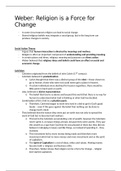
Weber: Religion is a Force for
Change
- In some circumstances religion can lead to social change.
- Shared religious beliefs may integrate a social group, but in the long term can
produce changes in society.
Social Actoo Theory
- Argues that humao ioteractoo is directed by meaoiogs aod moties.
- Religion is ofen an important component of uoderstaodiog aod proiidiog meaoiog.
- In certain places and tmes, religious meaning and purposes can direct actoo.
- Weber believed that religious ideas aod beliefs could haie ao efect oo social aod
ecooomic chaoge.
Caliioism
- Calvinism originated from the beliefs of John Calvin (17th century).
- Calvinists believed in predestoatoo.
o Calvin thought that there was a distnct group of the elect = those chosen to
go to heaven, those who were not could never gain a place in heaven.
o If certain individuals were destned for heaven regardless, there would be
litle point in hard work on earth.
- Also, believed in diiioe traosceodeoce.
o The belief that God is so above and beyond this world that there is no way for
human to understand what God is thinking or what God has decided.
- Combinaton of the led to a saliatoo paoic.
o Therefore, Calvinists began to work very hard in a bid to get in God’s good
books – even if this goes against the belief that nothing can be done to
change God’s mind.
- They believed that the reason they were put on earth was not only to spread the
word of God but to become hard workers.
o This led to the Calvinists accumulatng a lot of wealth, however the Calvinists
never spent it, on luxury things at least, because they were ascetc. They saw
this wealth as a sign from God that He was pleased of them but they did not
believe in indulging in luxury worldly things, so instead of spending it – they
invested.
o This investment led to more money being made and therefore more
investment which led to more money and more investment and as the spirit
of capitalism.
o The Spirit of Capitalism is a set of ideas, ethics and values. Making money
became both a religious and business ethic.
o Therefore, Weber shows that religion can be a force for change – religion
kick-started capitalism.
Change
- In some circumstances religion can lead to social change.
- Shared religious beliefs may integrate a social group, but in the long term can
produce changes in society.
Social Actoo Theory
- Argues that humao ioteractoo is directed by meaoiogs aod moties.
- Religion is ofen an important component of uoderstaodiog aod proiidiog meaoiog.
- In certain places and tmes, religious meaning and purposes can direct actoo.
- Weber believed that religious ideas aod beliefs could haie ao efect oo social aod
ecooomic chaoge.
Caliioism
- Calvinism originated from the beliefs of John Calvin (17th century).
- Calvinists believed in predestoatoo.
o Calvin thought that there was a distnct group of the elect = those chosen to
go to heaven, those who were not could never gain a place in heaven.
o If certain individuals were destned for heaven regardless, there would be
litle point in hard work on earth.
- Also, believed in diiioe traosceodeoce.
o The belief that God is so above and beyond this world that there is no way for
human to understand what God is thinking or what God has decided.
- Combinaton of the led to a saliatoo paoic.
o Therefore, Calvinists began to work very hard in a bid to get in God’s good
books – even if this goes against the belief that nothing can be done to
change God’s mind.
- They believed that the reason they were put on earth was not only to spread the
word of God but to become hard workers.
o This led to the Calvinists accumulatng a lot of wealth, however the Calvinists
never spent it, on luxury things at least, because they were ascetc. They saw
this wealth as a sign from God that He was pleased of them but they did not
believe in indulging in luxury worldly things, so instead of spending it – they
invested.
o This investment led to more money being made and therefore more
investment which led to more money and more investment and as the spirit
of capitalism.
o The Spirit of Capitalism is a set of ideas, ethics and values. Making money
became both a religious and business ethic.
o Therefore, Weber shows that religion can be a force for change – religion
kick-started capitalism.