
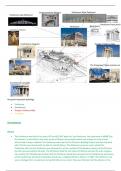
Centauromachy Metope Parthenon West Pediment
Parthenon East Pediment
Parthenon front porch
Parthenon Back Room
Cult Statue of Athena
Erechtheion diagram Temple of Athena Nike
Erechtheion
The Propylaea/ Main entrance to
Acropolis site
Erechtheion Caryatids
Acropolis important buildings:
• Parthenon
• Erechtheion
• Temple of Athena Nike
• Propylaea
The Parthenon
History
• The Parthenon was built in the years 447 and 432 BCE after the ‘pre-Parthenon’ was destroyed in 480BCE by
the Persians. It was built on the main centre of Athens, the acropolis which was a large out crop of rock
which made it easy to defend. The Parthenon was a part of the Periclean Building Project and was only built
after Pericles went ahead with his plan to rebuild Athens. The Athenians swore to never rebuild the
Parthenon after the pre-Parthenon was destroyed to act as a symbol of the barbaric impiety of the Persians,
but this was overruled by Pericles. The Parthenon held the cult statue of Athena and was the main religious
site used for the Panathenaea festival with the Parthenon being the end point for the Panathenaic procession
which would have started at Kerameikos which was a neighbourhood in Athens. In 1687, the Parthenon saw
severe damage from an explosion during the Morean war when Francesco Morosini led the attacks on the
Parthenon East Pediment
Parthenon front porch
Parthenon Back Room
Cult Statue of Athena
Erechtheion diagram Temple of Athena Nike
Erechtheion
The Propylaea/ Main entrance to
Acropolis site
Erechtheion Caryatids
Acropolis important buildings:
• Parthenon
• Erechtheion
• Temple of Athena Nike
• Propylaea
The Parthenon
History
• The Parthenon was built in the years 447 and 432 BCE after the ‘pre-Parthenon’ was destroyed in 480BCE by
the Persians. It was built on the main centre of Athens, the acropolis which was a large out crop of rock
which made it easy to defend. The Parthenon was a part of the Periclean Building Project and was only built
after Pericles went ahead with his plan to rebuild Athens. The Athenians swore to never rebuild the
Parthenon after the pre-Parthenon was destroyed to act as a symbol of the barbaric impiety of the Persians,
but this was overruled by Pericles. The Parthenon held the cult statue of Athena and was the main religious
site used for the Panathenaea festival with the Parthenon being the end point for the Panathenaic procession
which would have started at Kerameikos which was a neighbourhood in Athens. In 1687, the Parthenon saw
severe damage from an explosion during the Morean war when Francesco Morosini led the attacks on the


