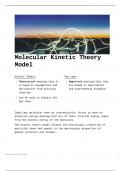
Molecular Kinetic Theory
Model
Kinetic Theory Gas Laws
Theoretical meaning that it Empirical meaning that they
is baed on assumptions and are based on observation
derivations from existing and experimental evidence.
theories.
Can be used to explain the
gas laws.
Ideal gas molecules have no intermolecular forces so have no
potential energy meaning that all of their internal energy comes
from the kinetic energy of the molecules.
The kinetic theory model relates the microscopic properties of
particles (mass and speed) to the macroscopic properties of
gasses (pressure and volume).
Molecular Kinetic Theory Model 1
, The assumptions of the kinetic theory model are:
The time of a collision is negligible compared to the time
between collisions.
The volume of the molecules is negligible compared to the
volume of the container.
Molecules of the gas are hard, 100% elastic
spheres.
Molecules of the gas are identical (same mass and
volume).
No intermolecular forces between molecules.
Particles move in continuous random motion.
Newton’s laws apply to the molecule’s
interactions .
Kinetic Theory Model
pV = (1/3)Nm(crms )2
p = Pressure (Pa)
V = Volume (m^3)
N = Number of molecules
m = Mass of 1 molecule (kg)
crms = Root mean square speed of all of the molecules (ms^-1)
Molecular Kinetic Theory Model 2
Model
Kinetic Theory Gas Laws
Theoretical meaning that it Empirical meaning that they
is baed on assumptions and are based on observation
derivations from existing and experimental evidence.
theories.
Can be used to explain the
gas laws.
Ideal gas molecules have no intermolecular forces so have no
potential energy meaning that all of their internal energy comes
from the kinetic energy of the molecules.
The kinetic theory model relates the microscopic properties of
particles (mass and speed) to the macroscopic properties of
gasses (pressure and volume).
Molecular Kinetic Theory Model 1
, The assumptions of the kinetic theory model are:
The time of a collision is negligible compared to the time
between collisions.
The volume of the molecules is negligible compared to the
volume of the container.
Molecules of the gas are hard, 100% elastic
spheres.
Molecules of the gas are identical (same mass and
volume).
No intermolecular forces between molecules.
Particles move in continuous random motion.
Newton’s laws apply to the molecule’s
interactions .
Kinetic Theory Model
pV = (1/3)Nm(crms )2
p = Pressure (Pa)
V = Volume (m^3)
N = Number of molecules
m = Mass of 1 molecule (kg)
crms = Root mean square speed of all of the molecules (ms^-1)
Molecular Kinetic Theory Model 2