

3.3 Transport in plants
Why do plants need transport systems?
Plants are multicellular and so have a small SA:Vol ratio and a relatively big
metabolic rate.
Exchanging substances by direct diffusion (from the outer surface to the cells) would
be too slow to meet their metabolic needs.
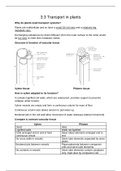
Structure & function of vascular tissue
Xylem tissue Phloem tissue
How is xylem adapted to its function?
It contains lignified cell walls, which are waterproof, provides support & prevents
collapse under tension.
Xylem vessels are empty and form a continuous column for ease of flow.
Continuous column also allows tension to pull water up.
Bordered pits in the cell wall allow movement of water sideways (lateral movement)
Compare & contrast vascular tissue
Xylem Phloem
Dead Alive
Lignified walls Walls not lignified
Cells arranged end to end to form Sieve tubes elements arranged end to
continuous vessel. end
No cross walls in vessels Sieve tube elements separated by sieve
plates
Bordered pits between vessels Plasmadesmata between companion
cells and sieve tube elements
No contents in vessels Sieve tube elements contain cytoplasm
only. Kept alive by companion cell.
Why do plants need transport systems?
Plants are multicellular and so have a small SA:Vol ratio and a relatively big
metabolic rate.
Exchanging substances by direct diffusion (from the outer surface to the cells) would
be too slow to meet their metabolic needs.
Structure & function of vascular tissue
Xylem tissue Phloem tissue
How is xylem adapted to its function?
It contains lignified cell walls, which are waterproof, provides support & prevents
collapse under tension.
Xylem vessels are empty and form a continuous column for ease of flow.
Continuous column also allows tension to pull water up.
Bordered pits in the cell wall allow movement of water sideways (lateral movement)
Compare & contrast vascular tissue
Xylem Phloem
Dead Alive
Lignified walls Walls not lignified
Cells arranged end to end to form Sieve tubes elements arranged end to
continuous vessel. end
No cross walls in vessels Sieve tube elements separated by sieve
plates
Bordered pits between vessels Plasmadesmata between companion
cells and sieve tube elements
No contents in vessels Sieve tube elements contain cytoplasm
only. Kept alive by companion cell.


