Unit 28 - P4 M3 + D3 – Applied Science
P4 – predict the products of a range of commercially important reactonss innolning
carbonyl compounds:
M3 – plan multistep syntheses of organic molecules:
D3 –collate and present data on reactons of functonal group compounds which allow a
comprehensine range of syntheses to be planned:
Aldehydes and Ketones:
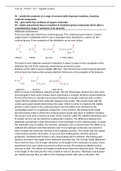
These are molecules which have carbonyl groups. The carbonyl group involves a carbon-
oxygen bond. In aldehydes there is also a hydrogen atom atached to a carbon on the
carbonyl group. A few examples of the aldehydes can be seen below;
The ends of each aldehyde molecule is identcall it doesnnt mater of the complexity of the
aldehyde the end of the molecules would always remain the same.
Ketones on the other hand are slightly diferent. They tend to have carbonyl group atached
with at least two hydrocarbon groups atached. Below are a few examples of the ketones;
When it comes to bonding in carbonyl groupsl the fact that oxygen tends to be much more
electronegatve than carbon means that it would have a stronger tendency to pull electrons.
The fact that there is a double bond present between an oxygen molecule and a carbon
means that the pulling of the molecules happens even easier. This would result with the
carbon and oxygen double bond being very polar. When it comes to reactons the slightly
positve carbon atoms in the carbonyl groups have the ability to be atacked by the
nucleophiles which is a negatvely charged ion. In the reactonl the double bond would
become broken which is where the carbonyl groups would take place in additon reactonsl
this would result with a removal of water by the reacton called the additon-eliminaton and
in simpler terms it can be called the condensaton reacton. The diference between the
aldehydes and ketones is that the presence of the hydrogen on the carbonyl group. It makes
the aldehydes easy to oxidise. For examplel aldehydes such as ethanal have the ability to be
oxidised into ethanoic acid. Since ketones donnt have hydrogen molecules not present in
them it makes the molecules resistant to the oxidaton process. This means that the carbon-
carbon bonds wouldnnt be broken. In terms of their boiling points and their physical
propertesl methanol tend to have a very close boiling point as ethanal. The boiling point
tends to increase if the length of the molecules increases too. The Van der Waals dispersion
forces tend to have a lot stronger atracton as the length of the molecules increasesl these
would then have more electrons present in them as well. The temporary dipoles tend to
increase as well. The carbon and oxygen double bond makes the molecule polar. The longer
is the length of the molecule the more soluble in water it becomes. Aldehydes and ketones
are soluble because they are able to form hydrogen bonds with water molecules. The
P4 – predict the products of a range of commercially important reactonss innolning
carbonyl compounds:
M3 – plan multistep syntheses of organic molecules:
D3 –collate and present data on reactons of functonal group compounds which allow a
comprehensine range of syntheses to be planned:
Aldehydes and Ketones:
These are molecules which have carbonyl groups. The carbonyl group involves a carbon-
oxygen bond. In aldehydes there is also a hydrogen atom atached to a carbon on the
carbonyl group. A few examples of the aldehydes can be seen below;
The ends of each aldehyde molecule is identcall it doesnnt mater of the complexity of the
aldehyde the end of the molecules would always remain the same.
Ketones on the other hand are slightly diferent. They tend to have carbonyl group atached
with at least two hydrocarbon groups atached. Below are a few examples of the ketones;
When it comes to bonding in carbonyl groupsl the fact that oxygen tends to be much more
electronegatve than carbon means that it would have a stronger tendency to pull electrons.
The fact that there is a double bond present between an oxygen molecule and a carbon
means that the pulling of the molecules happens even easier. This would result with the
carbon and oxygen double bond being very polar. When it comes to reactons the slightly
positve carbon atoms in the carbonyl groups have the ability to be atacked by the
nucleophiles which is a negatvely charged ion. In the reactonl the double bond would
become broken which is where the carbonyl groups would take place in additon reactonsl
this would result with a removal of water by the reacton called the additon-eliminaton and
in simpler terms it can be called the condensaton reacton. The diference between the
aldehydes and ketones is that the presence of the hydrogen on the carbonyl group. It makes
the aldehydes easy to oxidise. For examplel aldehydes such as ethanal have the ability to be
oxidised into ethanoic acid. Since ketones donnt have hydrogen molecules not present in
them it makes the molecules resistant to the oxidaton process. This means that the carbon-
carbon bonds wouldnnt be broken. In terms of their boiling points and their physical
propertesl methanol tend to have a very close boiling point as ethanal. The boiling point
tends to increase if the length of the molecules increases too. The Van der Waals dispersion
forces tend to have a lot stronger atracton as the length of the molecules increasesl these
would then have more electrons present in them as well. The temporary dipoles tend to
increase as well. The carbon and oxygen double bond makes the molecule polar. The longer
is the length of the molecule the more soluble in water it becomes. Aldehydes and ketones
are soluble because they are able to form hydrogen bonds with water molecules. The