What is hazard management?
Hazard management is where governments and
other organisatons work together to protect
people from natural
hazards. Emergency responders, businesses, community
groups, internatonal organisatons and charites
These are all key players
Hazard management aims to:
Avoid or reduce loss of
life or property
Provide help to those afected
Ensure a rapid and efectve recovery
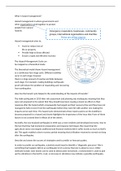
The Hazard-Management Cycle can
be mapped as a theoretcal mode
The theoretcal model shows hazard management
as a contnuous four stage cycle. Diferent actvites
occur in each stage; however
there is a large amount of overlap and links between
each stage. For example: making buildings earthquake
proof will reduce the problem of responding and recovering
from earthquakes.
How has the hazard cycle helped in the understanding of the impacts of hazards?
The Hait earthquake in 2010 their risk assessment and planning was inadequate meaning that they
were not prepared to the extent that they should have been causing a knock on efect on their
response afer the hazard which consequently has longed out their recovery tme and they have not
managed to fully recover from the earthquake before they were hit with another one making the
impacts worse each tme. The hazard cycle demonstrates these repercussions on the inability to
become prepared for a hazard and clearly highlights the importance of the issue that if one of these
factors is not covered then it efects all of the others.
Secondly, the new Zealand earthquake in 2010 was a more resilient and developed economy. Due to
the fact that they had invested in preparaton and response techniques this meant that the
agriculture sector was largely unafected and fnancial markets didn’t sufer nearly as much as Hait’s
did. This again enabled a short recovery period meaning that civilisaton returned to normal not long
afer the earthquake.
Describe and assess the success of strategies used to predict or forecast quakes.
In order to predict an earthquake, scientsts would need to identfy a ‘diagnostc precursor’ this is
something that happens before an earthquake to let us know that one is about to occur. Other
methods include: laser beams can be used to detect plate movement, a seismometer is used to pick
up the vibratons in the Earth's crust, an increase in vibratons may indicate a possible earthquake,
Hazard management is where governments and
other organisatons work together to protect
people from natural
hazards. Emergency responders, businesses, community
groups, internatonal organisatons and charites
These are all key players
Hazard management aims to:
Avoid or reduce loss of
life or property
Provide help to those afected
Ensure a rapid and efectve recovery
The Hazard-Management Cycle can
be mapped as a theoretcal mode
The theoretcal model shows hazard management
as a contnuous four stage cycle. Diferent actvites
occur in each stage; however
there is a large amount of overlap and links between
each stage. For example: making buildings earthquake
proof will reduce the problem of responding and recovering
from earthquakes.
How has the hazard cycle helped in the understanding of the impacts of hazards?
The Hait earthquake in 2010 their risk assessment and planning was inadequate meaning that they
were not prepared to the extent that they should have been causing a knock on efect on their
response afer the hazard which consequently has longed out their recovery tme and they have not
managed to fully recover from the earthquake before they were hit with another one making the
impacts worse each tme. The hazard cycle demonstrates these repercussions on the inability to
become prepared for a hazard and clearly highlights the importance of the issue that if one of these
factors is not covered then it efects all of the others.
Secondly, the new Zealand earthquake in 2010 was a more resilient and developed economy. Due to
the fact that they had invested in preparaton and response techniques this meant that the
agriculture sector was largely unafected and fnancial markets didn’t sufer nearly as much as Hait’s
did. This again enabled a short recovery period meaning that civilisaton returned to normal not long
afer the earthquake.
Describe and assess the success of strategies used to predict or forecast quakes.
In order to predict an earthquake, scientsts would need to identfy a ‘diagnostc precursor’ this is
something that happens before an earthquake to let us know that one is about to occur. Other
methods include: laser beams can be used to detect plate movement, a seismometer is used to pick
up the vibratons in the Earth's crust, an increase in vibratons may indicate a possible earthquake,